Your portal to
enterprise engagement

Books

Resources for Books - Generalclear search
Sorry, no results matched your search.


Save Link

The Corporate Storyteller

Are you struggling to remain an effective communicator in today's high-tech world? Are you feeling intimidated or overburdened by the constant barrage of text messages, emails, FaceBook and Twitter communications? Many corporate executives are, and that's why Elaine Stirling put together this book, which is subtitled "A Writing Manual & Style Guide for the Brave New Business Leader." It offers advice on how to communicate with clarity, confidence, and persuasive style in the workplace, whatever the medium.

iUniverse. 124. Paperback. Cost: $13.95

Save Link

The Inspiration Factor

Terry Barber, the author of The Inspiration Factor, subtitled "How You Can Revitalize Your Company Culture in 12 Weeks," argues that regardless of your personality type, background, or age, you can choose to create an inspirational transaction and positively impact the people around you. "Inspiration is precursor to leadership, to motivation, and is even a new category for business," Barber says. His book offers seven principles that can help readers become team leaders in their organizations and inspire those around them.

Inspiration Blvd. LLC. 196. Hardcover. Cost: $29.95

Save Link

Your Attention Please: How to Appeal to Today's Distracted, Disinterested, Disengaged, Disenchanted, and Busy Audiences

Maybe you're in sales...or marketing...or communications? Maybe you're a writer. Maybe you're even a CEO. Whatever your title, you're one of the hundreds of thousands of professionals who communicate for a living-and you're struggling to get your message heard in a noisy and crowded marketplace. Yes, you know what you want to say and who you want to reach. No, you don't have writer's block and you certainly know how to construct a sentence. So what's the problem? The audience you're writing for is going, going, gone... Today's consumer doesn't want to read anymore-they're already overwhelmed by overflowing e-mail, millions of Web pages, and 24/7 news proliferation. Your Attention, Please. is the new strategy guide for communicating to the reluctant consumer. It shows you who the new audience is, how to reach them, and how you must communicate differently-or risk losing mindshare and marketshare.

Adams Media Corporation. 224pp. Paperback. Cost: $14.95

Save Link

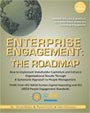
Enterprise Engagement: The Roadmap, 3rd Edition

Enterprise Engagement: The Roadmap, 3rd Edition has been completely updated with new information, illustrations and new chapters. Authored and edited by dozens of experts in general management, marketing, sales, data management, business and academia, the Textbook’s methodology has been endorsed by leading companies as a means of achieving both strategic and tactical organizational goals related to sales, marketing, human resources, vendor management, and community relations. A proven strategy to:
  • Increase long-term profitability
  • Maximize customer loyalty and referrals
  • Capture the commitment of dealers, agents and distributors
  • Increase sales and improve customer service
  • Maximize quality, productivity, quality and wellness
  • Foster greater prosperity through a focus on people 
 
Enterprise Engagement: The Roadmap, 3rd Edition also provides formal preparation for the Enterprise Engagement Certification program. To order a copy, click here.

Bruce Bolger, Allan Schweyer & Richard Kern . 242 pp. Cost: $36

Save Link

New Books Focus on Gratitude, Culture, Experience-Led Enterprises, and People ROI

Four new books focus on: how gratitude can improve morale, efficiency and profitability; strategies to reduce organizational griping; a new approach to maximize the customer experience through a holistic approach, and how to better measure the value of human capital. 
 
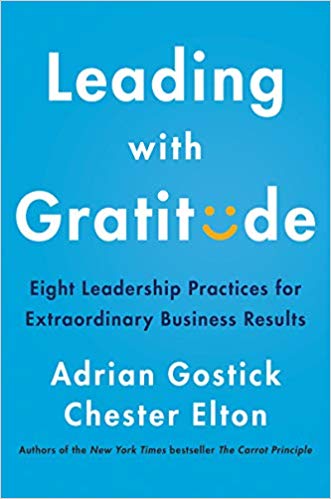
Leading-with-Gratitude
A series of new books are now available on how to humanize the workplace.
 
In Chester Elton and Adrian Gostick’s new book, “Leading With Gratitude,’ the authors share research that shows that “gratitude boosts employee engagement, reduces turnover, and leads team members to express more gratitude to one another—strengthening team bonds.” The authors assert that studies “have also shown that gratitude is beneficial for those expressing it and is one of the most powerful variables in predicting a person’s overall well-being—above money, health, and optimism.” As an example, the authors site the WD-40 Company, whose leadership “gave thousands of managers training in expressing gratitude to their employees” and, as a result, “saw record increases in revenue.” The authors share eight ways that managers can show employees they are valued. 
 
They highlight leaders such as Alan Mulally of Ford and Hubert Joly of Best Buy who they say have successfully incorporated the practice of gratitude into their leadership roles. The authors believe that showing gratitude “isn’t just about being nice, it’s about being smart—really smart—and it’s a skill that everyone can easily learn.” Elton and Gostick are the principles of The Culture Works, a culture advisory firm, and are well-known public speakers and authors.
[return to top]

Turning Complaints Into Culture Change

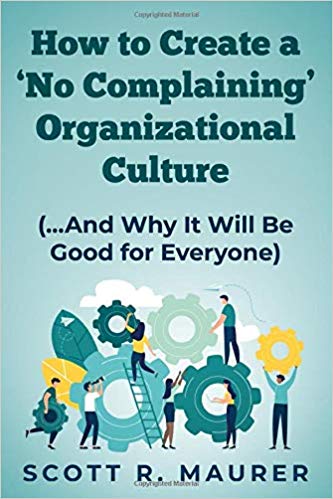
-No-Complaining-Org-CultIn “How to Create a ‘No Complaining’ Organizational Culture…And Why it Will Be Good for Everyone,” author Scott Maurer provides what he says is a practical system that everyone in all levels of and organization can follow to pursue healthy sustainable culture change.  Mauer is founder of Remedium Solutions, a culture advisory service. His approach focuses on teaching employees to recognize that frequent complaining among employees is a signal for the need for immediate culture change. The author argues that when complaining is addressed proactively, organizations can enjoy an increase in productivity, creativity, problem solving, employee health, morale, retention, engagement, and more. The book offers advice on how to focus on problem-solving, hold productive conversations to reduce tension, better understand relationship dynamics; streamline and align communications; improve self-awareness and emotional health, and establish formal or informal peer support structures to create a sense of purpose, loyalty, and employee well-being.
[return to top]

The Convergence of Customer and Employee Experience 

The new book, “In the Center of Experience: The Blueprint for Creating an Experience-Led Enterprise,” asserts that business is at an “inflection point in the relationship between brands and their audiences, where customers and employees are demanding better and more valuable experiences.” Author Greg Kihlstrom, President and Chief Experience Officer at Cravety, an agency focusing on employee and customer experience, says that “companies must keep up with this demand in order to remain competitive.” This, he says, includes competition for both customers as well as employees. He believes that organizations that start the customer experience process internally have the greatest potential to achieve long-term benefits.
 
The book is designed to provide a blueprint for organizations to implement a center of excellence incorporating brand experience, including the customer and employee experience. The book covers the following elements: brand, governance, culture, platform, measurement, and environment. The author provides recommendations on how organizations can implement their own “Centers of Experience” and how to measure success.
[return to top]

The ROI of People

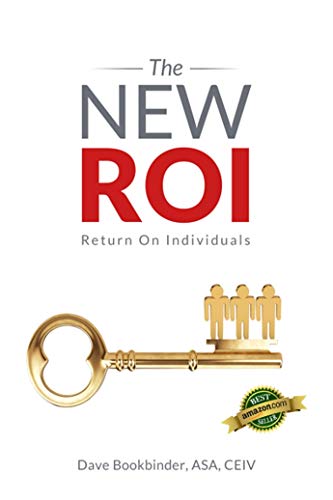
Return-on-IndividualsDave Bookbinder, Senior Director of CFGI, a financial advisory company, argues for more focus on the value of human capital in business valuations. In his book, “The New ROI: Return on Individuals,” he points out that while many executives say that people are their organizations’ No. 1 assets, he believes that when it comes to valuations, most organizations put more value on patents and trademarks than on people. The book explores ways to put more quantifiable value on the value of human capital. This includes strategies to promote greater workforce value by creating “difference makers,” increasing employee success, improving happiness, reducing the impact of toxic employees, generating innovation through trust, embracing and improving corporate culture, and much more. Author Dave Bookbinder and over 20 collaborators share strategies to achieve these goals and new ways to quantify the value of human capital. 
 

Master the Principles of Enterprise Engagement to Achieve Organizational Goals and Enhance Your Career

  • Profit from a new strategic and systematic approach to engagement to enhance your organization’s brand equity; increase sales, productivity, quality, innovation, and safety, and reduce risks.
  • Get trained to become a Chief Engagement Officer for your organization.
  • Learn how to create Sustainability or Integrated Reports for Your Organization or Clients.
Resources: The Brand Media Coalition, the only guide to the story-telling power of brands and where to source them for business, event, promotional gifting, and rewards and recognition. Enterprise Engagement Solution Provider Directory. The only directory of engagement solution providers covering all types of agencies and tactics as well as insights on how to select them.
 
Communities: The  Enterprise Engagement Alliance and Advocate and the  Brand Media Coalition free resource centers offering access to the latest research, news, and case studies; discounts, promotions, referrals, and commissions, when appropriate to third-party solution providers from participating coalition solution provider members.
 
A CEO's Guide to Engagement Across the Enterprise cover
In Print: 
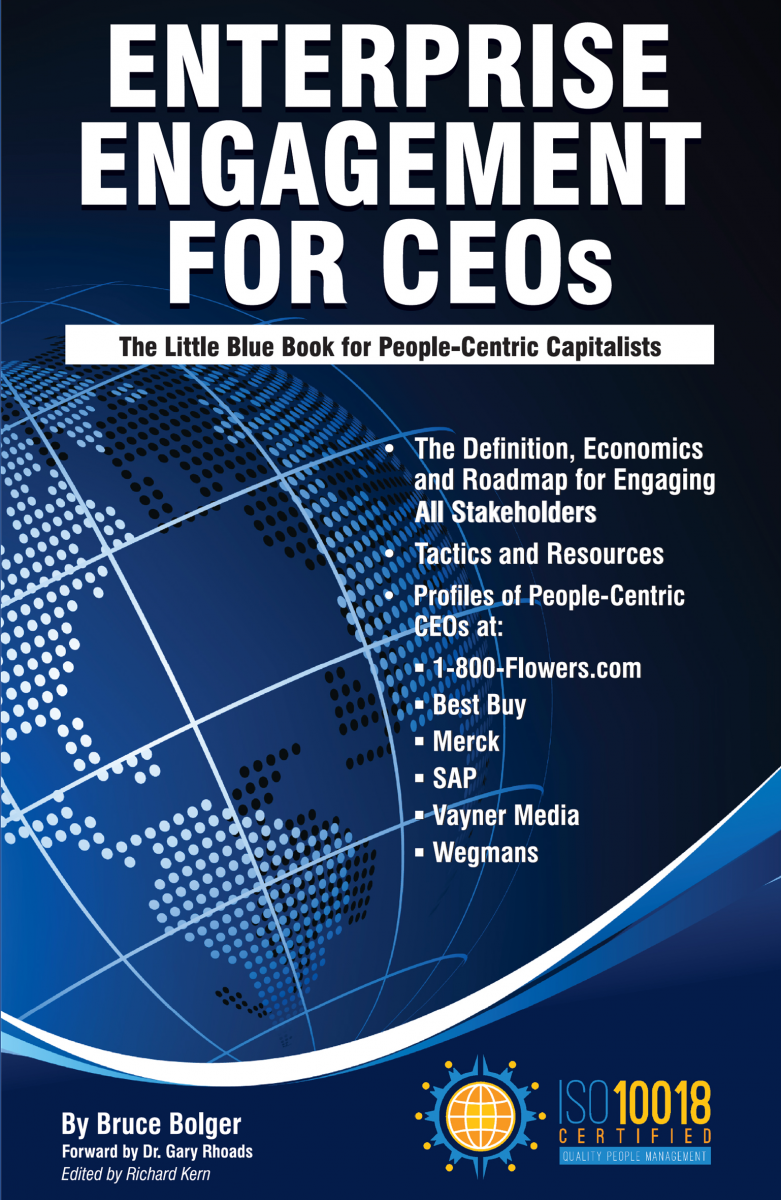
Enterprise Engagement for CEOs:The Little Blue Book for People-Centric Capitalists
This is the definitive implementation guide to Stakeholder Capitalism, written specifically to provide CEOs and their leadership teams a concise overview of the framework, economics, and implementation process of a CEO-led strategic and systematic approach to achieving success through people.  (123 pages, $15.99)

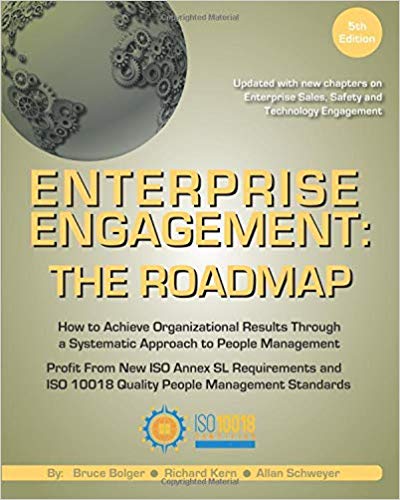
Enterprise Engagement: The Roadmap 5th Edition
The first and most comprehensive book on Enterprise Engagement and the new ISO 9001 and ISO 10018 quality people management standards. Includes 36 chapters detailing how to better integrate and align engagement efforts across the enterprise. (312 pages, $36.) 

Online:  
10-minute short course: click here for a 10-minute introduction to Enterprise Engagement and ISO standards from the Coggno.com learning platform.

Services: 
•  The International Center for Enterprise Engagement at TheICEE.org, offering: ISO 10018 certification for employers, solution providers, and Enterprise Engagement technology platforms; Human Resources and Human Capital audits for organizations seeking to benchmark their practices and related Advisory services for the hospitality field.ISO 10018 Cerfified. Quality People Management
•  The Engagement Agency at EngagementAgency.net, offering: complete support services for employers, solution providers, and technology firms seeking to profit from formal engagement practices for themselves or their clients, including Brand and Capability audits for solution providers to make sure their products and services are up to date.
•  C-Suite Advisory Service—Education of boards, investors, and C-suite executives on the economics, framework, and implementation processes of Enterprise Engagement. 
•  Speakers Bureau—Select the right speaker on any aspect of engagement for your next event.
•  Mergers and Acquisitions. The Engagement Agency’s Mergers and Acquisition group is aware of multiple companies seeking to purchase firms in the engagement field. Contact Michael Mazer in confidence if your company is potentially for sale at 303-320-3777.

Enterprise Engagement Benchmark Tools: The Enterprise Engagement Alliance offers three tools to help organizations profit from Engagement. Click here to access the tools.
•  ROI of Engagement Calculator. Use this tool to determine the potential return-on-investment of an engagement strategy. 
•  EE Benchmark Indicator. Confidentially benchmark your organization’s Enterprise Engagement practices against organizations and best practices. 
•  Compare Your Company’s Level of Engagement. Quickly compare your organization’s level of engagement to those of others based on the same criteria as the EEA’s Engaged Company Stock Index.
•  Gauge Your Personal Level of Engagement. This survey, donated by Horsepower, enables individuals to gauge their own personal levels of engagement.

For more information, contact Bruce Bolger at Bolger@TheEEA.org, 914-591-7600, ext. 230.

Save Link

Now Available: The Essential Guide to Implementation of Stakeholder Capitalism

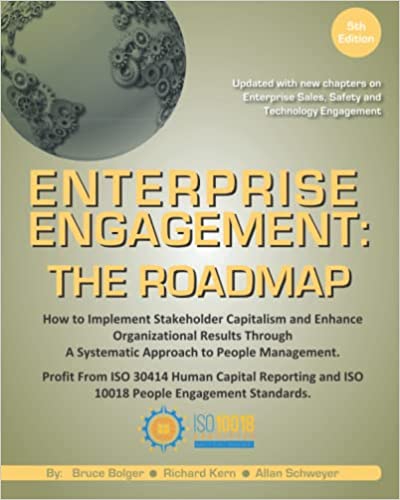
Last week, the Enterprise Engagement Alliance released its updated Enterprise Engagement for CEOs: The Little Blue Book for Stakeholder Capitalists. This week, it has published its updated Enterprise Engagement: The Roadmap—How to Implement Stakeholder Capitalism to provide management at all levels a comprehensive implementation guide with detailed information on the theory, economics, and practices of Stakeholder Capitalism and human capital management across the enterprise. 
EE Roadmap new cover
 
While Enterprise Engagement for CEOs provides an abbreviated overview of the principles of Stakeholder Capitalism and profiles of some of the CEOs who have practiced it at their organizations, Enterprise Engagement: The Roadmap offers a practical detailed implementation guide that includes information on the principles and economics, as well as on almost all of the tactics involved. 
 
The challenge facing the Stakeholder Capitalism movement is that it is not taught in any schools nor even in executive education program and that it requires organizations to break down the siloes between finance, marketing, human resources, operations, and other business units that hamper efficiency and create poor experiences for customers and employees alike. 
EE for CEOs
 
Stakeholder Capitalism enhances returns for investors by creating value for customers, employees, supply chain and distribution partners, communities, and the environment and should not be confused with “woke” capitalism or Corporate Social Responsibility. See ESM: Stakeholder Capitalism—A Primer.
 
Enterprise Engagement: The Roadmap aims to address the knowledge gap with a desk reference covering almost all the key areas of the field. Writes Grace Swanson, Vice President, Human Capital at Accumold, a leading precision manufacturer, “By the time I finished reading Enterprise Engagement: The Roadmap my copy was filled with Post-it notes highlighting information I knew I would need to reference later. This book provides a complete guide to almost everything an organization needs to implement a strategic approach to engaging everyone in organizational goals in a systematic way.”               
 
Gary Rhoads, retired Stephen Mack Covey Professor of Marketing Emeritus at the Marriot School of Business at Brigham Young University and Chairman of Xvoyant, a sales engagement technology firm, “As a professor of marketing and entrepreneurship for most of my career, and founder of two leading companies in sales and marketing management, I know that delivering promises is one of the most critical strategies for success. Yet too many organizations fail to address the importance of engaging all stakeholders in organizational goals. Enterprise Engagement: The Roadmap is the only book I know that focuses on how to apply a strategic and tactical approach to engagement across the enterprise in a systematic way.” 
          
Adds Barbara Porter, Managing Director, Ernst & Young, "I have spent much of my career helping organizations develop great cultures, and in the end a successful strategy requires a CEO-led approach to connecting employees, managers, customers, vendors, suppliers, the community—everyone inside and outside the organization who has a stake in its success. I have repeatedly referenced almost every chapter in Enterprise Engagement: The Roadmap since the first edition came out, as it’s the only book I know of that puts together in one place all the tactics needed to address engagement to achieve organizational results.” 
 
As shown in the table of contents below, the book covers almost every topic involved with the implementation of Stakeholder Capitalism, including career opportunities and the potential impact on government. The edition now includes appendices on human capital management, reporting, and analysis. 
 
Here is the table of contents: 
 
Part I: Introduction to Stakeholder Capitalism, Enterprise Engagement, ISO
Intro: Enterprise Engagement and ISO Annex SL and ISO 10018 and ISO 30414
Standards – A Practical Framework for Implementation and Measurement
Chapter 1  ISO 10018: People Engagement
Chapter 2 The Role of ISO Standards in Business and People Management
Chapter 3  Economics of Enterprise Engagement
Chapter 4  Culture and the Enterprise Brand
Chapter 5   Breaking Down Organizational Silos
 
Part II: Audiences of Engagement
Intro: The Audience Challenge
Chapter 6 Customer Engagement
Chapter 7 Channel Partner Engagement
Chapter 8 Employee Engagement
Chapter 9 Sales Engagement
Chapter 10  Volunteer & Community Engagement
Chapter 11  Supply Chain Engagement
Chapter 12 The Employee / Customer Link
Chapter 13 Case Study: Northwell Health
 
Part III: Tools of Engagement
Intro: Tools and Tactics
Chapter 14 Employee Assessment
Chapter 15  Communication
Chapter 16 Permission Management
Chapter 17 Content Marketing
Chapter 18 Learning and Training
Chapter 19  Gamification
Chapter 20 Collaboration and Innovation
Chapter 21  Rewards & Recognition
Chapter 22 Loyalty
Chapter 23  Recognition in the Era of Employee Engagement
Chapter 24 Diversity and Community
Chapter 25 Wellness
Chapter 26  Enterprise Safety Engagement
Chapter 27  Enterprise Technology Engagement
Chapter 28 Meetings and Motivational Events 
Chapter 29 Travel Rewards and Engagement
Chapter 30 The Importance of an Engaging Environment
Chapter 31  Trade Shows & Conferences: Engaging the Stakeholders
Chapter 32  Technology: The Heart of the Problem, The Core of the Solution
Chapter 33 Measuring Enterprise Engagement and Performance
Chapter 34 Big Data and Analytics
Chapter 35 Case Study: UnitedHealth Group
 
Part IV: Applications of Engagement
Intro: The Enterprise Engagement Framework
Chapter 36  Keys to Implementation
Chapter 37  Budgeting and ROI
Chapter 38 Engagement Careers
Chapter 39 Engagement and Nonprofits
Chapter 40 Implications for Government
Chapter 41  Engagement, Human Capital and the Accounting Profession
Chapter 42 Enterprise Engagement and ISO 30414 Human Capital Reporting Standards
 
Appendix 1  Sample Engagement Business Plan
Appendix 2  An Explanation of Tracer Audit Methodology
Appendix 3  ISO 10018 Audit
Appendix 4 Human Capital Evaluation Checklist
Appendix 5 Example of a “Model” Company
 
 
For More Information
Bruce Bolger
Founder, Enterprise Engagement Alliance
914-591-7600, ext. 230
Bolger@The ICEE.org 
 

Master the “S” of Environmental, Social, Governance (ESG), A.k.a. Stakeholder Capitalism
 
The Enterprise Engagement Alliance at TheEEA.org is the world’s first and only organization that focuses on outreach, certification and training, and advisory services to help organizations achieve their goals by fostering the proactive involvement of all stakeholders. This includes customers, employees, distribution and supply chain partners, and communities, or anyone connected to an organization’s success.
 
Training and Thought Leadership 
  • Founded in 2008, the Enterprise Engagement Alliance provides outreach, learning and certification in Enterprise Engagement, an implementation process for the “S” or Social of Stakeholder Capitalism and Human Capital Management and measurement of engagement across the organization.
  • The Enterprise Engagement Alliance provides a training and certification program for business leaders, practitioners, and solution providers, as well as executive briefings and human capital gap analyses for senior leaders.
  • The EEA produces an education program for CFOs for the CFO.University training program on Human Capital Management.
  • Join the EEA to become a leader in the implementation of the “S” of ESG and Stakeholder Capitalism. 
Engagement Digital Media and Marketplaces
Video Learning
The EEA Human Capital Management and ROI of Engagement YouTube channel features a growing library of 30- to 60-minute panel discussions with leading experts in all areas of engagement and total rewards.
 
Books
Enterprise Engagement Advisory Services 
The Engagement Agency helps:
  • Organizations of all types develop strategic Stakeholder Capitalism and Enterprise Engagement processes and human capital management and reporting strategies; conduct human capital gap analyses; design and implement strategic human capital management and reporting plans that address DEI (Diversity, Equity, and Inclusion), and assist with managed outsourcing of engagement products and services.
  • Human resources, sales and marketing solution providers profit from the emerging discipline of human capital management and ROI of engagement through training and marketing services.
  • Investors make sense of human capital reporting by public companies.
  • Buyers and sellers of companies in the engagement space or business owners or buyers who seek to account for human capital in their mergers and acquistions
For more information: Contact Bruce Bolger at Bolger@TheICEE.org or call 914-591-7600, ext. 230.
 

Save Link

Enterprise Engagement: The Roadmap, 3rd Edition

Enterprise Engagement: The Roadmap, 3rd Edition has been completely updated with new information, illustrations and new chapters. Authored and edited by dozens of experts in general management, marketing, sales, data management, business and academia, the Textbook’s methodology has been endorsed by leading companies as a means of achieving both strategic and tactical organizational goals related to sales, marketing, human resources, vendor management, and community relations. A proven strategy to:
  • Increase long-term profitability
  • Maximize customer loyalty and referrals
  • Capture the commitment of dealers, agents and distributors
  • Increase sales and improve customer service
  • Maximize quality, productivity, quality and wellness
  • Foster greater prosperity through a focus on people 
 
Enterprise Engagement: The Roadmap, 3rd Edition also provides formal preparation for the Enterprise Engagement Certification program. To order a copy, click here.

Bruce Bolger, Allan Schweyer & Richard Kern . 242 pp. Cost: $36

Save Link

Enterprise Engagement: The Roadmap, 5th Edition

Edition 5 Now Available on Amazon.com and on BarnesandNoble.com.

Enterprise Engagement: The Roadmap, 5th EditionThe only practical guidebook and desk reference for executives and front-line management seeking to apply a strategic and systematic approach to achieving organizational objectives and improving shareholder value and share-price performance in public and privately held organizations, government, and not-for-profits. This book offers a formal framework for the application of engagement principles across the enterprise and details the numerous tactics and applications of engagement in all segments of business and the economy. Enterprise Engagement differs from the traditional approach to employee and customer engagement in that it aligns engagement strategies and tactics across the organization to ensure efficiency and measurable success.Enterprise Engagement: The Roadmap is designed for the senior leaders in charge of strategic and tactical engagement plan development and for the front-line managers involved with implementation. It provides a desk reference to all the engagement strategies and tactics and how to better align them to achieve strategic or tactical goals. It provides a guide to developing ISO Annex SL and ISO 1001- compliant strategies and for auditing engagement processes, as well as information on engagement careers and applications for engagement in government and not-for profits.

Bruce Bolger, Allan Schweyer & Richard Kern . 310 pp. Cost: $36

Save Link

Leaders of Marketing Movement Advocate Need to Create an 'Inbound Organization'

In their new book, “Inbound Organization,” authors Todd Hockenberry and Dan Tyre, among the earliest leaders in the Inbound and Content Marketing movement, focus on the importance of engaging the entire organization, principles that will resonate with ESM readers and Enterprise Engagement Alliance members. 
 
The concept of Inbound Marketing first became popular in 2006, when Brian Halligan and Dharmesh Shah founded Hubspot, which has grown into one of the world’s leading inbound and content marketing platforms. According to Wikipedia, “Inbound marketing provides information, an improved customer experience and builds trust by offering potential customers information they value via company-sponsored newsletters, blogs and entries on social platforms.” The concept, reportedly based on the notion of “permission marketing” developed in the 1990s by consultant Seth Godin, is focused on enabling marketers “to earn their way into a customer’s awareness rather than invading their awareness through paid advertising.” To learn more about Inbound Marketing, go to Academy.hubspot.com for an online learning and certification program. 
 
We recently contacted the authors of Inbound Organization, Todd Hockenberry and Dan Tyre, who assert that to succeed at Inbound Marketing, a company has to have an “Inbound Culture.” 

 
ESM: What would you say are the key takeaways from the book—what message did you feel was essential to get across and to whom?
 
Hockenberry and Tyre: The world has changed and lots of business owners have missed it. Everyone wants to grow, but no one wants to change. We want to make sure everyone understands the high stakes involved in optimizing your company to take advantage of the inbound revolution. Inbound Organization is for anyone struggling to make sense of the new buyer behavior and needs to figure out how to build a team capable of delivering the experience those buyers demand. Business owners with large and small companies, entrepreneurs, startups, business leaders, managers, HubSpot partner agencies, marketing teams, salespeople…anyone with a need to grow today and into the future is the audience for our book. 
 
The key takeaways are that growing today and in the future will start with a mindset change, one where leaders must put their customers and their employees first and help them. Leaders must create a mission and vision, build a culture that is reflective of the goals and aspirations of both employees and customers, and then give them an operating system within which to do their best work. Inbound is a thing not because someone came up with a methodology, but because buyers changed the way they want to learn, research and find solutions to problems, which in turn changed the way people buy and sell. Inbound marketing was a reaction to the changing buyer and digital connectivity.
 
Inbound is at its heart two things: being helpful first and attracting versus interrupting. Everything else flows from those two principles. Our book is about how leaders take these core beliefs and drive them through the entire organization, so businesses are built for and solve for the customer at every step along the buying journey. It is now as much about who you are as it is what you sell that determines who grows and who stagnates. And buyers today are “inbound” so you must be inbound if you want to reach them. 
 
 
ESM: What was the “Aha”moment when you realized companies were missing the connection between the internal and external audiences?
 
Hockenberry and Tyre: We wrote the book because Dan and I both understood that Inbound was much more than a marketing methodology and had become a set of beliefs and a mindset required for businesses to grow with modern buyers. Dan and I were both speaking to a group of tool-and-die manufacturers at a trade show in Southern California in late 2016. We were having coffee and catching up, and Dan asked me what I was working on. I told him that I was working with business leaders to take the beliefs around Inbound to the entire organization and that just doing Inbound Marketing was no longer enough to grow.
 
He jumped up and excitedly said “I’m doing a presentation called The Inbound Organization and I’m talking about the same things!” So that was the “Aha “moment when we knew were thinking about the same thing and the moment we decided to write the book telling that story. We both saw a need to help companies understand the new competitive landscape and embrace the Inbound philosophy quickly for their own benefit. After our presentations, people would say “OK, we want to become an Inbound organization, what happens next? That’s why we wrote the book—to help provide the next step.  
[return to top]
 
ESM: What do you think is necessary for companies to implement your concept of the Inbound Organization?
 
Hockenberry and Tyre: The first step is to understand that the fundamental shift to Inbound has occurred and that organizations need to change to adapt to it. The same old playbooks and processes will not work. The next step becomes building a culture and an operating system that drives the ideas and beliefs of Inbound to everyone in the organization. These beliefs include:
Helping first
Solving for the customers
Transparency
Strategies based on a target persona
Engagement all along the buyer journey
Using content in a strategic way
Aligning everyone in the organization behind the mission
Using data to make decisions about marketing and sales
 
But it all starts with the mindset of the leadership team. You can’t fake it. You must lean into helping with your marketing team, sales team, customer service team. That seems obvious, but also your operations team, legal team, your human resources team. It really is the entire company.
 
 
ESM: Who do you think is the final decision maker for this? Who manages this? HR, Marketing, the CEO?
 
Hockenberry and Tyre: I think that’s an old-school way of thinking about Inbound. There’s no final decision maker. Inbound is a way of doing business, a way of looking at customers and employees and all partners and stakeholders. Leaders must start the process, but every person in every department is responsible, and in fact accountable, to act in an Inbound way and deliver the experience that buyers, employees and partners need and want. It’s also more monitored than command-and-control managed. Everyone must know what the mission, strategy, plays and goals are and be accountable to living up to them.
 
We’re not saying there’s no management, but the culture and operating system, if built correctly, keep everyone on track and living up to inbound beliefs. Leaders have been saying “customers first” for decades. We are now at the point where we can back it up with data, focus and instant results. For us, it’s the founders, board of directors, senior management team and division heads that are responsible for the vision and execution of the inbound philosophy.
 
 
ESM: How much do you think marketers understand about how to use content to identify people in a researching or shopping mode and to build trust—i.e., helping versus selling? In other words, where are marketers in this shift toward an Inbound approach on a scale from 1 to 10, 10 being most advanced?
 
Hockenberry and Tyre: Marketers are all over the map. It depends on the industry and even, to a degree, on location. Many B2C (business-to-consumer) marketers are well along the process of using content in a helpful and productive way, whereas B2B (business-to-business) tends to be much farther behind, though there are certainly exceptions. The test is to look at the brands you engage with and ask the simple question:Is this content/ad/marketing helpful to me and does it provide what I need/want/expect at this moment, or is it self-serving and focused on the seller?
 
We would grade marketers an overall 8 of 10, but the last mile is the most critical and hardest. We’re getting to the point where every individual should have a personalized interaction based on multiple factors that give them exactly what they want and need, in their preferred format and in the manner that they prefer to absorb it—think video vs. bullet points, story versus return-on-investment data. Machine learning will accelerate this trend. In 2019, if a website doesn’t know you by name the first time you visit it, you’ll scrunch up your nose like it is broken and think “How come this website doesn’t know who I am?”
[return to top]
 
ESM: Do you think that the average person in marketing and sales is receiving the necessary training on how to inform and help rather than sell?
 
Hockenberry and Tyre: No. Again, ask this question of the salespeople you interact with on a daily basis: Are they helping, or are they pitching/selling/closing?
 
 
ESM: Being an agency yourself, how do you think this big shift toward informing, helping and building trust rather than selling and promoting will affect the agency business? Do you think it’s possible that with the advent of the Inbound Organization that the traditional agency model will collapse upon itself due to all the waste of “spray and pray.”
 
Hockenberry and Tyre: Agencies that don’t deliver results and ROI will go away regardless of their approach. I live in the B2B world, and the majority of companies don’t have the internal expertise and experience to deliver great content and share it in a productive way, so they often need outside help to make Inbound happen. I think that will always be the case—technology and buyers will change faster than many B2B companies will be able to react.
 
Great agencies will understand how to help their clients become more Inbound so the client can then start to do Inbound. Agencies that coach, teach and guide their clients to change their culture and beliefs will be the ones that see the most success. The ones that follow a script or menu approach to services will do a lot of Inbound but lag in terms of results. Marketing agencies are one-dimensional and set up for the way companies did business 20 years ago. “Growth” agencies support both marketing and sales, and they help you grow. Almost everyone wants to grow. 
 
 
ESM: Do you believe that creating a platform to help organizations become what we call Inbound 360 to be a next frontier for Hubspot, or is this more a focus for Hubspot agencies?
 
Hockenberry and Tyre: It should be a focus for everyone. If you don’t have a mission, vision, plan and target to execute these days, you’re behind the curve. This is really important. When you’re buying any product, from a phone or a car to a house, copier or clothes, do you want someone to know you, help you and assist you, or do you want someone to push the same agenda all the time? If you’re not practicing Inbound, you could be playing catch up. 
[return to top]
 
ESM: Anything else you wish to tell us about the future of Inbound and Content Marketing and the connection to engagement across the enterprise?
 
Hockenberry and Tyre: We’re not going back to the days when interruptive marketing and product-focused selling were effective. Helping will be the new table stakes, personalizing interactions and relationships will be the expectation, and organizations lined up with the values and beliefs of their buyers will be the winners.
 
 
About the Authors: 
Dan Tyre is Sales Director for Hubspot, the leader of the Inbound movement, offering a complete technology and solution platform for agencies that bring content marketing solutions to clients. Tyre joined HubSpot as a member of the original team in May of 2007, and has led the recruiting, training and growth of HubSpot’s sales team ever since. 
 
Todd Hockenberry is Founder of Top Line Results, a nine-year-old Inbound agency focused on delivering growth strategies and tools to technology and capital equipment companies through more effective sales and marketing processes based on the needs of today’s buyers. 
[return to top]
 

Master the Principles of Enterprise Engagement and ISO 9001 and ISO 10018 Quality People Management and 9 New Human Resources Standards
 
Discover a new internationally sanctioned approach to create new wealthyou’re your organization by achieving greater return-on-investment on your organization’s budgets for culture, leadership, communications, training, rewards & recognition and more. 
 
Live: Enterprise Engagement in Action:  How to Apply ISO Annex SL and ISO 10018 Standards and Practices to Any Business. 
Date, Location, and Fees: Wed. Oct. 3, 3 pm-5 pm, and Thu. Oct. 4, 9 am-3 pm, at the University of Texas Arlington, 20 minutes from Dallas Fort Worth Airport. 
A crash course on how to apply Enterprise Engagement to everyday organizational goals and to profit from new ISO Annex SL and ISO 10018 standards and certification. Click here for more information and to register. 
 
In Print: Enterprise Engagement: The Roadmap 4th Edition, How to Achieve Organizational Results Through People and Quality for ISO 10018 Certification. 
The first and most comprehensive book on Enterprise Engagement and the new ISO 9001 and ISO 10018 quality people management standards. 
 
Online: The Enterprise Engagement Academy at EEA.tmlu.org, providing the only formal training on Enterprise Engagement and the new ISO 9001 and ISO 10018 quality people management standards. Provides preparation for professionals to support organizations seeking ISO 10018 employer or solution provider certification, as well as elective courses on Trade Show Engagement, Rewards and Recognition, Government, and other topics. 
Plus: 10-minute short course: click here for a 10-minute introduction to Enterprise Engagement and ISO standards on Coggno.com.
 
Services: The International Center for Enterprise Engagement at TheICEE.org, offering: ISO 10018 certification for employers, solution providers, and Enterprise Engagement technology platforms; Human Resources and Human Capital audits for organizations seeking to benchmark their practices and related Advisory services for the hospitality field.
The Engagement Agency at EngagementAgency.net, offering: complete support services for employers, solution providers, and technology firms seeking to profit from formal engagement practices for themselves or their clients, including Brand and Capability audits for solution providers to make sure their products and services are up to date.
 
Enterprise Engagement Benchmark Tools: The Enterprise Engagement Alliance offers three tools to help organizations profit from Engagement. Click here to access the tools.
• ROI of Engagement Calculator. Use this tool to determine the potential return-on-investment of an engagement strategy. 
• EE Benchmark Indicator. Confidentially benchmark your organization’s Enterprise Engagement practices against organizations and best practices. 
• Compare Your Company’s Level of Engagement. Quickly compare your organization’s level of engagement to those of others based on the same criteria as the EEA’s Engaged Company Stock Index.
• Gauge Your Personal Level of Engagement. This survey, donated by Horsepower, enables individuals to gauge their own personal levels of engagement.
 
For more information, contact Bruce Bolger at Bolger@TheEEA.org, 914-591-7600, ext. 230.
 
[return to top]
 

Save Link

Now Available: The Essential Guide to Implementation of Stakeholder Capitalism

Last week, the Enterprise Engagement Alliance released its updated Enterprise Engagement for CEOs: The Little Blue Book for Stakeholder Capitalists. This week, it has published its updated Enterprise Engagement: The Roadmap—How to Implement Stakeholder Capitalism to provide management at all levels a comprehensive implementation guide with detailed information on the theory, economics, and practices of Stakeholder Capitalism and human capital management across the enterprise. 
EE Roadmap new cover
 
While Enterprise Engagement for CEOs provides an abbreviated overview of the principles of Stakeholder Capitalism and profiles of some of the CEOs who have practiced it at their organizations, Enterprise Engagement: The Roadmap offers a practical detailed implementation guide that includes information on the principles and economics, as well as on almost all of the tactics involved. 
 
The challenge facing the Stakeholder Capitalism movement is that it is not taught in any schools nor even in executive education program and that it requires organizations to break down the siloes between finance, marketing, human resources, operations, and other business units that hamper efficiency and create poor experiences for customers and employees alike. 
EE for CEOs
 
Stakeholder Capitalism enhances returns for investors by creating value for customers, employees, supply chain and distribution partners, communities, and the environment and should not be confused with “woke” capitalism or Corporate Social Responsibility. See ESM: Stakeholder Capitalism—A Primer.
 
Enterprise Engagement: The Roadmap aims to address the knowledge gap with a desk reference covering almost all the key areas of the field. Writes Grace Swanson, Vice President, Human Capital at Accumold, a leading precision manufacturer, “By the time I finished reading Enterprise Engagement: The Roadmap my copy was filled with Post-it notes highlighting information I knew I would need to reference later. This book provides a complete guide to almost everything an organization needs to implement a strategic approach to engaging everyone in organizational goals in a systematic way.”               
 
Gary Rhoads, retired Stephen Mack Covey Professor of Marketing Emeritus at the Marriot School of Business at Brigham Young University and Chairman of Xvoyant, a sales engagement technology firm, “As a professor of marketing and entrepreneurship for most of my career, and founder of two leading companies in sales and marketing management, I know that delivering promises is one of the most critical strategies for success. Yet too many organizations fail to address the importance of engaging all stakeholders in organizational goals. Enterprise Engagement: The Roadmap is the only book I know that focuses on how to apply a strategic and tactical approach to engagement across the enterprise in a systematic way.” 
          
Adds Barbara Porter, Managing Director, Ernst & Young, "I have spent much of my career helping organizations develop great cultures, and in the end a successful strategy requires a CEO-led approach to connecting employees, managers, customers, vendors, suppliers, the community—everyone inside and outside the organization who has a stake in its success. I have repeatedly referenced almost every chapter in Enterprise Engagement: The Roadmap since the first edition came out, as it’s the only book I know of that puts together in one place all the tactics needed to address engagement to achieve organizational results.” 
 
As shown in the table of contents below, the book covers almost every topic involved with the implementation of Stakeholder Capitalism, including career opportunities and the potential impact on government. The edition now includes appendices on human capital management, reporting, and analysis. 
 
Here is the table of contents: 
 
Part I: Introduction to Stakeholder Capitalism, Enterprise Engagement, ISO
Intro: Enterprise Engagement and ISO Annex SL and ISO 10018 and ISO 30414
Standards – A Practical Framework for Implementation and Measurement
Chapter 1  ISO 10018: People Engagement
Chapter 2 The Role of ISO Standards in Business and People Management
Chapter 3  Economics of Enterprise Engagement
Chapter 4  Culture and the Enterprise Brand
Chapter 5   Breaking Down Organizational Silos
 
Part II: Audiences of Engagement
Intro: The Audience Challenge
Chapter 6 Customer Engagement
Chapter 7 Channel Partner Engagement
Chapter 8 Employee Engagement
Chapter 9 Sales Engagement
Chapter 10  Volunteer & Community Engagement
Chapter 11  Supply Chain Engagement
Chapter 12 The Employee / Customer Link
Chapter 13 Case Study: Northwell Health
 
Part III: Tools of Engagement
Intro: Tools and Tactics
Chapter 14 Employee Assessment
Chapter 15  Communication
Chapter 16 Permission Management
Chapter 17 Content Marketing
Chapter 18 Learning and Training
Chapter 19  Gamification
Chapter 20 Collaboration and Innovation
Chapter 21  Rewards & Recognition
Chapter 22 Loyalty
Chapter 23  Recognition in the Era of Employee Engagement
Chapter 24 Diversity and Community
Chapter 25 Wellness
Chapter 26  Enterprise Safety Engagement
Chapter 27  Enterprise Technology Engagement
Chapter 28 Meetings and Motivational Events 
Chapter 29 Travel Rewards and Engagement
Chapter 30 The Importance of an Engaging Environment
Chapter 31  Trade Shows & Conferences: Engaging the Stakeholders
Chapter 32  Technology: The Heart of the Problem, The Core of the Solution
Chapter 33 Measuring Enterprise Engagement and Performance
Chapter 34 Big Data and Analytics
Chapter 35 Case Study: UnitedHealth Group
 
Part IV: Applications of Engagement
Intro: The Enterprise Engagement Framework
Chapter 36  Keys to Implementation
Chapter 37  Budgeting and ROI
Chapter 38 Engagement Careers
Chapter 39 Engagement and Nonprofits
Chapter 40 Implications for Government
Chapter 41  Engagement, Human Capital and the Accounting Profession
Chapter 42 Enterprise Engagement and ISO 30414 Human Capital Reporting Standards
 
Appendix 1  Sample Engagement Business Plan
Appendix 2  An Explanation of Tracer Audit Methodology
Appendix 3  ISO 10018 Audit
Appendix 4 Human Capital Evaluation Checklist
Appendix 5 Example of a “Model” Company
 
 
For More Information
Bruce Bolger
Founder, Enterprise Engagement Alliance
914-591-7600, ext. 230
Bolger@The ICEE.org 
 

Master the “S” of Environmental, Social, Governance (ESG), A.k.a. Stakeholder Capitalism
 
The Enterprise Engagement Alliance at TheEEA.org is the world’s first and only organization that focuses on outreach, certification and training, and advisory services to help organizations achieve their goals by fostering the proactive involvement of all stakeholders. This includes customers, employees, distribution and supply chain partners, and communities, or anyone connected to an organization’s success.
 
Training and Thought Leadership 
  • Founded in 2008, the Enterprise Engagement Alliance provides outreach, learning and certification in Enterprise Engagement, an implementation process for the “S” or Social of Stakeholder Capitalism and Human Capital Management and measurement of engagement across the organization.
  • The Enterprise Engagement Alliance provides a training and certification program for business leaders, practitioners, and solution providers, as well as executive briefings and human capital gap analyses for senior leaders.
  • The EEA produces an education program for CFOs for the CFO.University training program on Human Capital Management.
  • Join the EEA to become a leader in the implementation of the “S” of ESG and Stakeholder Capitalism. 
Engagement Digital Media and Marketplaces
Video Learning
The EEA Human Capital Management and ROI of Engagement YouTube channel features a growing library of 30- to 60-minute panel discussions with leading experts in all areas of engagement and total rewards.
 
Books
Enterprise Engagement Advisory Services 
The Engagement Agency helps:
  • Organizations of all types develop strategic Stakeholder Capitalism and Enterprise Engagement processes and human capital management and reporting strategies; conduct human capital gap analyses; design and implement strategic human capital management and reporting plans that address DEI (Diversity, Equity, and Inclusion), and assist with managed outsourcing of engagement products and services.
  • Human resources, sales and marketing solution providers profit from the emerging discipline of human capital management and ROI of engagement through training and marketing services.
  • Investors make sense of human capital reporting by public companies.
  • Buyers and sellers of companies in the engagement space or business owners or buyers who seek to account for human capital in their mergers and acquistions
For more information: Contact Bruce Bolger at Bolger@TheICEE.org or call 914-591-7600, ext. 230.
 

Save Link

The Loyalty Leap: Turning Customer Information into Customer Intimacy

With over 20 years of experience running large loyalty programs, Bryan Pearson, President of LoyaltyOne, is a good person to query about the state of the industry. Pearson is the author of the best-selling book, The Loyalty Leap: Turning Customer Information into Customer Intimacy, as well as The Loyalty Leap for B2B. He explains that there are three essential elements involved with establishing loyalty: rewards, recognition and relevance. Relevance, notes Pearson, means providing customers useful information and special experiences based on their interests and preferences – in many cases demonstrated through interactions with loyalty programs, but also through customer relationship management data. “A lot of the folks in this space stop short of creating the full value that’s available to them by connecting the data they get from their loyalty programs and other communications filtered through the customer’s perspective and what specifically is valued in the relationship,” he explains. Addressing this overlooked element is the basis of his concept of what constitutes the “Capital L” in Loyalty. Available from Amazon

Brian Pearson . 272 pages. Hardcover. Cost: $17.69

Save Link

Two New Books Advocate Stakeholder Capitalism

Professors from Harvard Business School, University of Virginia’s Darden School of Business and George Washington University author books that include the fundamental need for CEOs to lead a strategic and systematic approach to addressing the needs of all stakeholders.
 
Reimagining-Capitalism
The financial and societal benefits of a stakeholder approach to Capitalism is front and center in these two recently published books. 
 
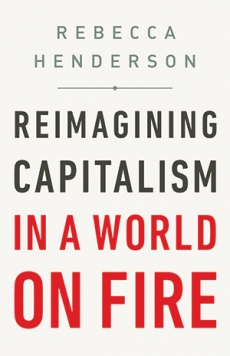
In Reimagining Capitalism in a World on Fire, the author Rebecca Henderson argues that companies have to move beyond maximizing profits to identify business opportunities to meet society’s needs, and that they should consider the welfare of all stakeholders. Investors, she asserts, will benefit by focusing on the long term and considering social and environmental impact. She believes that governments need to regulate markets more strictly and impose carbon taxes. The solution to failing capitalism, she says, lies in all sectors working together to address challenges through collective action, with the result being not only a better world but more profitable businesses and a stronger economy.
 
Rebecca Henderson is the John and Natty McArthur University Professor at Harvard University.
 
The Power of AND: Responsible Business Without Trade-Offs, by R. Edward Freeman, Kirsten E. Martin, and Bidhan L. Parmar, detail an emerging business model built on:
Prioritizing purpose as well as profits; 
Creating value for stakeholders as well as shareholders; 
Seeing business as embedded in society as well as markets; 
Recognizing people’s full humanity as well as their economic interests, and 
Integrating business and ethics into a more holistic model. 
 
Drawing on examples from multiple companies, industries, and countries, the authors seek to demonstrate that these values support resilience and prosperity over the long term. They share real-world success stories they say disprove the conventional wisdom that there are unavoidable trade-offs between acting ethically and succeeding financially. The Power of And is written to present a conceptual revolution about what it means for business to be responsible, providing a new story to help all kinds of companies thrive.
 
R. Edward Freeman is University Professor and Elis and Signe Olsson Professor of Business Administration at the University of Virginia Darden School of Business. Kirsten E. Martin is associate professor of strategic management and public policy at the George Washington University’s School of Business. Bidhan L. Parmar is associate professor of business administration at University of Virginia Darden School of Business. 
 

Master the Principles of Stakeholder Capitalism And Implementation Through Enterprise Engagement

Education, Certifications, and Information to Activate
Stakeholder Capitalism Available Nowhere Else
A complete learning, certification, and information program and a course syllabus for educators.
 
Training and Certification
Enterprise Engagement Alliance Education: Certified Engagement Practitioner; Advanced Engaged Practitioner, and Certified Engagement Solution Provider learning and certification programs on how to implement Stakeholder Capitalism principles at the tactical level. 
 
International Center for Enterprise Engagement: The only training and certification program for ISO 30414 human capital reporting and ISO 10018 quality people management certification. 
 
The EEA offers a complimentary course syllabus for educators.
 
A CEO's Guide to Engagement Across the Enterprise cover
Join the EEA to begin your certification process or see our other resources below. 
Or contact Bruce Bolger; Bolger@TheICEE.org; 914-591-7600, ext. 230 to learn more.
 
THE ONLY BOOKS ON STAKEHOLDER CAPITALISM IMPLEMENTATION
Enterprise Engagement for CEOs:The Little Blue Book for People-Centric Capitalists
This is the definitive implementation guide to Stakeholder Capitalism, written specifically to provide CEOs and their leadership teams a concise overview of the framework, economics, and implementation process of a CEO-led strategic and systematic approach to achieving success through people.  (123 pages, $15.99)

Enterprise Engagement: The Roadmap 5th Edition
The first and most comprehensive book on Enterprise Engagement and the new ISO 9001 and ISO 10018 quality people management standards. Includes 36 chapters detailing how to better integrate and align engagement efforts across the enterprise. (312 pages, $36.) 

OTHER RESOURCES TO ACTUALIZE STAKEHOLDER CAPITALISM 
Communities: The  Enterprise Engagement Alliance and Advocate and the  Brand Media Coalition free resource centers offering access to the latest research, news, and case studies; discounts, promotions, referrals, and commissions, when appropriate to third-party solution providers from participating coalition solution provider members.
 
Enterprise Engagement Resources:  EEXAdvisors.com provides the only curated online marketplace to access hundreds of solution providers in all areas of human capital management and enterprise engagement throughout the world. 

Online Overview:  
10-minute short course: click here for a 10-minute introduction to Enterprise Engagement and ISO standards from the Coggno.com learning platform.

Services: 
•  The Engagement Agency at EngagementAgency.net, offering: complete support services for employers, solution providers, and technology firms seeking to profit from formal engagement practices for themselves or their clients, including Brand and Capability audits for solution providers to make sure their products and services are up to date.
•  C-Suite Advisory Service—Education of boards, investors, and C-suite executives on the economics, framework, and implementation processes of Enterprise Engagement. 
•  Speakers Bureau—Select the right speaker on any aspect of engagement for your next event.
•  Mergers and Acquisitions. The Engagement Agency’s Mergers and Acquisition group is aware of multiple companies seeking to purchase firms in the engagement field. Contact Michael Mazer in confidence if your company is potentially for sale at 303-320-3777.

Enterprise Engagement Benchmark Tools: The Enterprise Engagement Alliance offers three tools to help organizations profit from Engagement. Click here to access the tools.
•  ROI of Engagement Calculator. Use this tool to determine the potential return-on-investment of an engagement strategy. 
•  EE Benchmark Indicator. Confidentially benchmark your organization’s Enterprise Engagement practices against organizations and best practices. 
•  Compare Your Company’s Level of Engagement. Quickly compare your organization’s level of engagement to those of others based on the same criteria as the EEA’s Engaged Company Stock Index.
•  Gauge Your Personal Level of Engagement. This survey, donated by Horsepower, enables individuals to gauge their own personal levels of engagement.

For more information, contact Bruce Bolger at Bolger@TheEEA.org, 914-591-7600, ext. 230.

Save Link

Beyond the Brand: Why Engaging the Right Customers is Essential to Winning in Business

Beyond the Brand provides an in depth look at the importance of certain customers in the marketplace. With case studies and practical step-by-step methods, readers learn how to engage customers in a dialog that can fuel real product and marketing innovation. Readers will learn how to develop a bottom-up strategy, hone intuition and find inspiration to drive innovation, find your company's center of gravity, and identify and find new ways to listen to the key voices in your marketplace.

Kaplan Business. 304 pages. Hardcover. Cost: $7.43

Save Link

Customer Connections: New Strategies for Growth

Customer Connections discusses information and knowledge management technologies to connect with customers in a new way. This new model fosters collaboration and playing the right role in supply and demand chain. This book is good for any salesperson.

Harvard Business School Press. 267pp. Hardcover. Cost: $29.95

Save Link

Customer Equity: Building and Managing Relationships As Valuable Assets

The authors explain the strategies and tactics that make customer equity management work. They outline customer equity's three core strategies: customer acquisition, customer retention, and add-on selling. With very detailed how-to chapters this book is good for any business person looking to strengthen the bond between them and their customers.

Harvard Business School Press. 228pp. Hardcover. Cost: $39.92

Save Link

Customer Inspired Marketing: Change the Game and Become the Brand They Really Love

A former senior level marketing executive at companies such as Macy’s, Eastman Kodak and Bank of America, author Aubryn Thomas has learned why certain brands generate energized reactions from customers and how these brands remain profitable by out-thinking the competition instead of overspending. In "Customer Inspired Marketing," Thomas has created an 8-step plan for companies to follow in order to create a successful marketing/branding campaign.

AuthorHouse. 148. Paperback.

Save Link

Customer Loyalty: How to Earn It, How to Keep It, New and Revised Edition

Customer Loyalty explores the true meaning of customer loyalty and how to acheive it. Author, Griffin, outlines the seven stages of customer affinity and offers strategies for recognizing which fustomers have the potential to become a company's advocates. This book is helpful for business people in small or large product or service based companies.

Jossey-Bass. 272pp. Paperback. Cost: $15.61

Save Link

Customers Mean Business: Six Steps to Building Relationships That Last

Through the example to the Unixyx Corporation, Customers Mean Business, explores the attention and care customers need in order to keep buying from a company. With a helpful six stage process called "Customerize," this book is good for anyone looking to get on the cutting edge of customer service.

Perseus Books. 212 pages. Hardcover.

Save Link

Enterprise Engagement: The Roadmap, 3rd Edition

Enterprise Engagement: The Roadmap, 3rd Edition has been completely updated with new information, illustrations and new chapters. Authored and edited by dozens of experts in general management, marketing, sales, data management, business and academia, the Textbook’s methodology has been endorsed by leading companies as a means of achieving both strategic and tactical organizational goals related to sales, marketing, human resources, vendor management, and community relations. A proven strategy to:
  • Increase long-term profitability
  • Maximize customer loyalty and referrals
  • Capture the commitment of dealers, agents and distributors
  • Increase sales and improve customer service
  • Maximize quality, productivity, quality and wellness
  • Foster greater prosperity through a focus on people 
 
Enterprise Engagement: The Roadmap, 3rd Edition also provides formal preparation for the Enterprise Engagement Certification program. To order a copy, click here.

Bruce Bolger, Allan Schweyer & Richard Kern . 242 pp. Cost: $36

Save Link

Principles of Results-Based Incentive Program Design

Based on the Incentive Marketing Association's Principles Of Results-Based Incentive Program Design Seminar, this is the first formal curriculum ever developed for incentive program planning. The textbook includes sections on Incentive Program Basics for the Business Executive, Core Strategies for the Business Executive, Planning and Design Considerations for the Practitioner, and Implementation and Management Considerations for the Practitioner.

Incentive Marketing Association. Cost: $69.95

Save Link

Relationship Marketing for Competitive Advantage: Winning and Keeping Customers

A collection of articles from some of the nation's leading academic researchers on all aspects of customer retention, including internal and external marketing, employee motivation, and long-term relationship-marketing strategies. Best for those who want to understand the internal as well as external marketing issues involved with one-to-one marketing, as well as those who want an international perspective.

Butterworth-Heinemann. 304pp. Hardcover.

Save Link

Relationship Marketing: Bringing Quality, Customer Service and Marketing Together

This book, which broke ground six years ago by outlining relationship marketing, provides an excellent overview. The book is intended for all marketing managers coming to terms with doing business in turbulent markets and facing up to strategic quality and customer services issues. However, it lacks implementation details and doesn't take into account advances in Internet and database technology that have taken place since its publication.

Butterworth-Heinemann. 204pp. Paperback.

Sorry, no results matched your search.


Earn Big $ In EEA Referral Program
Enterprise Engagement Resources
Committed to Stakeholder Capitalism   Refer, Rate, Suggest & Earn
Engagement Solutions

Bulova

Citizen

PurposePoint: The Purpose Leadership Community

BCAT

Catalyst Performance Group

CarltonOne

BMC

Fire Light Group

Luxe Incentives