Good Company: Caring as Fiercely as You Compete
This book looks at how companies can profit from a commitment to a corporate culture characterized by collaboration, innovation, and joy at work.
Perseus Books. 205 pp. Hardcover.


This book looks at how companies can profit from a commitment to a corporate culture characterized by collaboration, innovation, and joy at work.
Perseus Books. 205 pp. Hardcover.
Offers practical advice for managers on incentive methods such as cash and non-cash reward systems; incentive travel; events; recognition systems; and flexible benefits.
Kogan Page. Hardcover. Cost: $30.17
Although several years old, this book takes a thorough look at reward systems in the context of today's customer- and performance-based management styles. The author tells how to: make pay relate to achievement, foster a sense of stake in the company, update the traditional performance appraisal process, and measure customer-based performance.
McGraw-Hill. 350pp. Hardcover.
Light Their Fire discusses how employee communications is the key to delivering on solidifying customer relationships. This book will teach you how to identify the varying perspectives of different audiences, tailor your messages for maximum effectiveness, and much more.
Kaplan Business. 272pp. Hardcover. Cost: $15.64
Shows managers how to apply proven motivators to help any size firm energize the work force, increase its profits, and meet the challenges of today's competitive global economy. Presents the pros and cons of incentives as well as why and how they work and discusses in detail incentives for executives and workers and those used for marketing to consumers.
Oxford University Press. 352pp. Hardcover. Cost: $60.00
Takes a lighter approach to management that includes using toys, games, and contests to motivate employees.The keystone of this approach for businesses interested in team building for increased profitability is "fun in the workplace."
Fireside. 219pp. Paperback. Cost: $11.20
Measuring To Manage address the When, How, and Why of employee evaluations as well as provides information detailing how to turn mediocre employees into top performers.
88pp. Paperback.
This book reveals how Southwest Airlines, Walt Disney Co., Ben & Jerry's, and other companies have turned themselves into "motivating organizations" that inspire employees to do excellent work.
McGraw-Hill. 160pp. Paperback. Cost: $10.17
Various authors give you the lowdown on many motivational issues. Contains good summaries of both Maslow and Herzberg.
Facts on File. 369 pp. Hardcover.
Organizing Genius analyzes the "great" collaborative teams. It explores what it means to be a great group and how to achieve that working dynamic. This book is for anyone in a leadership position.
Perseus Books Group. 239pp. Paperback. Cost: $11.53
This science-based guide introduces a technique with which to influence those around us honestly and beneficially. Shows how to make the most of positive reinforcement to bring out the best in other people, establishing effective relationships based on mutual respect and shared expectations.
McGraw-Hill. 195pp. Hardcover.
Based on the Incentive Marketing Association's Principles Of Results-Based Incentive Program Design Seminar, this is the first formal curriculum ever developed for incentive program planning. The textbook includes sections on Incentive Program Basics for the Business Executive, Core Strategies for the Business Executive, Planning and Design Considerations for the Practitioner, and Implementation and Management Considerations for the Practitioner.
Incentive Marketing Association. Cost: $69.95
Described as a "crisp, fifty-minute" book, this concise, step-by-step approach to employee motivation. The authors focus on using "respect, recognition, and rewards" to achieve positive organizational results. In a concise, quickly readable format, they address the benefits to keeping employees and keeping them happy; creating a fun, enriching and "hard-to-leave" workfplace; understanding the impact of feeling valued at work, and tapping to employee desires for personal and professional growth.
Thomson Course Technology . 104pp. Paperback. Cost: $13.95
This short book provides a simple program designed especially for companies trying to break down barriers between management and a union. Based on the importance of thanking employees, the book provides some practical ideas, but its approach seems a bit simplistic for complex labor-management issues.
Productivity Press. 152pp. Paperback.
"Taking Charge of Change" explores why getting things to change is so hard. This book contains the diagnostic tools managers need to assess their need for change, and the tool kit needed to implement these changes.
Basic Books. 336pp. Paperback. Cost: $17.06
Outlines the steps involved with planning incentive campaigns for salespeople and other employees, dealers, and distributors.
Selling Communications Inc.. 80 pp. Cost: $25
This book examines why much of the current conventional wisdom is wrong and asks us to re-think the way managers link people with organizational performance. Pfeffer builds a powerful business case for managing people effectively--not just because it makes for good corporate policy, but because it results in outstanding performance and profits.
Harvard Business School Press. 345pp. Hardcover. Cost: $19.77
Terry Barber, the author of The Inspiration Factor, subtitled "How You Can Revitalize Your Company Culture in 12 Weeks," argues that regardless of your personality type, background, or age, you can choose to create an inspirational transaction and positively impact the people around you. "Inspiration is precursor to leadership, to motivation, and is even a new category for business," Barber says. His book offers seven principles that can help readers become team leaders in their organizations and inspire those around them.
Inspiration Blvd. LLC. 196. Hardcover. Cost: $29.95
"The Power of Open-Book Management" discusses the new approach to increased employee productivity and superior financial results. In this book, managers will find a complete guide to understanding and implementing this new method of building, strengthening, and growing their organizations.
John Wiley & Sons, Inc.. 320 pp. Paperback. Cost: $26.37
The author describes recognition and group incentive plans, as well as types of awards and implementation. This book comes closer than most to addressing brass-tacks programs that managers at almost any level of an organization can implement.
Jossey-Bass . 332pp. Paperback. Cost: $45.00
Employee engagement is the great, untapped resource of most organizations. Yet only 25% of employees are truly engaged in their work. Why are all the others so reluctant to "get in the game"? WINNING WITH A CULTURE OF RECOGNITION: Recognition Strategies at the World's Most Admired Companies reveals the surprising answer: Most managers fail to formally recognize high performance and connect it with company culture. Salary and bonuses are only part of today's employment contract. To get everyone performing together, employers need to create a culture of appreciation, recognition, and reward.
Globoforce Limited. 149 pages. Hardcover. Cost: $24.95
Anyone who understands the principles of Enterprise Engagement will enjoy "Disrupting Digital Business" by R. Ray Wang, published by Harvard Business Review Press. Wang, a veteran technology analyst running two of his own consulting firms (currently Constellation Research, and before that Altimeter) and with past positions at Forrester, Oracle, Ernst & Young and Deloitte, believes that, as stated in the subtitle of the book, the key to success is to “create an authentic experience in the peer-to-peer economy.” Many of the chapters overlay the basic framework of what we call Enterprise Engagement. This the perfect book to send to technology leaders seeking to understand the role of engagement in organizational success and the critical role of technology. “When you boil everything down, you can throw out the word ‘digital’ because it is all about relationships with people,” he says. “Companies that don’t make this transformation will go away. We are already seeing increasing gaps in various markets between the market leaders and the No. 2s and No. 3s. What will be the future for Samsung in the handheld marketplace if it continues to lose ground to Apple around the world? They’re getting squeezed at the low end of the market and at the top.” Available from Amazon.
R. Ray Wang . 208 pages. Hardcover. Cost: $17.16
Edition 5 Now Available on Amazon.com and on BarnesandNoble.com.
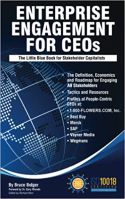
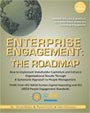
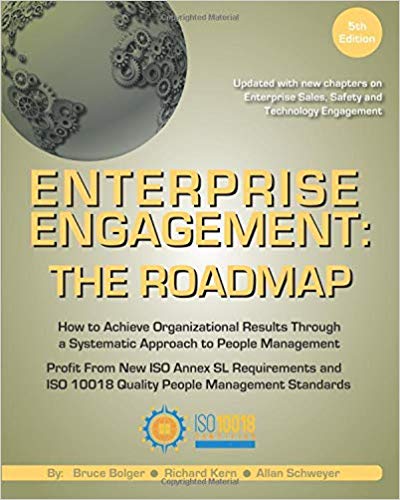 The only practical guidebook and desk reference for executives and front-line management seeking to apply a strategic and systematic approach to achieving organizational objectives and improving shareholder value and share-price performance in public and privately held organizations, government, and not-for-profits. This book offers a formal framework for the application of engagement principles across the enterprise and details the numerous tactics and applications of engagement in all segments of business and the economy. Enterprise Engagement differs from the traditional approach to employee and customer engagement in that it aligns engagement strategies and tactics across the organization to ensure efficiency and measurable success.Enterprise Engagement: The Roadmap is designed for the senior leaders in charge of strategic and tactical engagement plan development and for the front-line managers involved with implementation. It provides a desk reference to all the engagement strategies and tactics and how to better align them to achieve strategic or tactical goals. It provides a guide to developing ISO Annex SL and ISO 1001- compliant strategies and for auditing engagement processes, as well as information on engagement careers and applications for engagement in government and not-for profits.
Bruce Bolger, Allan Schweyer & Richard Kern . 310 pp. Cost: $36
 The concept of Inbound Marketing first became popular in 2006, when Brian Halligan and Dharmesh Shah founded Hubspot, which has grown into one of the world’s leading inbound and content marketing platforms. According to Wikipedia, “Inbound marketing provides information, an improved customer experience and builds trust by offering potential customers information they value via company-sponsored newsletters, blogs and entries on social platforms.” The concept, reportedly based on the notion of “permission marketing” developed in the 1990s by consultant Seth Godin, is focused on enabling marketers “to earn their way into a customer’s awareness rather than invading their awareness through paid advertising.” To learn more about Inbound Marketing, go to Academy.hubspot.com for an online learning and certification program.
Employees and leaders intuitively know that when we find a place where we can throw our hearts, spirits, minds, and hands into our work, we are happier, healthier, and produce better results. Yet, most struggle to understand exactly why we engage in some environments, and don't in others. Magic introduces the five MAGIC keys of employee engagement--Meaning, Autonomy, Growth, Impact, and Connection--and shows how leaders can help employees achieve higher levels of engagement, as well as how employees can be more successful by taking ownership for their own MAGIC. Based on over 14 million employee survey responses across 70 countries--the most extensive employee engagement survey database of its kind--Magic combines principles of psychology and motivation with solid business concepts. Written by internationally recognized experts in leadership and employee engagement, Dr. Tracy Maylett and Dr. Paul Warner, Magic provides actionable advice that will reduce employee attrition, encourage initiative, drive growth and profit, and increase personal engagement in one's work. Available from Amazon.
Tracy Maylett and Paul Warner. 256 pages. Cost: $20.31

 ESM News Alert for the latest news. Subscribe here.