Resources for Topic: Leadership
Sorry, no results matched your search.
A 2012 State of the Sector survey compiled by Gatehouse, in conjunction with the Institute of Internal Communication, reveals that improving leadership communication has emerged as a top priority, with 60% of respondents naming it as their main focus over the next 12 months.
Professors from Harvard Business School, University of Virginia's Darden School of Business and George Washington University author books that include the fundamental need for CEOs to lead a strategic and systematic approach to addressing the needs of all stakeholders.
This book present hundreds of methods and activities that incorporate fun in an organization's work: hiring, training sessions, meetings, communications, awards, and teamwork. The authors asked successful businesspeople worldwide if fun played a part in their corporate culture--and, if so, how it was actually manifested in everyday life.
Frustration isn’t an employee issue; it’s an organizational issue. Frustrated employees represent 20% or more of the total workforce, leading to a major loss in performance, talent and revenue. Frustration wears down motivated, dedicated employees who really care about
New Book Explores the Engagement Equation. One sign that engagement has emerged as a formal field is the proliferation of books published on the subject over the last few years. The latest, The Engagement Equation: Leadership Strategies for an Inspired Workforce,
Blur explores the emerging economic landscape where knowledge and imagination are more valubale than physical capital. Authors, Davis and Meyer, challenge readers to question their assumptions they know about business and to experiment at the edges of business.
This book tells how to use a behavior-based performance management system to transform employees' work into something they are willing—even eager—to do. Offers the newest strategies used by companies like Xerox, 3M, and Kodak.
Enterprise Engagement: The Roadmap, 3rd Edition has been completely updated with new information, illustrations and new chapters. Authored and edited by dozens of experts in general management, marketing, sales, data management, business and academia, the Textbook’s methodology has been endorsed by leading companies as a means of achieving both strategic and tactical organizational goals related to sales, marketing, human resources, vendor management, and community relations.
Based on the business practices and history of Enterprise Rent-a-Car, this book focuses on how the company has achieved financial results by creating happy customers, successful business partnerships, and an engaged and motivated workforce. It discusses the relationship between the company's employee satisfaction, retention, and profitability, and shows how Enterprise makes and reinforces those connections.
This book addresses basic management issues applicable to almost any organization and manager. It provides a simple approach summarized as "select, direct, evaluate, and reward," but is in no way short of details. It includes extensive information on every aspect of the process, including benefits of cash and noncash awards.
This book looks at how companies can profit from a commitment to a corporate culture characterized by collaboration, innovation, and joy at work.
How to Motivate People explains the principles of successful motivation through author, Tarkenton's, P.R.I.C.E (Pinpointing, Recording, Invovlement, Consequences, Evaluation) program. This book shows you how to identify motivational stumbling blacks, track performance levels, inspire participation in setting goals and achieving objectives, plus much more.
This book reveals how Southwest Airlines, Walt Disney Co., Ben & Jerry's, and other companies have turned themselves into "motivating organizations" that inspire employees to do excellent work.
Organizing Genius analyzes the "great" collaborative teams. It explores what it means to be a great group and how to achieve that working dynamic. This book is for anyone in a leadership position.
"Taking Charge of Change" explores why getting things to change is so hard. This book contains the diagnostic tools managers need to assess their need for change, and the tool kit needed to implement these changes.
This book examines why much of the current conventional wisdom is wrong and asks us to re-think the way managers link people with organizational performance. Pfeffer builds a powerful business case for managing people effectively--not just because it makes for good corporate policy, but because it results in outstanding performance and profits.
Terry Barber, the author of The Inspiration Factor, subtitled "How You Can Revitalize Your Company Culture in 12 Weeks," argues that regardless of your personality type, background, or age, you can choose to create an inspirational transaction and positively impact the people around you. "Inspiration is precursor to leadership, to motivation, and is even a new category for business," Barber says. His book offers seven principles that can help readers become team leaders in their organizations and inspire those around them.
HRM Canada recently interviewed Rodd Wagner, author of the business best-seller Widgets, calling it a "frame-breaking approach to leadership." In response to a range of questions on employee engagement, human resources and management, Wagner noted that
Employee engagement is the great, untapped resource of most organizations. Yet only 25% of employees are truly engaged in their work. Why are all the others so reluctant to "get in the game"? WINNING WITH A CULTURE OF RECOGNITION: Recognition Strategies at the World's Most Admired Companies reveals the surprising answer: Most managers fail to formally recognize high performance and connect it with company culture. Salary and bonuses are only part of today's employment contract. To get everyone performing together, employers need to create a culture of appreciation, recognition, and reward.
Pink’s latest book, 'To Sell is Human,' may sound unrelated to engagement, but it actually offers a number of useful insights into human nature and what compels us to make the decisions we do
Employees and leaders intuitively know that when we find a place where we can throw our hearts, spirits, minds, and hands into our work, we are happier, healthier, and produce better results. Yet, most struggle to understand exactly why we engage in
Four new books focus on: how gratitude can improve morale, efficiency and profitability; strategies to reduce organizational griping; a new approach to maximize the customer experience through a holistic approach, and how to better measure the value of human capital.
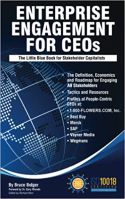
Last week, the Enterprise Engagement Alliance released its updated Enterprise Engagement for CEOs: The Little Blue Book for Stakeholder Capitalists. This week, it has published its updated Enterprise Engagement: The Roadmap - How to Implement Stakeholder Capitalism to provide management at all levels a comprehensive implementation guide with detailed information on the theory, economics, and practices of Stakeholder Capitalism and human capital management across the enterprise.
Sorry, no results matched your search.