

The Rise of the Engagement Executive: From Managing Client Accounts to Mobilizing People Around Purpose
Two Very Different Meanings of Engagement
Current Jobs Illustrate the Shift
From Employee Engagement to Enterprise Engagement?
Click here to subscribe to the ESM weekly e-newsletter.
 Search for “engagement manager” and it is easy to become confused. The title has long been associated with consulting, professional services and account management—the executive or manager who takes responsibility for a client engagement and makes sure the work gets done. Today, however, a distinctly different engagement career is taking shape inside organizations: leaders responsible for helping employees understand and become proactively involved in the organization’s purpose, values, goals and strategic priorities.
A broad LinkedIn search currently returns more than 6,000 US positions under “Director or Manager of Employee Engagement, or Experience, Well-Being, or Culture" although the results include adjacent people, culture and employee-experience positions. The volume alone suggests that engagement is becoming an increasingly identifiable management discipline rather than simply another HR program.
Skills required in the listings include:
- Strategy and program design
- Measurement and analytics
- Employee listening
- Communication and storytelling
- Well-being
- Rewards, recognition
- Employee voice
- Cross-functional leadership
- Project and change management
- Understanding the employee lifecycle
- Connecting engagement initiatives with organizational outcomes
Ironically, while the orientations of the two types of engagement jobs are quite different, many of the skills required overlaps.
Two Very Different Meanings of Engagement
The original meaning remains very much alive. A current McKinsey Engagement Manager posting describes a manager who leads the day-to-day execution of a client project, supervises consultants, works directly with clients and takes ownership of the project's results. Gartner similarly describes its engagement manager as responsible for consulting project delivery, client relationship management, scope, budgets and deliverables. That is essentially engagement management from the outside in: managing the relationship between a service provider and a customer.
The newer career is almost the reverse. These executives work inside the enterprise to connect people with purpose, strategy, values and one another. Their responsibilities increasingly include culture, employee listening, communications, recognition, learning, leadership support, organizational effectiveness, measurement and change management.
What makes the development noteworthy is the elevation of these responsibilities from isolated HR or communications activities into increasingly senior positions with enterprise-wide mandates.
Current Jobs Illustrate the Shift
A review of current job openings as of September 2026 finds numerous examples in the US and elsewhere. The average pay of jobs found was about $120,000 per year.
- The MTA Senior Director, Employee Engagement & Recognition leads the New York City's Metropolitan Transportation Authority organization-wide efforts to foster engagement, belonging, purpose and organizational pride throughout the employee lifecycle, while overseeing enterprise engagement and recognition frameworks.
- Safe Horizon's Senior Director, Culture and Employee Wellbeing is charged with enterprise-wide strategies for organizational culture, engagement, recognition and employee connection, including reinforcing the organization's mission, vision and values.
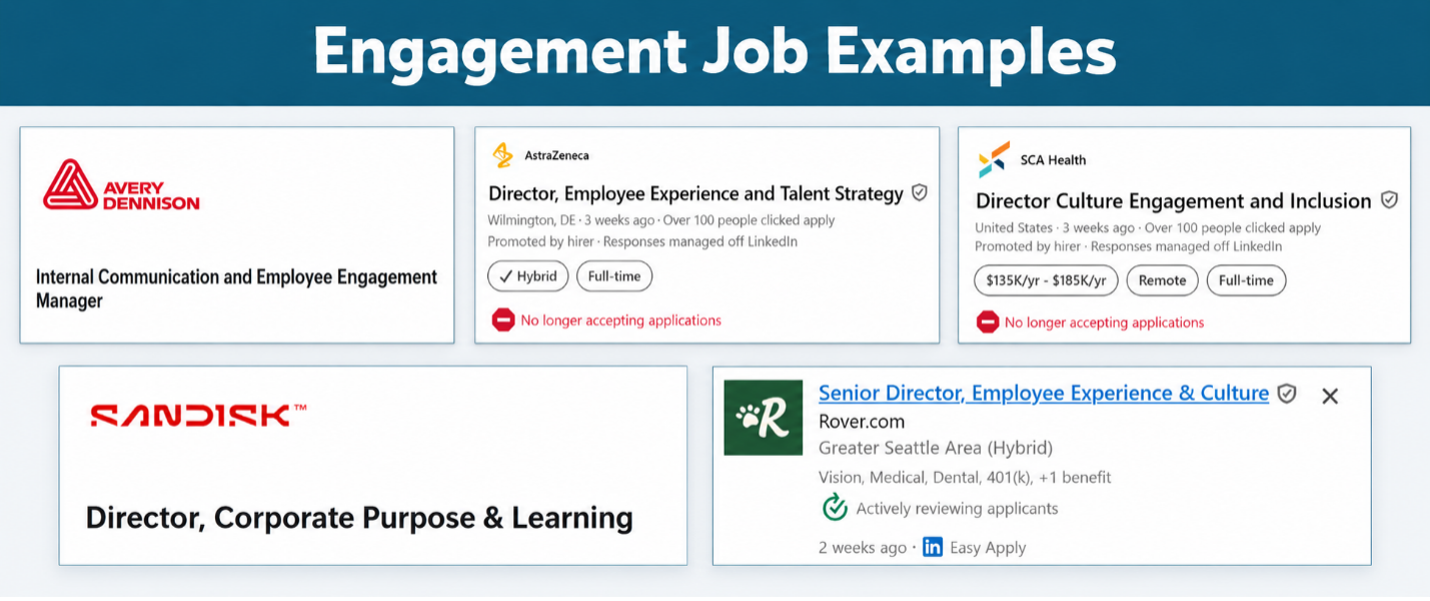
- SCA Health's Director, Culture, Engagement & Inclusion serves as an enterprise leader for culture strategy, employee engagement, organizational health and employee listening. The company explicitly measures success through engagement metrics, leader adoption of action plans and advancement of its culture behaviors.
- AstraZeneca's Director, Employee Experience and Talent Strategy is responsible for strategies designed to strengthen organizational capability, employee engagement and business performance, including employee listening and culture.
- Sandisk's Director, Corporate Purpose & Learning goes even further. The executive is responsible for embedding corporate purpose into the employee experience while overseeing employee communities, volunteering, giving, learning, engagement and measurement aligned with business priorities.
- The Avery Dennison Internal Communication and Employee Engagement Manager is expected to help create a high-performance culture and align the workforce with global business objectives, using engagement data to identify opportunities for improvement.
- Rover's Senior Director, Employee Experience & Culture is a senior leadership position responsible for employee experience, culture, organizational effectiveness, learning and enterprise people programs, with an explicit connection to business performance.
- Amcor's current Culture & Engagement Manager position is particularly explicit: the job calls for embedding the company's Purpose, Values and Behaviors across more than 8,700 employees and turning people strategies into “measurable business impact.”
The principal difference is domain expertise. Client engagement managers generally need knowledge of the product, service, industry, and commercial account relationship, while employee engagement managers require expertise in areas such as culture, employee listening, communications, organizational development, recognition, and the employee experience.
This suggests that engagement management may be emerging as a broader management discipline built around understanding stakeholder needs, aligning people around organizational goals, coordinating resources, and measuring results.
From Employee Engagement to Enterprise Engagement?
Most of these employee oriented positions do not involve customers, although some of the customer engagement jobs do mention coordination with employees. These employee engageement jobs do demonstrate that organizations are beginning to assign senior management responsibility for systematically connecting employees with culture, purpose and strategic priorities. They do not yet generally assign one executive responsibility for engaging all of the stakeholders upon whom an enterprise depends—customers, distribution and supply-chain partners, communities and investors as well as employees. That may be the next stage in the evolution of the profession.
If organizations increasingly accept that sustainable performance depends on the proactive involvement of multiple stakeholders in a common purpose, goals and objectives, engagement management eventually becomes more than an HR discipline. It becomes a cross-functional management responsibility requiring expertise in leadership, communications, learning, rewards and recognition, voice and feedback, analytics, process design and continuous improvement.
The current job market does not yet demonstrate that the fully fledged “Enterprise Engagement Executive” or Chief People Officer has arrived. It does provide considerable evidence that one of its most important building blocks—the executive responsible for turning organizational purpose and strategy into meaningful employee involvement—is rapidly becoming a recognizable career path. See ESM: New Model for a Chief People Officer.
Enterprise Engagement Alliance Services
 Celebrating our 18th year, the Enterprise Engagement Alliance helps organizations enhance performance through:
1. Information and marketing opportunities on stakeholder management and total rewards:
- ESM Weekly on stakeholder management since 2009. Click here to subscribe; click here for media kit.
- RRN Weekly on total rewards since 1996. Click here to subscribe; click here for media kit.
- EEA YouTube channel on enterprise engagement, human capital, and total rewards since 2020
 Management Academy to enhance future equity value for your organization.
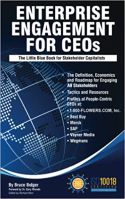
3. Books on implementation: Enterprise Engagement for CEOs and Enterprise Engagement: The Roadmap.
4. Advisory services and research: Strategic guidance, learning and certification on stakeholder management, measurement, metrics, and corporate sustainability reporting.
5. Permission-based targeted business development to identify and build relationships with the people most likely to buy.
Contact: Bruce Bolger at TheICEE.org; 914-591-7600, ext. 230.