

When CEOs Fail to Value People, Nothing Else Matters
.jpeg) A firsthand account from Enterprise Engagement Alliance Academic Director Gary Rhoads reveals a hard truth: employee engagement often fails not only because of flawed or ad hoc tactics, but because leaders don’t understand—or value—the psychology behind people. From the misunderstood nature of burnout to a real-world case where a CEO rejected clear evidence, this true story underscores a fundamental gap at the top.
A firsthand account from Enterprise Engagement Alliance Academic Director Gary Rhoads reveals a hard truth: employee engagement often fails not only because of flawed or ad hoc tactics, but because leaders don’t understand—or value—the psychology behind people. From the misunderstood nature of burnout to a real-world case where a CEO rejected clear evidence, this true story underscores a fundamental gap at the top.By Gary Rhoads
Academic Director, Enterprise Engagement Alliance, Stephen M. Covey Professor Emeritus, Marketing and Entrepreneurship, Marriott School of Business, Brigham Young University.
Burnout Isn’t What Most Leaders Think
A Simple Change That Transformed a Team
The CEO’s Reaction—and the Real Problem
Click here to subscribe to the ESM weekly e-newsletter.
The biggest barrier to employee engagement isn’t tools, surveys, or even strategy—it’s leadership mindset. And more specifically, whether CEOs truly understand the psychology of engagement and well-being—or care enough to act on it.
In one revealing experience, I was invited by the CEO of a major company to diagnose why turnover was high and performance uneven. He had read my work on building passionate organizations but remained skeptical. Still, he issued a challenge: take one underperforming team and prove that engagement principles could improve results. What happened next wasn’t theory—it was proof.
Burnout Isn’t What Most Leaders Think
 One of the first misconceptions to address is burnout. Leaders often assume burnout comes from people who are weak, disengaged, or unable to handle pressure. The reality is the opposite. Burnout only happens to people who care deeply. As I’ve often said, “people who don’t care don’t burn out—they disengage.” When employees enter an organization with passion—wanting to serve customers, contribute, and make a difference—but encounter systems, policies, and politics that prevent them from doing so, that’s when burnout occurs. It’s the collision between passion and obstruction. This leads to a simple but powerful formula:
- When passion exceeds stress, people thrive—and so does the business.
- When stress exceeds passion, performance drops, turnover rises, and disengagement spreads.
Most organizations measure stress. Very few measure passion.
A Simple Change That Transformed a Team
In the underperforming team I was assigned, I identified a highly productive and engaged employee who was on the verge of quitting. She wasn’t disengaged—she was deeply committed. But she faced a real-life challenge: she needed flexibility to pick up her children and ensure their safety in a difficult neighborhood. The company had a rigid system. There was no flexibility or exceptions. So I asked the CEO for one change.
We allowed her to leave briefly during her shift and return later to complete her work. The CEO was convinced this would reduce productivity. I argued the opposite: when people feel supported, they respond with greater commitment—and teams rally around each other. That’s exactly what happened.
Her teammates voluntarily increased their output while she was away, motivated not by pressure but by purpose. They wanted to help and they cared. And in less than six weeks, that team went from one of the lowest performers to one of the highest in the company. Not through incentives. Not through mandates. Through empowerment and trust.
The CEO’s Reaction—and the Real Problem
When I presented the results to the CEO, I expected curiosity, perhaps even a shift in thinking. Instead, the CEO said: “You’ve just proven to me I’m not pushing people hard enough.” In that moment, the real problem became clear. The data, outcome or psychology didn’t matter. The mindset at the top was fixed.
This isn’t an isolated case. It’s emblematic of why engagement efforts fail across industries. Organizations invest in programs, platforms, and messaging—but if leadership views people primarily as units of output rather than sources of passion, no initiative will stick. Engagement is not driven by just by perks, appreciation or recognition frequency. It’s about whether people can do meaningful work in an environment that supports, rather than blocks, their intent.
If CEOs don’t understand that burnout is a symptom of blocked passion, not weak employees; that flexibility and empowerment can increase, not decrease productivity, and that teams perform best when they feel trusted and supported, then engagement will remain a talking point, not a business outcome.
You can prove engagement works. You can demonstrate it with data. You can transform teams in weeks. But if leadership doesn’t believe in the psychology behind it—or worse, it interprets success through the wrong lens—nothing changes. And that may be the most important challenge of all to enhancing engagement.
Enterprise Engagement Alliance Services
 Celebrating our 17th year, the Enterprise Engagement Alliance helps organizations enhance performance through:
1. Information and marketing opportunities on stakeholder management and total rewards:
- ESM Weekly on stakeholder management since 2009. Click here to subscribe; click here for media kit.
- RRN Weekly on total rewards since 1996. Click here to subscribe; click here for media kit.
- EEA YouTube channel on enterprise engagement, human capital, and total rewards since 2020
 Management Academy to enhance future equity value for your organization.
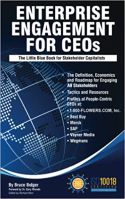
3. Books on implementation: Enterprise Engagement for CEOs and Enterprise Engagement: The Roadmap.
4. Advisory services and research: Strategic guidance, learning and certification on stakeholder management, measurement, metrics, and corporate sustainability reporting.
5. Permission-based targeted business development to identify and build relationships with the people most likely to buy.
Contact: Bruce Bolger at TheICEE.org; 914-591-7600, ext. 230.