

Why Engagement Remains Stubbornly Low: Its Not a Mystery Its a System Failure
 Despite decades of investment in engagement, global scores remain near historic lows because organizations lack a formal, taught, and measured management system for people. From education gaps to investor blind spots and outdated organizational structures, the root causes are systemic—not tactical.
By Darwin Hanson
Human Capital Analytics Advisor, Enterprise Engagement Alliance; President of the International Center for Enterprise Engagement, and CEO and Founder, Talent Management Evolution.
Engagement Isn’t Taught—Yet It’s Expected
Investors and CEOs Rarely See the Warning Signs
Organizations Are Designed for Autonomy, Not Alignment
There Is No Real Accountability at the Top
Manager Burnout: The Weak Link in the System
The Over-Reliance on Tactics Instead of Systems
A Lack of Standardization and Professionalization
Engagement Is a Management System, Not a Program
Click here to subscribe to the ESM weekly e-newsletter.
The latest reporting on global engagement trends—including persistent declines and rising manager burnout—should not surprise anyone paying close attention. According to recent coverage in RRN, organizations continue to invest billions in engagement initiatives with little measurable progress. The reason is straightforward: engagement is not failing because of poor intentions or insufficient tools, but because it is rarely managed as a disciplined, enterprise-wide system. It is not taught in schools, not demanded by investors, not embedded in organizational design, not tied to CEO accountability and is a discipline with few if any professionals or solution providers capable of providing holistic impact-focused solutions. Until those conditions change, engagement will remain low.
Despite billions spent each year, and a bevy of highly acclaimed leadership coaches, leadership training has failed to reverse declining engagement because it focuses on improving individual behaviors rather than fixing the systems those leaders operate within. Even well-trained managers cannot sustain engagement when goals, incentives, and processes are misaligned or disconnected from real business outcomes. Without a unified framework that links engagement to strategy, metrics, and continuous improvement, leadership training becomes an isolated intervention—well-executed but ultimately overwhelmed by the organization itself.
Engagement Isn’t Taught—Yet It’s Expected 
Business schools routinely emphasize that “people are our most important asset,” but rarely teach what that actually means in practice. And to which people are they referring to? There is no widely adopted curriculum on how to design systems that foster the proactive involvement of employees, customers, distribution and supply chain partners and communities.
This gap is precisely what organizations like the Enterprise Engagement Alliance have sought to address through frameworks grounded in Total Quality Management (TQM) and standards such as ISO 10018 for people engagement. These approaches treat engagement not as a program, but as a process—one that can be designed, implemented, and measured like any other business system. Yet most leaders enter the workforce without exposure to these principles. As a result, engagement is often reduced to periodic surveys, leadership training or coaching, recognition programs, or communications campaigns—tactics without an overarching system. The outcome is predictable: activity without impact.
Investors and CEOs Rarely See the Warning Signs
Another structural issue lies in how markets evaluate companies. While financial metrics are scrutinized intensely, human capital and customer-related indicators—arguably leading indicators of future performance—are often overlooked. Frameworks such as the Sustainability Accounting Standards Board and growing ESG reporting standards have begun to introduce human capital disclosure, but adoption remains inconsistent and often superficial. Those impact investors who have seized on this potential for alpha have no incentive to share their insights with other investors if alpha is their goal.
Even when companies report engagement or turnover data, it is rarely integrated into valuation models in a meaningful way. This creates a dangerous blind spot. A company can show strong quarterly earnings while underlying engagement deteriorates—setting the stage for future declines in productivity, innovation, and customer satisfaction. Because analysts and investors rarely press CEOs on these metrics, leadership teams face little external pressure to address them systematically. In effect, organizations are navigating without a meaningful dashboard for what they call their No. 1 asset.
Organizations Are Designed for Autonomy, Not Alignment
Modern corporations still largely operate on an organizational model that resembles feudal systems: individual departments function with significant autonomy, often pursuing their own objectives with limited coordination. HR, sales, marketing, and operations may each run their own engagement-related initiatives—recognition programs, incentives, training—without a unified strategy or shared metrics. The result is fragmentation, duplication, and sometimes even conflicting signals to employees and customers.
Research and frameworks highlighted in the EEA Stakeholder Management Library and Forum emphasize that effective engagement requires the harmonization of stakeholder interests. This means aligning goals, metrics, and processes across functions so that every touchpoint reinforces desired outcomes. Without such alignment, even well-designed initiatives can cancel each other out. For example, a sales incentive plan focused on short-term revenue may undermine customer experience goals or employee well-being—ultimately eroding long-term value.
There Is No Real Accountability at the Top
Perhaps the most critical issue is the lack of consequences for poor engagement. CEOs are held accountable for financial performance, but rarely for the quality of stakeholder engagement. Engagement scores, turnover rates, or customer satisfaction metrics may be reviewed internally, but they seldom carry the same weight as earnings per share or revenue growth, even though human capital metrics can be a predictor of future equity value creation.
In some cases, the incentives are actually misaligned. Public markets can react negatively to investments in wages, training, or employee experience—even when those investments are likely to improve productivity and quality over time. This creates a paradox: leaders who prioritize long-term engagement may face short-term penalties.
As a result, engagement often becomes a “nice to have” rather than a strategic imperative. Without clear accountability mechanisms—such as linking executive compensation to engagement-related outcomes—there is little reason to expect sustained focus or improvement.
Manager Burnout: The Weak Link in the System
The recent focus on manager burnout adds another layer to the problem. Managers are expected to drive engagement, yet they are often the least supported group within the organization. They face increasing demands—performance targets, administrative tasks, hybrid workforce challenges—without the training or tools needed to foster engagement effectively. As burnout rises, their ability to connect with and motivate their teams declines, creating a cascading effect throughout the organization. This is not simply a workload issue; it is a systems issue. Managers are being asked to deliver outcomes that the organization itself is not structured to support.
The Over-Reliance on Tactics Instead of Systems
Another missing piece is the industry’s continued focus on individual tactics—coaching and training, culture initiatives, recognition platforms, incentive programs, pulse surveys—rather than integrated systems. While these tools can be valuable, they are often implemented in isolation, without a clear connection to broader organizational objectives or metrics. This leads to what might be called “engagement theater”: visible activity that creates the impression of progress without delivering measurable results. The enterprise engagement framework emphasizes the importance of linking all engagement-related activities to organizational goals and continuously improving them based on data. Without this systems approach, even the best tools fall short.
A Lack of Standardization and Professionalization
Unlike fields such as finance or operations, engagement lacks widely recognized standards, certifications, and professional training pathways. This allows organizations to position themselves as “engagement experts” without demonstrating a consistent methodology or measurable outcomes. The result is a marketplace filled with varying approaches, making it difficult for buyers to distinguish between evidence-based solutions and marketing claims. Efforts to introduce certification and standardized practices—such as those offered through the Enterprise Engagement Alliance—aim to address this gap, but adoption is still in its early stages.
Engagement Is a Management System, Not a Program
The persistent decline in engagement is not due to a lack of awareness or investment. It is the result of systemic gaps in how organizations educate leaders, measure performance, structure operations, and assign accountability. To reverse this trend, organizations should:
- Treat engagement as a core business process, not a series of initiatives.
- Integrate human capital and customer metrics into executive decision-making and investor communications.
- Align organizational structures and incentives around shared purpose, goals, objectives, and values.
- Provide managers with the training and support needed to succeed.
- Establish clear accountability for engagement outcomes at the highest levels.
Enterprise Engagement Alliance Services
 Celebrating our 17th year, the Enterprise Engagement Alliance helps organizations enhance performance through:
1. Information and marketing opportunities on stakeholder management and total rewards:
- ESM Weekly on stakeholder management since 2009. Click here to subscribe; click here for media kit.
- RRN Weekly on total rewards since 1996. Click here to subscribe; click here for media kit.
- EEA YouTube channel on enterprise engagement, human capital, and total rewards since 2020
 Management Academy to enhance future equity value for your organization.
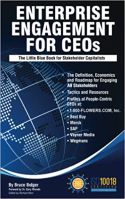
3. Books on implementation: Enterprise Engagement for CEOs and Enterprise Engagement: The Roadmap.
4. Advisory services and research: Strategic guidance, learning and certification on stakeholder management, measurement, metrics, and corporate sustainability reporting.
5. Permission-based targeted business development to identify and build relationships with the people most likely to buy.
Contact: Bruce Bolger at TheICEE.org; 914-591-7600, ext. 230.