

Why LinkedIn Is No Longer Enough for Permission Marketing
The Problem: Followers Do Not Guarantee Access
Days 1–15: Define the Audience and Editorial Promise
Days 16–30: Build the Publication and Subscription Process
Days 31 and Ongoing: Equip Employees to Build the Audience
Days 46–60: Test Relevant Niche Publications
Days 61–90: Measure, Improve, and Repeat
Keep Earning the Next Read
Click here to subscribe to the ESM weekly e-newsletter.
 The concept seemed to be too good to be true. Build an audience of people who believe in you and access a free way to communicate with your prospects and clients on an ongoing basis.
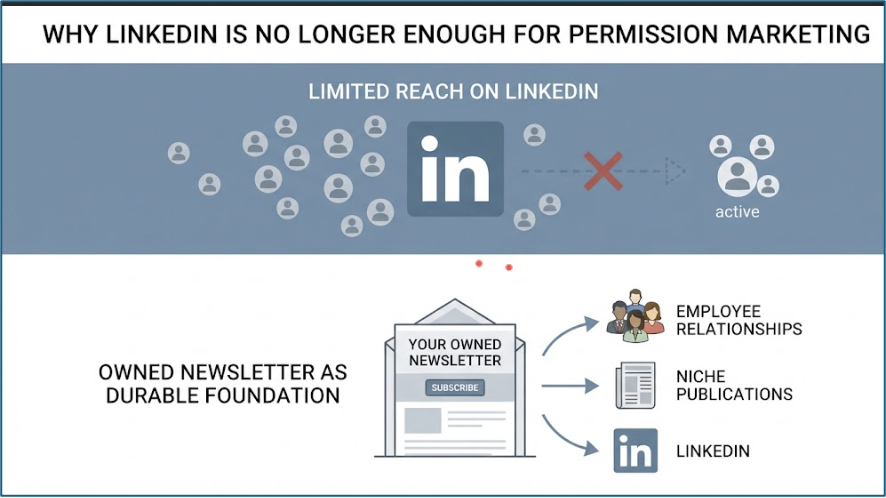
Organizations can spend years building LinkedIn connections and followers without establishing a dependable way to communicate with them. Publishing a post does not ensure that interested followers will see it. Attention on a platform also does not automatically create permission to continue the conversation elsewhere. If you publish your newsletters on Linkedin, it soon becomes apparent that you don't own your audience.
LinkedIn remains highly useful for professional discovery, general branding, introductions, and conversations. For organizations seeking a more durable foundation for permission marketing, an owned newsletter, useful content promoted through it and relevant niche publications, and employees who help earn subscribers through everyday relationships can provide a more effective and still low-cost alternative. Here is a practical plan for building that foundation in 90 days.
The Problem: Followers Do Not Guarantee Access
Permission marketing rests on a simple exchange: people agree to hear from you because they expect useful information or other value, and you earn their continued attention by delivering it. A follower count does not establish a dependable channel for that exchange. On LinkedIn, your updates compete with countless other messages through a distribution system you do not control. Visibility can change independently of the quality of your work. Chasing engagement can also pull attention toward provocative commentary and away from information that helps customers make better decisions.
Use LinkedIn to introduce your expertise, start conversations, and invite people to subscribe directly. Build your ongoing communications around a publication whose subscriber relationships you can manage. It's surprisingly simple if you have an editor with the right expertise in your field.
Days 1–15: Define the Audience and Editorial Promise
Assign one person responsibility for the newsletter, its schedule, and its results. Marketing should coordinate the program, with leadership providing resources and employees supplying ideas. Choose a specific audience and identify three recurring problems and trends it needs help addressing. Review customer questions with sales and service teams. For organizations serving the engagement marketplace, topics might include employee communication, customer retention, recognition, channel relationships, and measuring results.
Write a simple editorial promise: “Each month, we help [audience] solve [problems] through practical examples and useful guidance.” Choose a frequency you can sustain. A strong monthly issue is a sensible starting point. Finish this phase with an accountable owner, a defined reader, an editorial promise, and topics for your first three issues. Newsletters that provide useful, trustworthy information in most cases achieve far higher open rates over time than purely promotional messages. Newsletters can carry ads or promotions as part of the mix, but providing useful, trustworthy information helps enhance ongoing engagement.
Days 16–30: Build the Publication and Subscription Process
Create a subscription page explaining what readers will receive and how often. Include a sample article, a straightforward signup form, and a clear way to unsubscribe. Record when possible where subscribers come from so you can evaluate recruitment efforts later. Produce the first issue around a problem your audience recognizes. Offer a practical framework, documented case study, checklist, or explanation of common mistakes. Ask whether the content would help someone who is not ready to buy. Keep it short, and put the most important messages at the top.
Invest in writers who understand the industry and respect the reader’s knowledge. Pair practitioners with an editor when necessary. Expertise provides substance; clear writing makes it useful. Avoid filling the newsletter with generic commentary or repeated sales pitches. Publish the article on your website as well, giving employees and partners a useful resource to share. Test registration, email delivery, links, and unsubscribe functions before launch.
Days 31–and Ongoing: Equip Employees to Build the Audience
Give employees a subscription link, a sample issue, and a short explanation of the newsletter’s value. Show salespeople, service teams, executives, and specialists how to introduce it naturally after a relevant conversation. Add invitations to appropriate email signatures, presentations, event materials, and follow-up messages. A useful invitation is specific: “Our next issue addresses the challenge we discussed. You can subscribe here.”
Ask each department to contribute customer questions and project lessons. Employees need not write finished articles; a brief interview can supply valuable material. Keep participation based on permission. Invite contacts to subscribe rather than uploading address books. In business to business, you can send sample editions as long as you disclose your company's information and make it easy for people to opt out.
Use Linkedin to share your content or other appropriate social media to promote your content and solicit subscriptions.
Days 46–60: Test Relevant Niche Publications
Identify specialized newsletters or trade publications serving your intended readers. Compare audience roles, industries, editorial quality, placement options, prices, and available reporting.
Choose one initial placement with a budget you can evaluate. Promote useful content through a clearly labeled sponsored article, educational excerpt, or newsletter advertisement. Give readers a concrete reason to visit your subscription page.
Use a distinct tracking link for each placement. Measure resulting subscriptions and subsequent engagement. A smaller publication reaching relevant decision-makers may deliver more value than a much larger, loosely matched audience. The publisher introduces you to its readers. Those readers must still choose to subscribe to your publication.
Days 61–90: Measure, Improve, and Repeat
Review results after each issue and advertising test. Track new subscribers by source, acquisition costs, article clicks, replies, unsubscribes, and inquiries. Treat open rates as supporting information rather than a universal pass-or-fail benchmark.
Where practical, connect subscriber activity with customer records to understand which topics and sources contribute to business conversations. Avoid assuming that a subscription alone caused a sale.
Use these findings to choose the next three topics, improve the subscription page, and decide which placements deserve another test. Maintain a simple monthly review involving marketing, sales, and a representative from service. Set the next review date before closing each monthly planning meeting.
Keep Earning the Next Read
An owned newsletter still requires attention to delivery and reader preferences. Its strength is greater control over subscriber relationships. LinkedIn supports discovery, niche publications introduce relevant audiences, and employees extend informed invitations. The publication must then deliver useful information consistently. That continuing exchange of value is what turns a contact database into a permission marketing asset.
Enterprise Engagement Alliance Services
 Celebrating our 18th year, the Enterprise Engagement Alliance helps organizations enhance performance through:
1. Information and marketing opportunities on stakeholder management and total rewards:
- ESM Weekly on stakeholder management since 2009. Click here to subscribe; click here for media kit.
- RRN Weekly on total rewards since 1996. Click here to subscribe; click here for media kit.
- EEA YouTube channel on enterprise engagement, human capital, and total rewards since 2020
 Management Academy to enhance future equity value for your organization.
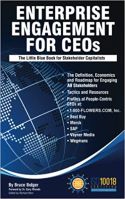
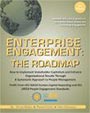
3. Books on implementation: Enterprise Engagement for CEOs and Enterprise Engagement: The Roadmap.
4. Advisory services and research: Strategic guidance, learning and certification on stakeholder management, measurement, metrics, and corporate sustainability reporting.
5. Permission-based targeted business development to identify and build relationships with the people most likely to buy.
Contact: Bruce Bolger at TheICEE.org; 914-591-7600, ext. 230.