

Qualtrics Study of 8.5 Million Employee Responses Links Leadership Credibility to Financial Performance
Research Connects Employee Experience With Financial Results
Leadership Credibility Emerges as the Strongest Differentiator
Employee Connection Goes Beyond Satisfaction
Organizational Support Matters More Than Pay Alone
Implications for Enterprise Engagement and Measurement
Click here to subscribe to the ESM weekly e-newsletter.
A new Qualtrics EX High-Performing Company Benchmark Report, based on 8.5 million employee responses from 264 companies, finds that leadership credibility is the strongest employee experience characteristic associated with superior financial performance. The research identifies 65 companies that combine top-quartile employee experience with financial results exceeding their industry averages.
The study finds three common characteristics among these organizations: credible leadership, strong employee connections to the organization, and tangible organizational support. The findings provide further evidence of the relationship between effective people management and financial performance, while raising questions about how organizations measure the business impact of employee engagement.
Research Connects Employee Experience With Financial Results
 The Qualtrics study draws on employee experience and financial performance data from 2023 through 2025. Of the 264 companies examined, 65 qualified as high-performing based on two criteria: financial performance exceeding industry averages on at least four of six financial measures, including revenue growth, return on assets, and return on equity; and employee experience scores in the top quartile of the company's global benchmark.
The 65 high-performing organizations account for approximately 2.5 million employee responses, span numerous industries and countries, and include companies of different sizes. About 60% employ more than 10,000 people. The analysis uses 114 benchmarked employee experience questions.
Qualtrics compared these organizations with 67 companies that fell below the top quartile in employee experience and met three or fewer financial performance criteria. Another 132 companies fell between these groups.
By comparing financial performance with industry averages, the researchers sought to distinguish organizational performance from the advantages of operating in a rapidly growing industry. The analysis identifies consistent associations between employee perceptions and financial results, although it does not establish that improvements in employee experience independently cause superior financial performance.
Leadership Credibility Emerges as the Strongest Differentiator
The most striking finding concerns employee confidence in senior management. Among high-performing companies, 79% of employees express trust in senior leadership, compared with 62% in the comparison group. Similarly, 76% have confidence in leadership's decisions, compared with 60% elsewhere.
The differences extend beyond trust. At high-performing organizations, 81% believe senior leadership behaves consistently with company values, compared with 69% at other companies. Another 77% say leadership provides a clear picture of organizational direction, versus 62% in the comparison group. Perhaps most significantly, 86% of employees at high-performing companies see a clear connection between their work and organizational strategic objectives, compared with 72% elsewhere.
Qualtrics identifies leadership credibility and strategic clarity as the employee experience factors most consistently associated with financial performance. These findings suggest that engagement efforts focused primarily on communications, surveys, or recognition may be insufficient without credible leadership and clear organizational objectives.
Employee Connection Goes Beyond Satisfaction
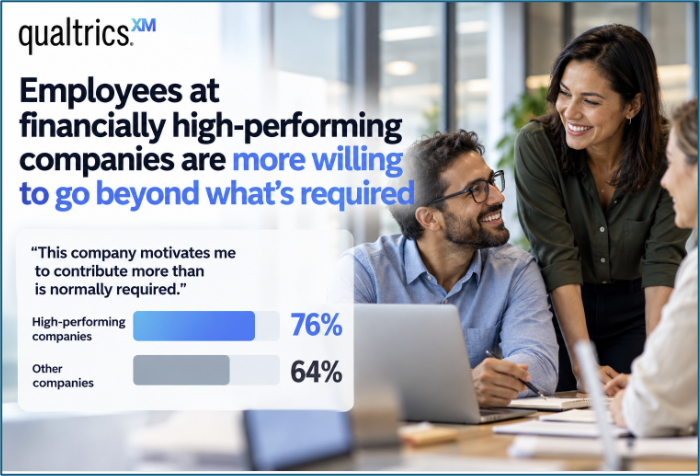
A second distinguishing characteristic is the extent to which employees feel connected to their organizations. At high-performing companies, 84% would recommend their employer as a great place to work, compared with 70% at other organizations. Some 76% report being motivated to contribute more than normally required, compared with 64%. The differences also extend to belonging and personal accomplishment. At high-performing companies, 82% report feeling they belong, compared with 73% elsewhere. Similarly, 82% derive personal accomplishment from their work, compared with 74% in the comparison group.
Employees at financially stronger organizations are also more likely to feel energized at work, with favorable responses of 73%, compared with 62%. These findings reinforce the distinction between employee satisfaction and engagement. The research suggests that organizations combining strong financial performance with positive employee experience are more likely to have employees who identify with their employers, understand their contributions, and feel motivated to exert discretionary effort.
Organizational Support Matters More Than Pay Alone
The third major characteristic involves the practical support organizations provide employees. Among high-performing companies, 75% of employees believe their career goals can be achieved within the organization, compared with 65% at other companies. Some 77% feel supported in adapting to organizational change, compared with 67%. Access to necessary job resources also differs, with favorable responses of 83% versus 75%. Employee benefits receive favorable ratings from 78% of employees at high-performing companies, compared with 66% elsewhere.
Interestingly, Qualtrics reports that differences in satisfaction with pay were considerably smaller than differences in satisfaction with benefits. The researchers suggest that high-performing organizations may place greater emphasis on a comprehensive employee value proposition rather than compensation alone.
The implication is that organizational support involves more than financial rewards. Career development, resources, benefits, and support during change all contribute to the employee experience associated with stronger financial performance.
Implications for Enterprise Engagement and Measurement
The findings are consistent with the principles of enterprise engagement: sustainable performance depends on aligning leadership, organizational purpose, employee capabilities, and the systems that support people in their work. The study's contribution is its combination of extensive employee experience data with financial comparisons across industries. Rather than relying exclusively on engagement scores, Qualtrics identifies organizations meeting both employee experience and financial performance criteria.
There are limitations. Because high-performing companies were selected partly for their strong employee experience scores, differences in employee perceptions are to be expected. The more consequential finding is which specific experiences are most consistently associated with financial performance.
The research does not quantify the incremental financial return from improving any individual management practice. Nor does it determine whether stronger employee experience drives financial results, whether financially successful companies are better positioned to support employees, or whether both relationships operate together.
Nevertheless, the findings reinforce the business case for evaluating employee engagement as part of a broader management system rather than as an isolated HR initiative. They also point to the importance of connecting employee experience measures with financial outcomes to better understand how investments in people contribute to enterprise value creation.
Enterprise Engagement Alliance Services
 Celebrating our 18th year, the Enterprise Engagement Alliance helps organizations enhance performance through:
1. Information and marketing opportunities on stakeholder management and total rewards:
- ESM Weekly on stakeholder management since 2009. Click here to subscribe; click here for media kit.
- RRN Weekly on total rewards since 1996. Click here to subscribe; click here for media kit.
- EEA YouTube channel on enterprise engagement, human capital, and total rewards since 2020
 Management Academy to enhance future equity value for your organization.
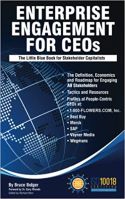
3. Books on implementation: Enterprise Engagement for CEOs and Enterprise Engagement: The Roadmap.
4. Advisory services and research: Strategic guidance, learning and certification on stakeholder management, measurement, metrics, and corporate sustainability reporting.
5. Permission-based targeted business development to identify and build relationships with the people most likely to buy.
Contact: Bruce Bolger at TheICEE.org; 914-591-7600, ext. 230.