

Study: Executive Coaching's Business Impact Depends on the Organizational Context
The Research and Methodology
Better Leadership Behavior Is an Intermediate Result
Organizational Practices Can Enable—or Limit—the Impact
Measurement Should Start With Strategy
Implications for Enterprise Engagement
Later Research Findings
Click here to subscribe to the ESM weekly e-newsletter.
 Why hasn’t decades of leadership coaching helped improve organizational performance in a measurable way or contributed to meaningful stakeholder engagement? This 2009 study and subsequent research suggest one reason: traditional leadership training generally is not designed to enhance organizational performance but rather personal leadership skills.
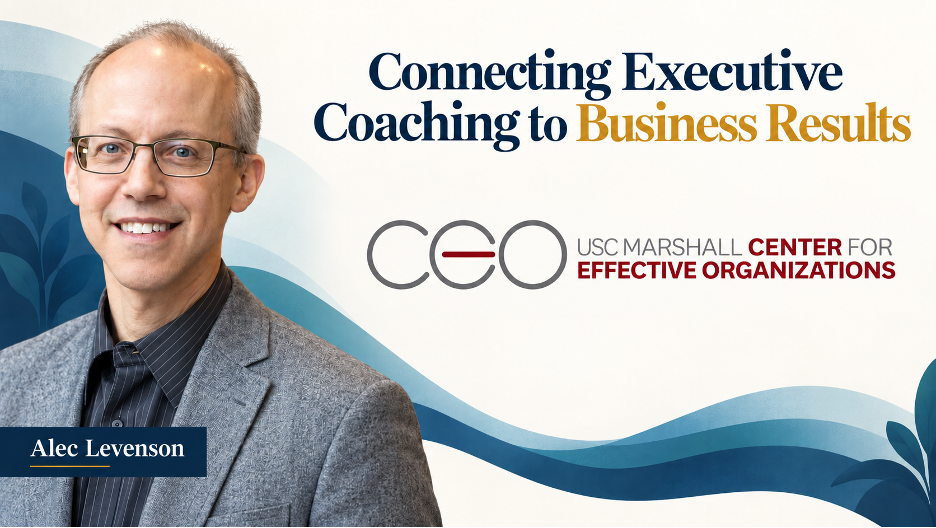
 A 2009 exploratory study suggests that coaching’s business contribution depends on whether it addresses actual barriers to performance and is supported by complementary organizational practices. The study was conducted by Alec Levenson, currently Senior Research Scientist and Director of Center for Effective Organizations at University of Southern California’s Marshall School of Business California Marshall Center,
Based on interviews covering 12 coaching engagements at four large companies, the research points to the importance of connecting coaching with business objectives, team effectiveness, performance management, and rewards—while cautioning that the evidence does not establish a causal impact or a financial return.
The implications? Perhaps leadership development should be expanded to include how to strategically and systematically connect great leadership skills to greater organizational alignment and measurable results.
Benjamin Granger, Chief Workplace Psychologist at Qualtrics, the Provo, UT-based survey and analytics firm, makes a similar point in his book published in early 2026, A Leader Worth Following. He contends that business performance begins with leaders who earn the commitment of the people they depend on. In an interview with ESM about his book, he agrees that lasting leadership improvement requires personal change supported by a management system. Artificial intelligence, he believes, could make these connections easier to measure while increasing the competitive value of human relationships.
The Research and Methodology
The Levenson article, Measuring and Maximizing the Business Impact of Executive Coaching, appeared in the American Psychological Association’s Consulting Psychology Journal: Practice and Research, 2009, Volume 61, Number 2, pages 103–121.
The paper combines a review of previous coaching research, a conceptual framework for evaluating business impact, and an exploratory case study analysis. Levenson collected data in 2004–2005 from four Fortune 500-size companies in consumer products, financial services, and health care.
He interviewed 12 executives at director level or above and their corresponding coaches, representing 12 matched coach–executive pairs and 10 individual coaches. Corporate human resources or organizational development managers selected engagements already considered successful in improving behavior or learning.
The interviews examined coaching objectives, perceived behavioral improvements, connections to business performance, and whether improvements might have occurred without coaching. Because of the small sample, no statistical analyses were conducted.
Better Leadership Behavior Is an Intermediate Result
All 12 engagements were considered successful under the companies’ internal behavioral evaluation procedures. Improvements included listening, communication, influence, empathy, performance feedback, and relationship building. Nevertheless, participants often struggled to identify a direct connection between coaching and business outcomes. Only two of the 12 engagements explicitly included a specific business problem among their coaching objectives.
The distinction is relevant to organizations evaluating leadership development. Evidence that an executive communicates more effectively does not, by itself, establish that the change improved productivity, customer service, innovation, or financial performance. The evaluation must identify how the behavior affects a process important to the organization’s strategy.
Organizational Practices Can Enable—or Limit—the Impact
Executives generally achieve results through other people. Their effectiveness therefore depends on team capabilities, work design, management systems, and relationships across the organization. In cases with more tangible reported business improvements, coaching accompanied changes such as team restructuring, better scheduling, training, management replacement, and stronger performance feedback. These examples suggest that coaching can help leaders implement broader improvements, but they do not isolate coaching’s contribution from the other changes.
Levenson also describes cases in which coaching alone appeared to provide benefits, such as reducing fear within a team or improving collaboration. Those contributions, however, were difficult to quantify or link conclusively to business results.
Measurement Should Start With Strategy
The paper recommends defining the relevant strategic or financial objectives before selecting measures of coaching effectiveness. For example, an organization seeking to improve innovation might examine development speed, collaboration, or the success of new products. A short-term financial ROI calculation could miss strategically important benefits that take longer to produce financial returns.
The study also argues for examining whether coaching is the appropriate intervention. Skills training, team development, changes in work processes, or a combination of approaches may better address the underlying problem.
Implications for Enterprise Engagement
For enterprise engagement practitioners, the paper offers a framework for connecting leadership development with the conditions that enable people to perform. Coaching, communications, learning, rewards, and performance management should be evaluated in relation to shared organizational objectives.
The findings remain preliminary. The sample was small and deliberately limited to engagements considered behaviorally successful; results relied on participant reports without independent validation, and there was no control group. The research therefore supports better diagnosis and integrated program design, rather than a definitive claim that coaching produces a particular return or that combined interventions always outperform coaching alone.
Later Research Findings
Research published since Levenson’s 2009 study provides stronger evidence that coaching can improve individual work performance, leadership effectiveness, and goal attainment, including a 2023 meta-analysis of 37 randomized controlled studies involving 2,528 participants. However, these findings do not establish a predictable financial return: evidence directly attributing independently measured revenue, profit, productivity, or cost savings to coaching alone remains more limited, and many outcomes are self-reported. Meanwhile, the 2025 International Coaching Federation Global Coaching Study, conducted by PwC with more than 10,000 participants in 127 countries, estimates annual global professional coaching revenue at $5.34 billion, up 17% from its 2023 study, with approximately 123,000 coach practitioners worldwide. These figures cover the broader professional coaching market, including specialties outside business and executive coaching.
Enterprise Engagement Alliance Services
 Celebrating our 18th year, the Enterprise Engagement Alliance helps organizations enhance performance through:
1. Information and marketing opportunities on stakeholder management and total rewards:
- ESM Weekly on stakeholder management since 2009. Click here to subscribe; click here for media kit.
- RRN Weekly on total rewards since 1996. Click here to subscribe; click here for media kit.
- EEA YouTube channel on enterprise engagement, human capital, and total rewards since 2020
 Management Academy to enhance future equity value for your organization.
3. Books on implementation: Enterprise Engagement for CEOs and Enterprise Engagement: The Roadmap.
4. Advisory services and research: Strategic guidance, learning and certification on stakeholder management, measurement, metrics, and corporate sustainability reporting.
5. Permission-based targeted business development to identify and build relationships with the people most likely to buy.
Contact: Bruce Bolger at TheICEE.org; 914-591-7600, ext. 230.