

Qualtrics Report: Closing the Experience Gap Requires Enterprise Leadership
Faster Decisions Can Create Greater Fragmentation
Capabilities That Differentiate Today May Become Expected
Trust Has Business Consequences
Human Connection Requires Deliberate Choices
Three Steps Toward Enterprise Accountability
Click here to subscribe to the ESM weekly e-newsletter.
Organizations risk using artificial intelligence to make individual functions more efficient while making the overall employee and customer experience less consistent, according to a report from Qualtrics XM Institute, Provo, UT. The report argues that closing the gap between what people expect and what organizations deliver requires enterprise accountability, explicit standards for how people should be treated, and consideration of experience in major business decisions. Its central message: collecting feedback and improving individual interactions cannot substitute for coordinating the management decisions that produce those experiences.
Experience Is the Future of Business: The Leadership Case for Closing the Experience Gap was prepared by Isabelle Zdatny, Head of Thought Leadership and Editor-in-Chief; Benjamin Granger, PhD, Chief Workplace Psychologist; Talia Quaadgras, Senior Research Program Manager; and Ava Feider, Senior Research and Content Associate. It draws on several XM Institute studies, including a fourth-quarter 2025 global survey of 1,500 executives, consumer and employee research, and perspectives from experience professionals.
Faster Decisions Can Create Greater Fragmentation
The authors identify four changes that challenge conventional organizational structures: intelligence is becoming widely available, decisions are moving into automated systems, relationships increasingly involve outside platforms and intermediaries, and work is becoming continuous rather than organized around periodic projects and reviews.
AI enables managers in different functions to generate their own analyses and act more quickly. However, without a common basis for interpreting information and making decisions, each department can reach reasonable conclusions that pull the organization in different directions. Similarly, automated systems can make choices about customer service, communications, or employee development that are appropriate within a particular process but inconsistent with the organization’s broader commitments.
Customers and employees encounter the combined effect of those decisions. They do not experience the organization according to its departmental boundaries. The authors describe the resulting distance between expectations and consistent delivery as the experience gap, arguing that faster and more distributed decisions make coordination increasingly consequential.
Capabilities That Differentiate Today May Become Expected
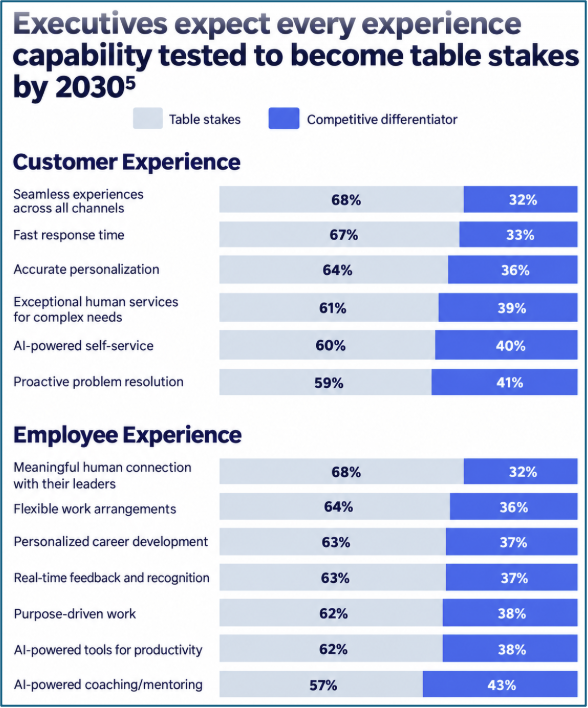 The report suggests that AI will make many current competitive advantages easier to reproduce. In the executive survey, majorities expected every customer and employee experience capability tested to become a basic requirement by 2030, rather than a differentiator.
For example, 68% viewed seamless customer experiences across channels as a future baseline expectation. On the employee side, 68% said the same of meaningful human connections with leaders, while 63% classified real-time feedback and recognition that way. These are executive expectations about the future, rather than evidence that organizations already deliver these capabilities consistently.
The implication is that organizations cannot assume that introducing personalization, faster responses, recognition, or AI tools will create a durable advantage. As those capabilities become more accessible, differentiation will depend increasingly on how reliably they work together and whether people trust the organization behind them.
Trust Has Business Consequences
The report cites Qualtrics research indicating that nearly half of negative customer interactions result in reduced spending, with an estimated $3 trillion in global sales at risk in 2026. This is an estimate of exposure associated with poor experiences, rather than a tally of realized losses.
Employee commitment also presents a challenge. The report states that 40% of employees with less than one year of tenure intend to remain for at least three years, compared with 64% of longer-tenured employees. Those figures measure stated intentions, not actual retention, but underscore the importance of building relationships early.
The authors place particular emphasis on emotional experience. Citing a third-quarter 2025 study of 10,000 US consumers, they report that consumers with strong emotional experiences were 4.5 times more likely to purchase more, 5.6 times more likely to trust the organization, and 4.5 times more likely to forgive a problem. These relationships support the business relevance of experience, although they do not establish that a particular intervention will cause those outcomes.
Human Connection Requires Deliberate Choices
Perspectives from Tiffany & Co. and Nationwide illustrate why decisions about automation should reflect the nature of the relationship. Darren Degiorgio, Director of Tiffany’s Global Client Service Center, describes AI’s role as reducing friction around client advisors so they can strengthen customer relationships. Jenn Duska, Senior Consultant, Voice of the Customer at Nationwide, distinguishes the need for human care when someone first reports a death from the convenience of digital processes for subsequent claim administration.
Both examples point to a management question: where does technology improve the experience, and where is human involvement essential to earning trust? The report argues that organizations need explicit standards to guide those choices.
Three Steps Toward Enterprise Accountability
The authors recommend assigning a leader or team responsibility for the experience across the organization, with authority to bring decision-makers together and escalate unresolved conflicts. Shared objectives and incentives should reinforce accountability when outcomes depend on several functions. See ESM: Why Companies Need a Chief People Officer to Run the People Operating System.
Second, leaders should translate brand promises, organizational values, and employee commitments into practical experience standards. These should guide human involvement, tradeoffs between efficiency and care, AI governance, and partner requirements.
Third, major investment, automation, policy, and organizational decisions should include an assessment of their effects on employee and customer experience alongside financial and operational considerations. The authors say organizations can begin through existing governance structures without adding headcount or reorganizing.
For enterprise engagement practitioners, the report supports a familiar strategic principle: sustainable relationships depend on coordinated implementation across the business. Feedback provides essential information, but leadership must connect that information to the policies, systems, incentives, and everyday decisions that determine how people are treated.
Enterprise Engagement Alliance Services
 Celebrating our 18th year, the Enterprise Engagement Alliance helps organizations enhance performance through:
1. Information and marketing opportunities on stakeholder management and total rewards:
- ESM Weekly on stakeholder management since 2009. Click here to subscribe; click here for media kit.
- RRN Weekly on total rewards since 1996. Click here to subscribe; click here for media kit.
- EEA YouTube channel on enterprise engagement, human capital, and total rewards since 2020
 Management Academy to enhance future equity value for your organization.
3. Books on implementation: Enterprise Engagement for CEOs and Enterprise Engagement: The Roadmap.
4. Advisory services and research: Strategic guidance, learning and certification on stakeholder management, measurement, metrics, and corporate sustainability reporting.
5. Permission-based targeted business development to identify and build relationships with the people most likely to buy.
Contact: Bruce Bolger at TheICEE.org; 914-591-7600, ext. 230.