

USC Center for Effective Organizations Director Alec Levenson: Why Better Management Requires Seeing the Whole System
 The USC Marshall Center for Effective Organizations has spent more than 45 years connecting management science with real-world organizational performance; its current director, Alec Levenson, argues that many companies still leave substantial value on the table because they manage people, work and performance too narrowly and reactively. Perhaps as few as one in four companies or less he believes operates with a systematic approach to value creation through people.
 The Lawler Legacy
Why So Much Management Remains Reactive
Systems Before Programs
What Leaders Need Now
Click here to subscribe to the ESM weekly e-newsletter.
 Founded in 1979 by management scholar Edward E. Lawler III, the USC Marshall Center for Effective Organizationsoccupies an unusual position between academia and management consulting. Its purpose is not simply to study organizations or publish research, but to work directly with companies to apply research to difficult organizational performance problems and learn from the results.
 That heritage remains evident under Alec Levenson, Senior Research Scientist and Director
USC Marshall Center for Effective Organizations. He is an economist whose work integrates organization design, job design, human capital analytics and strategic talent management. A recent USC CEO document identifies Levenson as director and senior research scientist and describes his focus as optimizing operating models, improving strategy execution, developing talent practices and integrating analytics with organization development.
The center says its goal is to provide leaders with research, practical tools and hands-on learning to help them solve complex problems and create “highly effective, sustainable organizations.” Its work currently spans organization design, transformation, the future of work, human capital analytics and related areas of organizational effectiveness. The common thread is systems thinking: understanding how strategy, people, jobs, teams, processes, technology, incentives and management practices interact to produce—or inhibit—performance. The center describes its approach as combining scientific research with practical interventions and evaluating whether those interventions actually work. Click here for the overview of its CEO’s mission and approach.
The Lawler Legacy
Lawler, who founded the Center after joining USC in 1978, became one of the leading figures in organizational effectiveness, compensation, human resources and organizational development. USC describes his original vision as bridging the gap between theory and practice by developing and communicating knowledge about how organizations can be managed more effectively. His work included the concept of high-involvement work systems—creating conditions in which people have the information, skills, authority and rewards necessary to contribute to organizational performance.
Levenson summarizes the center’s role more simply. Asked by ESM what he would tell a CEO about what the organization does, he replied: “We help to solve intractable organizational performance problems.” His starting point, he says, would not be a predetermined solution but questions: What are the problems keeping the executive awake at night, and what has the organization already tried?
Why So Much Management Remains Reactive
Levenson agrees that organizations generally are not as strategic in managing people and organizational performance as they could or should be—and consequently leave value on the table. Two factors stand out to him. Organizations routinely promote strong individual contributors into management without sufficiently determining whether they can manage people, and short-term financial pressures frequently favor efficiency and immediate cash returns over investments in longer-term organizational capabilities.
The management problem is particularly important to him. Levenson calls the routine promotion of individuals into supervisory jobs without evidence of management capability “one of the biggest problems” in organizations worldwide. Poor management then produces additional HR procedures, performance systems and legal protections designed partly to compensate for failures that better frontline management could have prevented. This creates a reactive, backward-looking foundation for much of what management focuses on, rather than the skills to proactively stopping budding challenges from growing into real problems.
Yet Levenson cautions against broad declarations that companies simply fail to understand and invest in their people. He says his experience is more nuanced. Leading companies frequently understand very well how to manage the particular people, roles and processes essential to their competitive advantage. The problem is that these practices often remain confined to relatively small portions of the enterprise rather than becoming general management principles applied systematically. In addition, “good” management practices often get spread like peanut butter across all roles and throughout the organization, rather than being adapted to the needs and context different teams operate under.
Systems Before Programs
This distinction helps explain Levenson’s emphasis on systems rather than individual HR practices. In his “Systems Optimization” newsletter, he describes his focus as using organizational behavior and economics to improve strategy execution and organizational effectiveness. His work on systems diagnostics argues that performance problems cannot automatically be attributed to individual employees, teams, leadership, incentives or culture. The real cause may lie in the interaction among jobs, teams, business processes, technology and management systems.
That also explains his skepticism toward simplistic employee-engagement formulas. His research with Alexis Fink has found that engagement and performance are related, while emphasizing that job design, autonomy, skills, technology and the nature of the work can substantially determine how much engagement can affect results. Their research is summarized here.
For Levenson, effective management therefore is not about treating employees well as an act of generosity. Lawler’s “virtuous spiral,” as Levenson describes it, combines appropriate treatment with accountability, meaningful goals, feedback, capability and rewards. These elements work together as a system rather than as disconnected programs.
What Leaders Need Now
Levenson believes the challenge has become more urgent because many management assumptions developed over the last several decades no longer fit current economic conditions. In his “Strategic Leadership Crossroads” series,he argues that more expensive labor and capital, supply-chain uncertainty, hybrid work and rapidly changing markets require much faster organizational learning. Senior executives need better information flowing upward from employees closest to customers, suppliers and operating processes; greater collaboration across silos; more dynamic planning; and closer attention to the organizational capabilities required to execute strategy.
That may ultimately be the Center for Effective Organizations’ most enduring proposition, he suggests. There is no single engagement program, HR technology, management methodology or metric that creates an effective organization. Performance comes from understanding the system, identifying the real sources of underperformance, designing the appropriate interventions and measuring what happens.
More than four decades after Lawler founded CEO, Levenson’s message suggests that the science of effective organizations is well established. The larger challenge is getting management to use it systematically.
Enterprise Engagement Alliance Services
 Celebrating our 18th year, the Enterprise Engagement Alliance helps organizations enhance performance through:
1. Information and marketing opportunities on stakeholder management and total rewards:
- ESM Weekly on stakeholder management since 2009. Click here to subscribe; click here for media kit.
- RRN Weekly on total rewards since 1996. Click here to subscribe; click here for media kit.
- EEA YouTube channel on enterprise engagement, human capital, and total rewards since 2020
 Management Academy to enhance future equity value for your organization.
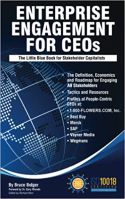
3. Books on implementation: Enterprise Engagement for CEOs and Enterprise Engagement: The Roadmap.
4. Advisory services and research: Strategic guidance, learning and certification on stakeholder management, measurement, metrics, and corporate sustainability reporting.
5. Permission-based targeted business development to identify and build relationships with the people most likely to buy.
Contact: Bruce Bolger at TheICEE.org; 914-591-7600, ext. 230.