

What Caterpillar, Deere and Komatsu Can Learn From Their People-Value Performance
Caterpillar: How Can Strong Performance Be Sustained?
Deere: Strong Relationships, Weaker Growth
Komatsu: Growth Without Comparable Productivity
Satisfaction Is Only the Beginning
Click here to subscribe to the ESM weekly e-newsletter.
The purpose of the Enterprise Engagement Index is not to declare that one company has a “better culture” than another. It is to provide executives,
 investors and other stakeholders with a directional view of how effectively an organization appears to convert its people resources (employees and customers) into sustainable economic value.
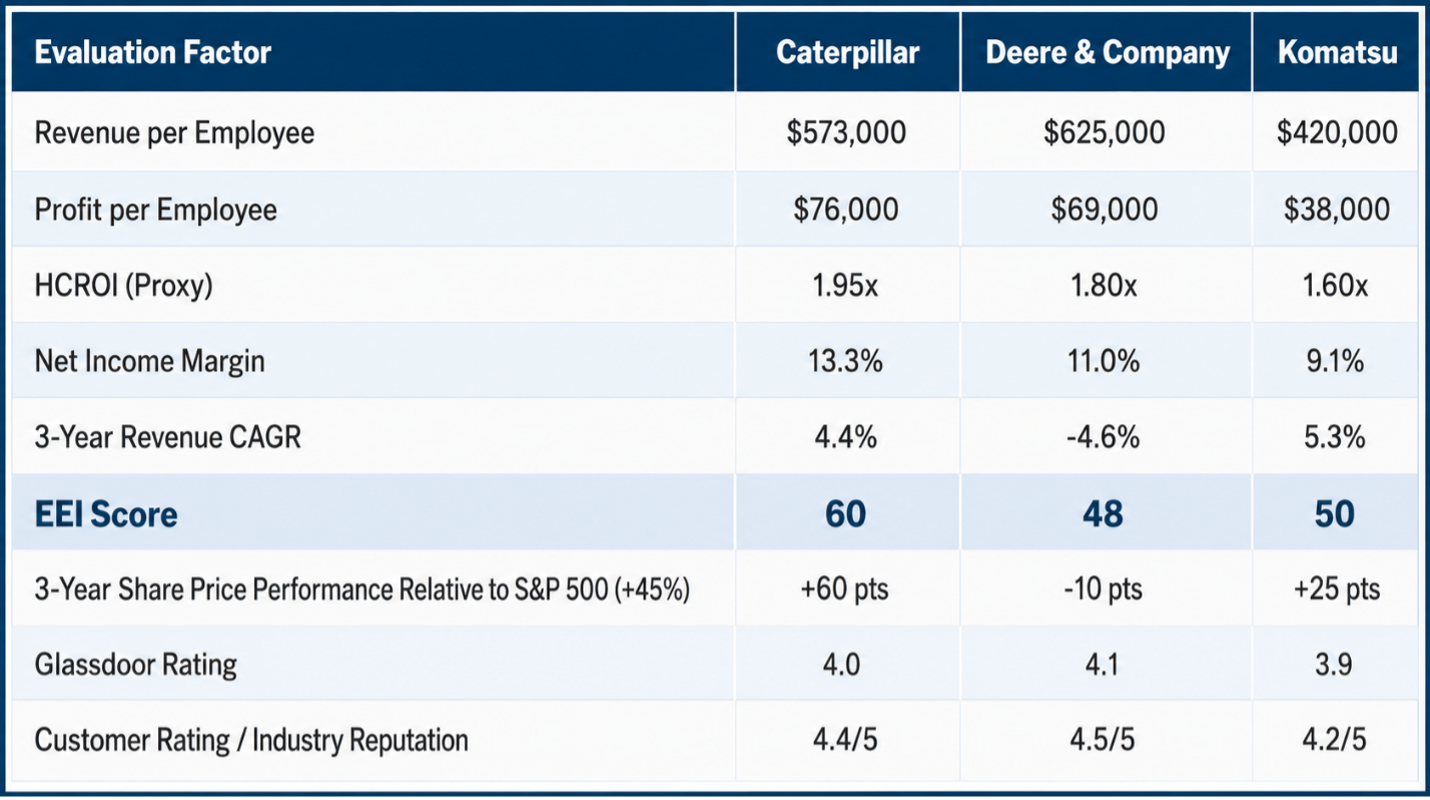
The construction equipment comparison provides an especially useful example because Caterpillar, Deere & Companyand Komatsu all have above-average employee and customer ratings. The differences emerge when those measures are viewed alongside revenue and profit per employee, profitability, growth and shareholder returns. Caterpillar earns the highest EEI score at 60, followed by Komatsu at 50 and Deere at 48. The question for management is less about the rankings themselves than what the gaps might reveal about opportunities to create more value through customers and employees.
Based on this range of rankings, these companies operate in an industry in which it is more difficult to create value through employees and other stakeholders because of the fundamental high-costs and moderate margin economics of the industry. There is less room for people management error than in the industries with the highest EEI scores, such as high-tech, pharmaceutical and related firms that generate high levels of revenues and profits per employee and customer.
Caterpillar: How Can Strong Performance Be Sustained?
Caterpillar has the strongest overall EEI profile. Based on when this analysis was conducted earlier this year, it generates approximately $573,000 in revenue and $76,000 in profit per employee, with an estimated Human Capital ROI of 1.95 times and a 13.3% net income margin. Three-year revenue growth of 4.4% is positive, and its share-price performance has significantly exceeded the S&P 500 benchmark used in the analysis. Stock performance is not a factor in the EEI.
Its Glassdoor rating of 4.0 and customer/reputation rating of 4.4 out of 5 also suggest that the financial results are not obviously being achieved at the expense of employees or customers. For Caterpillar executives, therefore, the findings raise a different question than they do for the other companies. What specifically is producing these results, and how systematically is management managing and measuring these processes?
Executives should be able to identify which employee, dealer, customer, learning, communications, incentive and recognition strategies have the greatest relationship with productivity, quality, retention, customer loyalty and profitable growth. If management cannot answer those questions, some of the company's strongest value-creation practices may be occurring more by organizational instinct and tradition than through a measurable operating system.
The opportunity for Caterpillar is to identify the people practices most closely associated with its superior economics and make them repeatable and measurable enough to withstand changes in management, markets and economic conditions.
Deere: Strong Relationships, Weaker Growth
Deere presents perhaps the most interesting management challenge. It has the highest revenue per employee in the group at approximately $625,000 and the strongest employee and customer reputation measures, with a 4.1 Glassdoor rating and a 4.5 customer/reputation score. Yet its EEI score falls to 48 because profit per employee and margins trail Caterpillar and, most importantly, three-year revenue growth is negative at approximately 4.6%.
The agricultural equipment cycle clearly matters, so the figures should not be interpreted as evidence of a management failure. They do, however, pose an important strategic question. If Deere has highly regarded employees, strong customer relationships and exceptionally high revenue productivity, can those strengths be used more effectively to offset cyclical market pressures?
Management might examine whether its strong employee and customer relationships are generating all the innovation, cross-selling, service revenue, customer retention and productivity opportunities they potentially can. A high satisfaction score is valuable, although satisfaction by itself does not necessarily create economic value. The more important issue is whether engaged employees and customers are contributing measurable ideas, referrals, productivity gains, repeat purchases, aftermarket opportunities and innovation.
For Deere, the EEI does not suggest that its people strategy is weak. It suggests an opportunity to determine whether strong stakeholder relationships can be converted into greater resilience during a difficult market cycle.
Komatsu: Growth Without Comparable Productivity
Komatsu presents almost the reverse situation. Its three-year revenue growth of 5.3% is the highest of the three companies, yet it trails significantly in revenue per employee at approximately $420,000 and profit per employee at $38,000. Its estimated HCROI of 1.60 times and 9.1% net income margin also lag the other two companies. Employee and customer reputation remain respectable, with Glassdoor at 3.9 and customer/reputation at 4.2.
For Komatsu executives, the central question is straightforward. Why is respectable growth and stakeholder satisfaction not translating into productivity and profitability closer to its major competitors?
This is where a people-focused operating analysis can become useful. Management could examine differences in workforce structure, processes, skills, training, technology utilization, dealer productivity, customer mix and other factors affecting revenue and profit per employee.
The objective would not simply be cost reduction. Cutting people can improve revenue-per-employee statistics temporarily while damaging customer experience, innovation or growth. A more useful analysis asks how employees, dealers, suppliers and customers can be better equipped and aligned to create more value with the resources already committed.
Satisfaction Is Only the Beginning
One important finding applies to all three companies. Their employee and customer ratings are relatively close, yet their economic outcomes differ significantly. That illustrates why employee engagement surveys, customer satisfaction scores and similar measures should not be viewed as end results. They are potentially valuable indicators, but management ultimately needs to understand whether positive stakeholder experiences contribute to productivity, quality, innovation, retention, sales, margins and sustainable growth.
The EEI comparison cannot establish causation, nor is it intended to. HCROI in this analysis is a proxy because consistent companywide labor-cost information is unavailable, Komatsu results require currency conversion, and construction and agricultural equipment markets are influenced by economic cycles. Customer ratings likewise rely on available reputation, dealer and customer information rather than a common ACSI measure. What the index can do is highlight questions worth asking.
For Caterpillar, the priority is to understand and protect whatever is helping translate strong stakeholder relationships into superior financial outcomes. For Deere, it is to determine how its particularly strong employee and customer standing can contribute more effectively to resilience and renewed growth. For Komatsu, it is to examine why growth and respectable stakeholder ratings have not produced comparable employee productivity and margins.
For all three, the larger management question is the same: Does the company have a systematic way to connect investments in people and customers with the financial and operating outcomes that ultimately create value for shareholders? If the answer is unclear, that may be the most important finding of all.
Enterprise Engagement Alliance Services
 Celebrating our 17th year, the Enterprise Engagement Alliance helps organizations enhance performance through:
1. Information and marketing opportunities on stakeholder management and total rewards:
- ESM Weekly on stakeholder management since 2009. Click here to subscribe; click here for media kit.
- RRN Weekly on total rewards since 1996. Click here to subscribe; click here for media kit.
- EEA YouTube channel on enterprise engagement, human capital, and total rewards since 2020
 Management Academy to enhance future equity value for your organization.
3. Books on implementation: Enterprise Engagement for CEOs and Enterprise Engagement: The Roadmap.
4. Advisory services and research: Strategic guidance, learning and certification on stakeholder management, measurement, metrics, and corporate sustainability reporting.
5. Permission-based targeted business development to identify and build relationships with the people most likely to buy.
Contact: Bruce Bolger at TheICEE.org; 914-591-7600, ext. 230.