

EEA Launches Confidential Survey to Gauge Strategic Maturity of Engagement Programs
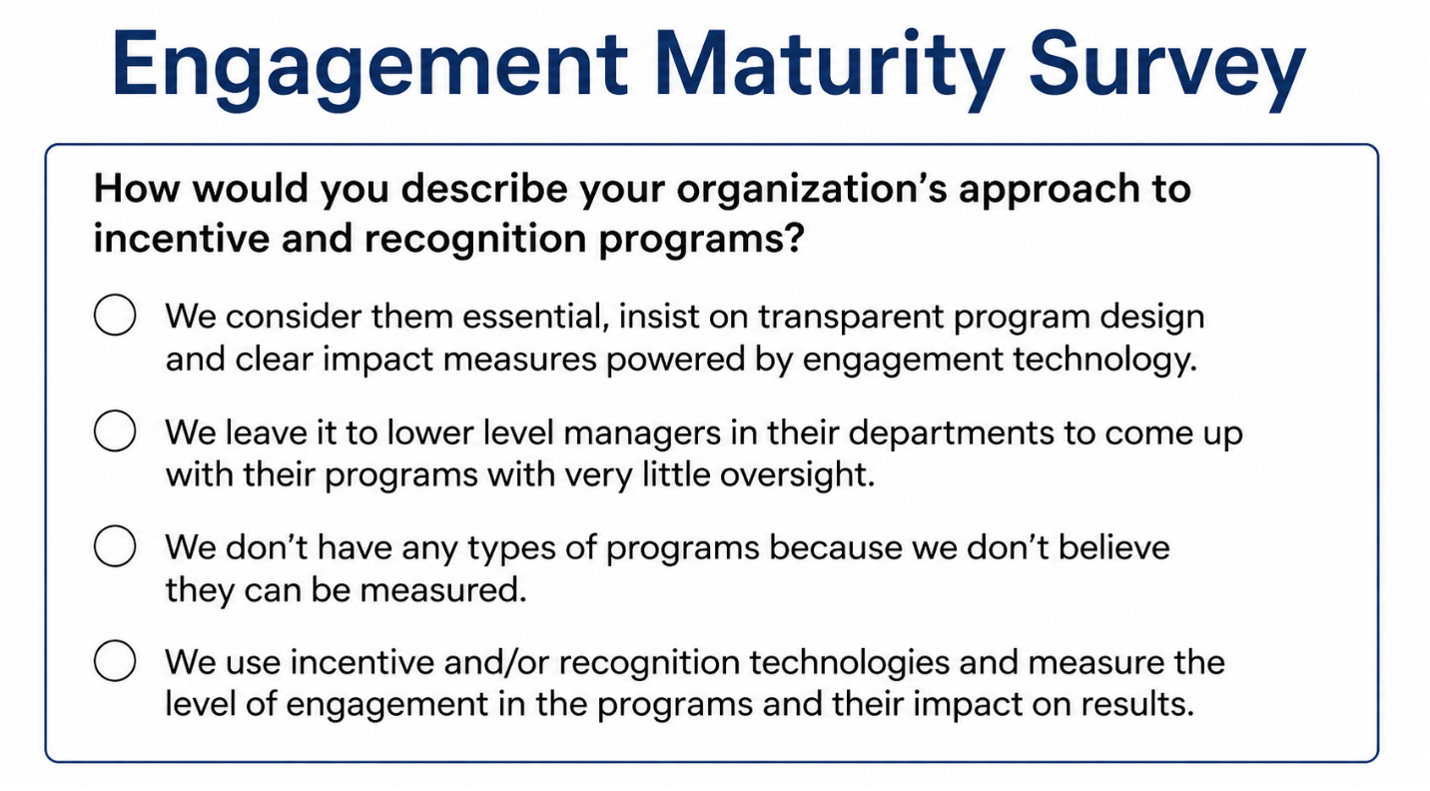 The Enterprise Engagement Alliance has launched a confidential one-question survey to determine how many organizations manage incentives, recognition, loyalty, surveys and other engagement efforts strategically—and how many still treat them primarily as tactical programs. Take the confidential one-question survey here: EEA Engagement Maturity Assessment
Strategic or Tactical?
Establishing a Benchmark
The Hypotheses
Estimated Engagement Maturity Survey Results
For all the money organizations spend on incentives, recognition, loyalty, employee engagement and related initiatives, remarkably little is known about how strategically these investments are actually managed.
The Enterprise Engagement Alliance has launched its first confidential Engagement Maturity Assessment to begin establishing a clearer benchmark. The survey takes less than a minute to complete, and participants are not required to identify themselves. Click here to take the confidential survey.
Strategic or Tactical?
The objective is not simply to determine whether organizations have incentive, recognition, loyalty, surveys or other programs to engage stakeholders. These practices are already widespread. The more important question is whether they are managed as part of a strategic process for creating value through people.
The survey is designed to distinguish between organizations that connect engagement efforts to organizational purpose, goals and objectives in a systematic with clear impact measures and supporting technology, and those that largely leave program design and measurement to individual departments or focus primarily on participation and activity.
It also seeks to better understand the role of engagement technology—not simply whether companies use platforms, but whether the technology supports a systematic approach to program design, management and measurement.
Establishing a Benchmark
The survey is being conducted under the supervision of Gary Rhoads, Professor Emeritus of Marketing and Entrepreneurship at the Marriott School of Business at Brigham Young University and Academic Director of the EEA.
All responses are confidential. Registration information is optional, and participants who choose to provide an email address can elect to receive the findings when the survey is completed. The EEA expects to publish the aggregated results in fall 2026 through Engagement Strategies Media. Take the confidential one-question Engagement Maturity Assessment.
The Hypotheses
Based on common business practices in incentive, recognition, and employee engagement programs, ChatAI expects a survey of 3,000 senior executives across finance, sales, marketing, and human resources to show that most organizations remain relatively decentralized and lightly measured in how they manage these programs. Its working estimate is that about 52% of respondents would say programs are largely left to individual departments or managers with limited oversight, while approximately 23% would characterize their approach as strategic, transparent, and supported by clear impact measures.
Another 18% might report using engagement technology and attempting to measure both engagement and business impact, while only about 7% would say they avoid such programs because they do not believe they can be measured. These are informed estimates rather than research findings, and responses could skew somewhat toward the more sophisticated answers because executives may describe their organizations more favorably than their actual practices warrant.
Estimated Engagement Maturity Survey Results
| Expected Response | Estimated % |
|---|---|
| Programs largely left to departments or lower-level managers with limited oversight | 52% |
| Consider programs essential, with transparent design and clear impact measures | 23% |
| Use engagement technology and measure engagement and impact on results | 18% |
| Do not have programs because they do not believe they can be measured | 7% |
| Total | 100% |
As part of the hypothesis behind this survey, this pattern could represent a significant hidden cost to organizations—not simply through money spent on incentive and recognition programs that may have little measurable impact, but through the larger consequences of fragmented management, inconsistent employee experiences, avoidable turnover, lower productivity, weaker customer engagement, and duplicated technology and administrative expense. In a large organization, the combined value at risk could plausibly reach millions or even tens of millions of dollars annually, depending on workforce size and industry. The key hypothesis is not that these losses can be attributed directly to incentive, recognition, surveys or other engagement programs, but that organizations may be making substantial investments intended to influence behavior and performance without the level of strategic oversight and impact measurement normally expected for other significant business expenditures.
Enterprise Engagement Alliance Services
 Celebrating our 17th year, the Enterprise Engagement Alliance helps organizations enhance performance through:
1. Information and marketing opportunities on stakeholder management and total rewards:
- ESM Weekly on stakeholder management since 2009. Click here to subscribe; click here for media kit.
- RRN Weekly on total rewards since 1996. Click here to subscribe; click here for media kit.
- EEA YouTube channel on enterprise engagement, human capital, and total rewards since 2020
 Management Academy to enhance future equity value for your organization.
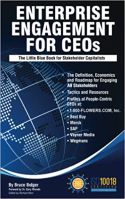
3. Books on implementation: Enterprise Engagement for CEOs and Enterprise Engagement: The Roadmap.
4. Advisory services and research: Strategic guidance, learning and certification on stakeholder management, measurement, metrics, and corporate sustainability reporting.
5. Permission-based targeted business development to identify and build relationships with the people most likely to buy.
Contact: Bruce Bolger at TheICEE.org; 914-591-7600, ext. 230.