

Case Study: How a Small Candy Store Built a Loyal Following Before It Ever Opened
 The launch of The Village Confectionery demonstrates how stakeholder management can help even a small retailer successfully launch a new business. It takes a clear vision; authentic storytelling; the engagement of suppliers and trades people, the community, and employees, and a permission-based media platform that together create extraordinary business momentum with little reliance on traditional paid advertising. It’s a case study in effective stakeholder engagement by a small company. See personal note below.
 By Bruce Bolger
Sharing the Uncertainty of a Major Life Change
It Takes a Destination
Building an Audience Before Building the Store
Tapping the Power of a True Story
The Story Yet Unknow
A Personal Note
Click here to subscribe to the ESM weekly e-newsletter.
Most small businesses develop a product and then try to find an audience. The Village Confectionery in Sleepy Hollow, NY, did the opposite.
Before opening its doors in mid-June, the store had already built an Instagram following of more than 50,000 people and generated extensive media attention. On opening day, a line stretched out the door and around the corner from morning until closing. More than 700 customers visited during the first few days.
In the month following its opening, sales exceeded the initial forecast by more than 100%, requiring the founder to significantly revise inventory and financial projections. Even on its slowest day, the store has reportedly far outpaced the average daily revenue of most candy stores, despite being located in a small town and launching during the summer after schools had closed with no candy-oriented holiday to drive traffic.
Customers have arrived from across the US, Europe and South America—and even from as far away as New Zealand. More importantly, the store has already developed a steady stream of repeat customers from Sleepy Hollow, neighboring Tarrytown and from throughout Westchester County. Visitors from New York City and New Jersey include the store as part of their weekend outings to this picturesque and historic area.
The Village Confectionery illustrates the value of articulating and creating a vision ready for its time; identifying and building relationships with the people most likely to buy; developing a network of engaged suppliers, tradespeople, and advisors; working with other members of the business community to promote the destination, and identifying employees (sooner than expected) who could live the store's focus on making each visit a special indulgence.
Without any demonstrated awareness or use of the term stakeholder management, the founder demonstrates how a small business can create value by aligning the interests of its investors, customers, employees, supply-chain partners and community around a common purpose, set of goals and experience.
Sharing the Uncertainty of a Major Life Change
After years of working in film production, the founder—then in her mid-30s and raising two young children—envisioned creating a candy store inspired by childhood summers spent visiting a beloved shop in Wellfleet, MA. Although that store had closed long ago, she saw an opportunity to recreate some of its magic for today’s generation. She believed people were ready for a return to the nostalgic experience of a village candy shop, combining familiar penny candies with carefully selected chocolates, other delicacies, seasonal gifts, games and small treasures.
With limited seed capital from her savings and angel investors, a Small Business Administration-backed loan from a local bank, and guidance from friends and local businesspeople, she selected Sleepy Hollow as the location. The village is internationally associated with Washington Irving and “The Legend of Sleepy Hollow,” but its downtown has long been overshadowed by neighboring Tarrytown. For decades, North Tarrytown—as Sleepy Hollow was long named—was closely associated with a major General Motors plant that employed thousands of its residents.
Tarrytown, immediately to the south, became home to many GM managers and more affluent New York City commuters. Its downtown also benefited from its proximity to the Tarrytown train station, helping it develop a more upscale and visible commercial district. The downtown of today's Sleepy Hollowed was for the factory workers. The success of The Village Confectionery is therefore linked in part to the continuing emergence of Sleepy Hollow's commercial district on Beekman Avenue as a destination in its own right—one that can complement rather than compete with the already successful Tarrytown Main Street but a mile or so away.
It Takes a Destination
Visitors traveling north on Route 9 from Tarrytown can easily miss downtown Sleepy Hollow on their way to the area’s major attractions. Few communities of comparable size offer such a concentration of historic, cultural and natural destinations. They include the 17th-century Old Dutch Church and its colonial burial ground where Washington Irving is buried; the area where the Headless Horseman was imagined to ride; the 17th century Philipsburg Manor gristmill; Kykuit, the hilltop estate of John D. Rockefeller; the Union Church of Pocantico Hills, with stained-glass windows by Marc Chagall and Henri Matisse; the Stone Barns restaurant and organic farm; and Rockefeller State Park, with miles of bridle trails crossing 2,200 acres of forests and pastures with magnificent Hudson River views and a virtual museum of trees and old stone bridges.
Following the closure of the GM plant and the loss of thousands of jobs, North Tarrytown faced the need to redefine itself. In 1996, residents changed the village’s name to Sleepy Hollow, strengthening its connection to its historic and literary identity. At the time, residents could not have known that the former factory property would gradually become a large and still-growing development of upscale apartments and condominiums with thousands of new residents. A riverwalk on the Hudson River offers impressive views of the Governor Mario M. Cuomo Bridge—formerly the Tappan Zee Bridge—the broad river and surrounding hills, and leads to a historic lighthouse. It will be even more beautiful when the development is completed in the coming years.
Sleepy Hollow itself has early entrepreneurial roots. The community was once known as Beekman Town, shaped in the early 19th century by Cornelia Van Cortlandt Beekman, who laid out streets and sold building lots from her family’s property. Cornelia Beekman was the daughter of Revolutionary-era patriot Pierre Van Cortlandt, New York’s first lieutenant governor. He purchased the land from the state when the property was abandoned by the loyalist Philipse family after they escaped to England after the war. Her work in developing Beekman Town took place as the young American republic was beginning to grow and industrialize, making her an especially relevant predecessor to today's new generation women entrepreneurs creating businesses in the village.
Building an Audience Before Building the Store 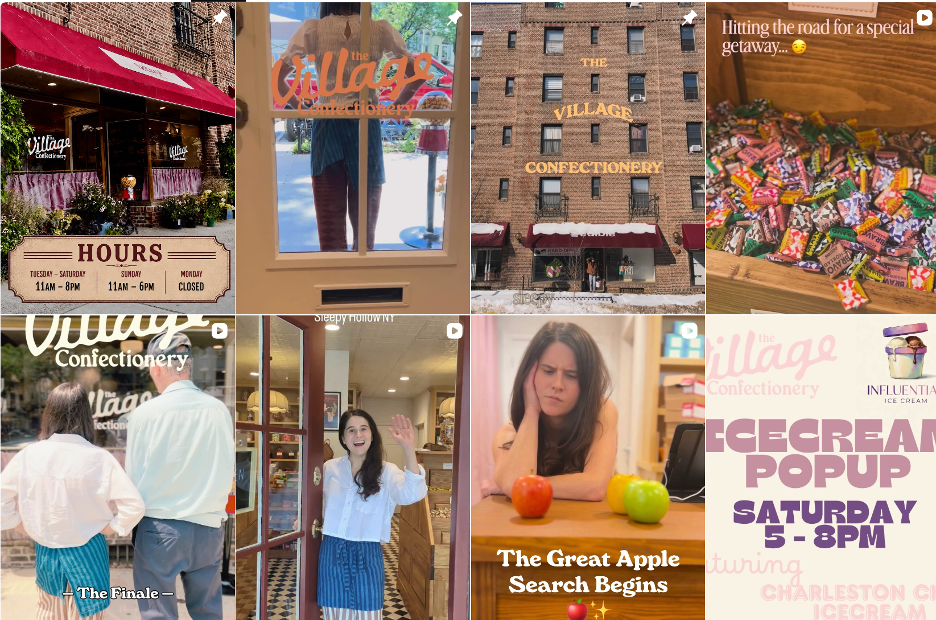
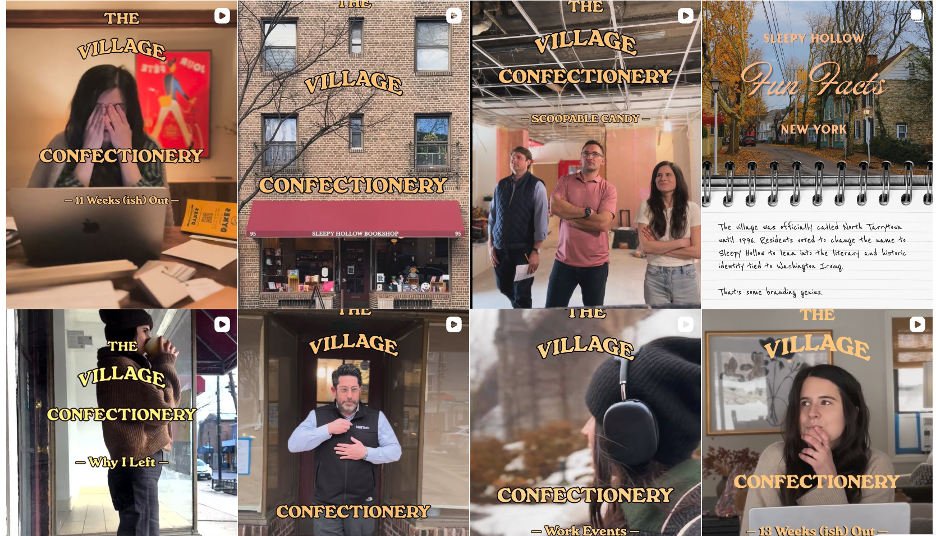
What happened next surprised even the founder and her supporters. Drawing upon her film-production experience, she began documenting her journey on Instagram almost from the moment the idea was conceived—long before construction began on the new interior.
Rather than presenting a polished entrepreneurial success story, she shared the reality of starting a business from scratch: excitement, uncertainty, fears, setbacks, competing personalities, victories, tears, laughter and joy. Because she understood that her success would be connected to the success of downtown Sleepy Hollow, she also featured the stories of local merchants who had persevered in a historic community long overlooked by many area visitors. Her followers watched not only a candy store take shape but also a village commercial district begin to claim greater recognition.
Many followers, particularly women, appeared to identify with the founder’s journey. The story was never simply about candy. It was about pursuing a dream, taking a risk and trying to create something meaningful. The store promised a return to the childhood experience of wandering through a world of affordable, uncomplicated pleasures—candies, chocolates, small gifts, games and unexpected discoveries that people of all ages could enjoy.
Followers became emotionally invested in the outcome. Many wanted to meet the person behind the story and see the store they had watched develop. Even when the shop became crowded, the founder made an effort to personally greet visitors who asked for her and answer their questions. Some customers drove considerable distances to experience in person what they had been following online when the store opened on June 13.
On opening day, the line remained outside for nearly the entire day. The owner asked friends and family members to distribute bottles of water and candy to people waiting in line. No one left. The turnout had been so greatly underestimated that the store opened with only one point-of-sale system. Customers remained patient. The store was filled again the following day, and it has rarely experienced an empty period since. Frequent requests for gift certificates signals strong referral activity and engagement.
Tapping the Power of a True Story
Although the founder was at the center of the narrative, she consistently highlighted the people making the vision possible: the banker, tradespeople, craftspeople, candy makers, local neighboring merchants, employees, media supporters and community leaders, including the mayor. A nearby pottery studio, flower shop, pizzeria, ale house and other local businesses became part of the story. In effect, she was documenting the development of a community as much as the opening of a store.
The social media campaign attracted the attention of local journalists and influencers, who began covering the launch. A media professional working with the nascent business observed that the founder was succeeding because she was continually creating news rather than simply seeking publicity. The visibility also attracted interest from major brands, including requests for her to produce authentic social media content that could help promote their products.
Several principles associated with successful stakeholder engagement help explain the results to date:
• A clearly defined customer persona and value proposition: a carefully curated return to the simple pleasure of a village confectionary where simple joy is the principal product—accompanied by a sensitivity to customer needs by offering vegan and gluten-free options, for example.
• Meaningful engagement with suppliers, tradespeople, neighbors, prospective customers and other stakeholders long before opening day.
• Authentic storytelling that allowed followers to experience both the founder’s excitement and uncertainty rather than merely seeing polished promotional content.
• Mutual value creation for local businesses and community partners by drawing attention to one of America’s most storied villages, all within a short train ride from Manhattan.
• Consistent communication through an owned social media audience rather than dependence on paid advertising.
• Meticulous execution of the vision, from the selection of candy and gifts to their presentation, making the store an experience rather than simply a place to purchase sweets. Customers browse. Children don't have to reach up to find their delights at eye level.
• A hands-on owner supported by three part-time employees with distinctly different backgrounds: one retired from a successful career and working solely for the enjoyment of it; one an aspiring professional interested in the candy industry; and one a local student who enjoys candy and making people happy.
• A growing combination of local regulars and far-flung visitors, many of whom are already asking about the planned online store for personal shopping and gifting, not to mention regular requests for gift certificates.
The result is a business with its own permission-based communications platform. Instead of continually paying to reach prospective customers or handing out flyers or frantically posting on social media, the store can use its established audience to announce new products, promote special events, support local festivals and organizations, and eventually develop its online gifting business.
The Story Yet Unknow
It remains too early to predict the store’s long-term future, but the initial results are promising. Opening-weekend sales far exceeded the forecast, and the momentum continued into ordinary work and school weeks during the dead of summer. The anticipated summer slowdown has not yet materialized, and Sleepy Hollow’s most important visitor season—Halloween—is still ahead.
The founder is already developing the online business and exploring other ways to scale the brand without diminishing the experience that made the original location successful.
The broader lesson extends well beyond candy retailing. The Village Confectionery demonstrates that, in an era of advertising overload, people still respond to authenticity, purpose and community. Whether viewed through the lens of entrepreneurship, stakeholder engagement or permission marketing, the case suggests that people are more likely to support a business when they feel they have become part of its story.
Its early success reflects the contributions of every stakeholder: the banker and angel investors who watched the opening-day lines with delight; the tradespeople who collaboratively created the retro décor, shelving and displays; the suppliers who helped fill the store with delightful candies; the advisers and neighboring businesses that offered guidance and support; the employees whose roles became essential when demand exceeded expectations; and the customers who followed the journey before the doors opened and continue to follow it today.
Most of all, this case study that stakeholder management is simply a better way to build a business because it focuses on the people who create the value.
A Personal Note
Kate Bolger, the founder, is one of my three children. I am sharing this story solely because I personally witnessed a case study of stakeholder management applied by a small business for which I can take almost no credit. The Enterprise Engagement Alliance and its marketing agency had no involvement in the launch and we have had too many other things to talk about over the years than stakeholder capitalism. I did not consult Kate for her business beyond the usual fatherly advice, nor advise her of publication of this article, and everything described here is based on what I personally observed. The concept, execution, storytelling and results are of all of her own making.
I avoid mixing family and business on social media, and it is not my practice to single out one of our three children when all three are equally successful in their own journeys. I have made an exception because this is such a rare and compelling example of a small-business launch based on the principles of stakeholder management.
Enterprise Engagement Alliance Services
 Celebrating our 17th year, the Enterprise Engagement Alliance helps organizations enhance performance through:
1. Information and marketing opportunities on stakeholder management and total rewards:
- ESM Weekly on stakeholder management since 2009. Click here to subscribe; click here for media kit.
- RRN Weekly on total rewards since 1996. Click here to subscribe; click here for media kit.
- EEA YouTube channel on enterprise engagement, human capital, and total rewards since 2020
 Management Academy to enhance future equity value for your organization.
3. Books on implementation: Enterprise Engagement for CEOs and Enterprise Engagement: The Roadmap.
4. Advisory services and research: Strategic guidance, learning and certification on stakeholder management, measurement, metrics, and corporate sustainability reporting.
5. Permission-based targeted business development to identify and build relationships with the people most likely to buy.
Contact: Bruce Bolger at TheICEE.org; 914-591-7600, ext. 230.