

Employees Cannot Execute a Strategy They Cannot See: 70% Lack Access to Key Performance Data
 A national employee study from The 80/20 Institute finds that strategy execution often breaks down because employees cannot see the metrics defining success or connect their work to the organization’s priorities.
The Management Takeaway: Give Employees a Clear Line of Sight
Strategy Often Breaks Down Between the Boardroom and the Front Line
About the Author and The 80/20 Institute
Key Insights for Management
Click here to subscribe to the ESM weekly e-newsletter.
A nationwide survey of 1,000 US employees delivers a straightforward warning to management: 70% say they cannot access data tied to their organization’s strategic goals, 57% lack access to information relevant to their own role or department, and only 26% describe their organization as highly data-driven. The findings suggest that many companies do not have only a strategy or engagement problem: They have a visibility problem that leaves employees without the information needed to make better decisions, identify problems, improve processes, or understand how their work contributes to business results.
The white paper findings are based on a national survey of 1,000 US employees commissioned by The 80/20 Institute.
The 80/20 Institute, Lakewood Ranch, FL helps companies identify where they create the most value, eliminate unnecessary complexity, and focus people and resources on the customers, products, and activities that drive profitable growth.
The Management Takeaway: Give Employees a Clear Line of Sight
The most important implication of the study is not that every employee needs access to every piece of company data. It is that every employee should understand the small number of financial, operational, customer, quality, and people measures that define success for the organization and for their role. Management should identify the “vital few” measures that employees can influence, explain why they matter, provide timely access to the results, and create a regular process for discussing what is improving, what is falling behind, and what employees can do about it. Without that connection, goals issued by senior management remain abstract instructions rather than an operating system employees can use.
The report’s findings point to several immediate priorities:
Select the metrics that truly matter. More dashboards and reports do not necessarily produce greater clarity. Leadership must determine which measures most directly reflect value creation, customer satisfaction, quality, productivity, retention, safety, innovation, and profitability.
Make the information relevant to each role. Corporate goals need to be translated into department, team, and job-level measures. Employees should be able to see how their daily decisions affect the broader organization.
Explain the numbers. Access without understanding is insufficient. Managers need to help employees interpret results, understand tradeoffs, identify root causes, and distinguish between measures they can control and those they cannot.
Use metrics to encourage participation—not merely accountability. Employees closest to customers, production, service delivery, and administrative processes often see problems before senior management does. Performance information should be used to invite their ideas and support continuous improvement, rather than simply to evaluate them after results have already declined.
Connect recognition to meaningful contribution. Recognition becomes more credible when employees understand what the organization is trying to accomplish and how their actions helped improve a customer, quality, financial, operational, or people outcomes. This closely reflects the principles of total quality management: people closest to the work require timely feedback, clear process measures, and the opportunity to participate in identifying and correcting problems. The 80/20 Institute itself traces part of its approach to quality pioneer Joseph Juran and his focus on the “vital few” causes responsible for a disproportionate share of quality problems.
Strategy Often Breaks Down Between the Boardroom and the Front Line
.png) The white paper, What 1,000 U.S. Workers Reveal About Why Strategy Breaks Down and How Leaders Fix It, argues that organizational alignment depends on shared visibility into performance. When employees cannot see the numbers, do not understand the mission, or remain unclear about priorities, focus disappears and execution stalls.
The white paper, What 1,000 U.S. Workers Reveal About Why Strategy Breaks Down and How Leaders Fix It, argues that organizational alignment depends on shared visibility into performance. When employees cannot see the numbers, do not understand the mission, or remain unclear about priorities, focus disappears and execution stalls.As report author Bill Canady puts it, “You can’t align people around value they can’t see.” Many organizations communicate strategies through annual meetings, presentations, mission statements, or leadership messages. Far fewer convert those strategies into a manageable set of measures that employees regularly see, understand, discuss, and use. A strategy therefore should not end with communicating what management wants to achieve. It should include a measurement and feedback system showing employees whether the organization is progressing, where performance is falling short, and how they can contribute to improvement.
About the Author and The 80/20 Institute
Bill Canady is founder and CEO of The 80/20 Institute and the author of The 80/20 CEO, From Panic to Profit, and The Rule of Three. The Institute says he has led more than 20 implementations of its methodology and developed its Profitable Growth Operating System, or PGOS. The 80/20 Institute works primarily with CEOs, owners, and operators of middle-market manufacturing, distribution, and service companies. Its programs are designed to help organizations identify where value and profit are being created, reduce unnecessary complexity, and concentrate resources on the customers, products, processes, and activities producing the greatest return.
Its PGOS methodology has four phases: Segment, to identify where value is created; Simplify, to reduce low-value complexity; Zero-Up, to reallocate time, talent, and capital; and Grow, to expand in areas where the company has demonstrated the ability to do so profitably.
Key Insights for Management
The study reinforces a basic but frequently overlooked principle of engagement: employees cannot be expected to improve results they cannot see, understand, or influence. Organizations should ask a few direct questions. Do employees know the company’s most important goals? Can they see current performance against those goals? Do they understand which measures their team influences? Are managers prepared to discuss the numbers openly? And do employees have a channel for recommending improvements based on what the data reveals?
The objective is not to turn every employee into a financial analyst. It is to give people a clear, credible scorecard showing what success means and how their work contributes to it.
Companies that communicate goals without sharing relevant measures are asking employees to play without seeing the score. The 80/20 Institute research suggests that this remains the reality for a substantial portion of the US workforce—and a potentially significant obstacle to quality, productivity, engagement, and profitable growth.
Enterprise Engagement Alliance Services
 Celebrating our 17th year, the Enterprise Engagement Alliance helps organizations enhance performance through:
1. Information and marketing opportunities on stakeholder management and total rewards:
- ESM Weekly on stakeholder management since 2009. Click here to subscribe; click here for media kit.
- RRN Weekly on total rewards since 1996. Click here to subscribe; click here for media kit.
- EEA YouTube channel on enterprise engagement, human capital, and total rewards since 2020
 Management Academy to enhance future equity value for your organization.
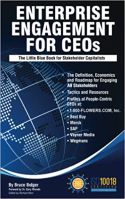
3. Books on implementation: Enterprise Engagement for CEOs and Enterprise Engagement: The Roadmap.
4. Advisory services and research: Strategic guidance, learning and certification on stakeholder management, measurement, metrics, and corporate sustainability reporting.
5. Permission-based targeted business development to identify and build relationships with the people most likely to buy.
Contact: Bruce Bolger at TheICEE.org; 914-591-7600, ext. 230.