

Gallup’s 2026 Global Workplace Findings: A Warning Signal for Leaders Everywhere
The Engagement Issue Beneath the Well-Being Data
Managers Matter, But They Need Support
Hybrid Work May Be a Clue, Not a Cure
Lessons for International Leaders
Management Recommendation: It Takes a System
Click here to subscribe to the ESM weekly e-newsletter.
Gallup’s 2026 State of the Global Workplace life-evaluation findings should give business and public-sector leaders pause. Only 34% of workers globally describe themselves as “thriving,” while 56% are “struggling” and 9% are “suffering.” The data also shows that managers are more likely to be thriving than individual contributors, and that workers in hybrid or remote-capable on-site roles report materially higher thriving levels than those in fully remote or non-remote-capable on-site roles. For leaders seeking to build high-performing organizations, the message is that engagement cannot be separated from employees’ broader experience of life, work, autonomy, opportunity, and support.
The Engagement Issue Beneath the Well-Being Data
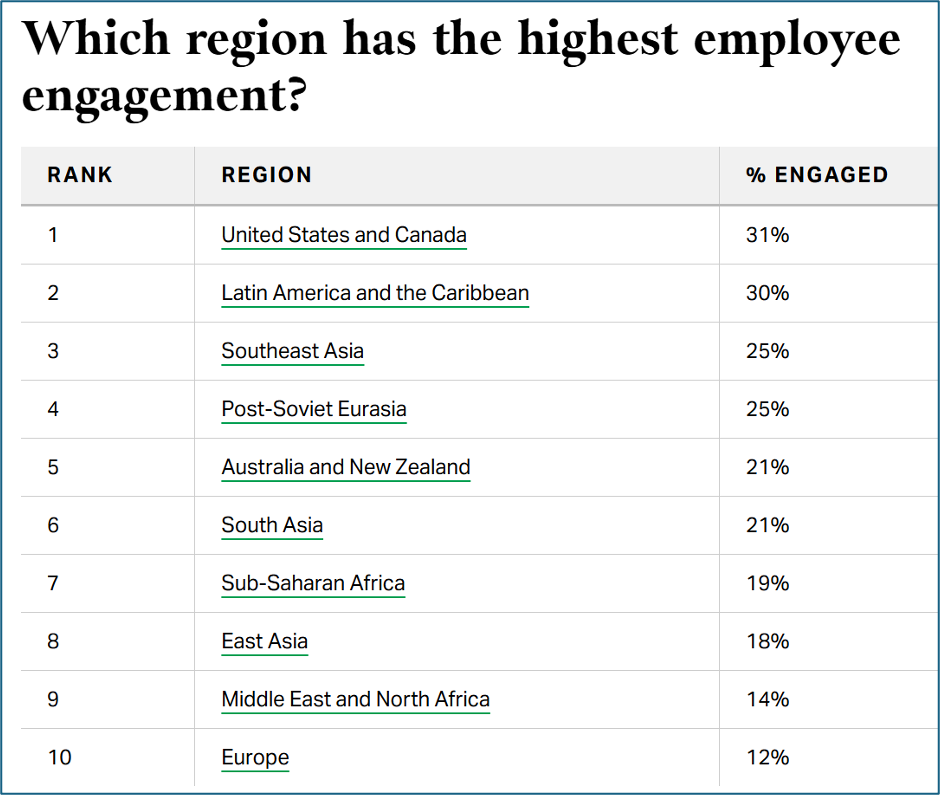
Gallup’s life-evaluation question asks respondents to imagine a ladder from zero to 10, with the top representing the best possible life and the bottom the worst, both now and five years from now. That framing goes beyond job satisfaction. It asks whether people believe their lives are working and whether they see a better future ahead.
For management, this is a crucial distinction. A person can have a job and still feel stuck. An employee can receive a paycheck and still feel disconnected from the organization’s purpose, ignored by supervisors, uncertain about development, or unconvinced that extra effort will lead to a better future. When only about one-third of workers globally are thriving, the issue is not merely morale; it is a warning about the human foundation on which productivity, innovation, customer service, safety, quality, and retention depend.
The regional differences are equally instructive. Latin America and the Caribbean lead the global ranking at 56% thriving, followed closely by Australia and New Zealand at 55%, the United States and Canada at 51%, and Europe at 49%. At the other end, South Asia reports only 16% thriving and Sub-Saharan Africa, 18%. These gaps suggest that workplace engagement strategies cannot be exported mechanically from one region to another. Leaders must understand local expectations, economic realities, family structures, cultural norms, and the degree of trust people have in institutions.
Managers Matter, But They Need Support
One of the most important management implications is the gap between managers and individual contributors. Gallup reports that 40% of managers are thriving compared with 32% of individual contributors. This does not mean managers are flourishing at a level that should satisfy organizations. It means that those closest to customers, operations, production, and service delivery may be experiencing the workplace with less optimism and well-being than the people supervising them.
For executives, that is a serious engagement risk. Individual contributors are often the people who determine whether customers feel cared for, whether quality standards are met, whether safety procedures are followed, and whether innovation becomes part of daily practice. If they are struggling, the organization’s strategy is already under pressure.
The lesson is not simply to train managers to be nicer. It is to design management systems that help supervisors create purpose, clarity, recognition, growth, trust, and alignment. Managers cannot be expected to improve engagement if they are overloaded, poorly trained, measured only on short-term output, or given no tools to connect individual work to enterprise purpose and customer value.
Hybrid Work May Be a Clue, Not a Cure
The work-location data is also revealing. Gallup finds that hybrid workers and on-site remote-capable workers each report 45% thriving, compared with 33% for exclusively remote workers and 32% for on-site non-remote-capable workers. This does not prove that hybrid work automatically produces well-being. It does suggest that flexibility, autonomy, connection, and the nature of the job all matter.
The lower thriving level among exclusively remote workers may reflect isolation, weaker connection to teams, or challenges in separating work from life. The lower number for on-site non-remote-capable workers may reflect less control, more physically demanding jobs, lower flexibility, or fewer perceived options. The strongest lesson for management is that workplace design should not be reduced to a remote-versus-office debate. The real issue is whether people have the conditions to do their best work, maintain meaningful relationships, grow their capabilities, and believe their employer understands the realities of their lives.
Lessons for International Leaders
For international business and government leaders, Gallup’s findings point to a larger conclusion: human well-being is becoming a competitiveness issue. Countries and companies that create environments in which people believe they can build better lives are likely to have an advantage in attracting talent, encouraging entrepreneurship, improving service quality, and sustaining trust in enterprise.
The regional gaps also raise important questions for multinational employers. A global engagement strategy must be principled but locally informed. The core principles may be universal: people want dignity, fairness, opportunity, voice, competent management, and a sense that their work matters. The way these principles are expressed will vary sharply across regions.
In lower-thriving regions, leaders may need to focus first on basic trust, safety, income security, manager capability, and credible career pathways. In higher-thriving regions, the challenge may be sustaining purpose, flexibility, innovation, and belonging in more complex and diverse workforces. In every region, the danger is treating engagement as a survey score rather than as an operating system for how the organization creates value through people.
Management Recommendation: It Takes a System
The most practical conclusion from Gallup’s 2026 life-evaluation data is that engagement must be managed as a strategic discipline, not a communications campaign. Leaders should ask whether employees understand the organization’s purpose, see how their work contributes to customers and communities, trust their managers, feel recognized for meaningful contributions, and believe they have a future with the organization.
The data also reinforces a core principle of enterprise engagement: employees, customers, business partners, communities, and investors are not separate constituencies to be managed in isolation. Their interests are connected. Employees who are struggling are less likely to deliver exceptional customer experiences. Customers who receive poor service weaken growth. Weak growth reduces opportunities for employees and returns for investors. The cycle can work in either direction.
Gallup’s numbers do not provide a simple formula. They do provide a clear signal. In a world in which only 34% of workers globally are thriving, the organizations and nations that take engagement seriously will have an opportunity to build more resilient, productive, and trusted institutions. Those that continue to treat well-being and engagement as soft issues may discover that they are among the hardest issues to fix once trust, energy, and hope have been lost.
Enterprise Engagement Alliance Services
 Celebrating our 17th year, the Enterprise Engagement Alliance helps organizations enhance performance through:
1. Information and marketing opportunities on stakeholder management and total rewards:
- ESM Weekly on stakeholder management since 2009. Click here to subscribe; click here for media kit.
- RRN Weekly on total rewards since 1996. Click here to subscribe; click here for media kit.
- EEA YouTube channel on enterprise engagement, human capital, and total rewards since 2020
 Management Academy to enhance future equity value for your organization.
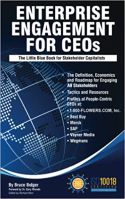
3. Books on implementation: Enterprise Engagement for CEOs and Enterprise Engagement: The Roadmap.
4. Advisory services and research: Strategic guidance, learning and certification on stakeholder management, measurement, metrics, and corporate sustainability reporting.
5. Permission-based targeted business development to identify and build relationships with the people most likely to buy.
Contact: Bruce Bolger at TheICEE.org; 914-591-7600, ext. 230.