

47-Industry Review Finds EEI Leaders Lead Stock Performance in Nearly Six of 10 Cases
Results at a Glance
Where All the Measures Line Up
The Outliers May Be Just as Valuable
Employee Ratings Show a More Nuanced Relationship
Customer Satisfaction Shows Promise but Remains Harder to Measure
What Management, Investors, and Journalists Can Learn
A Promising Finding—But More Testing Is Needed
Click here to subscribe to the ESM weekly e-newsletter.
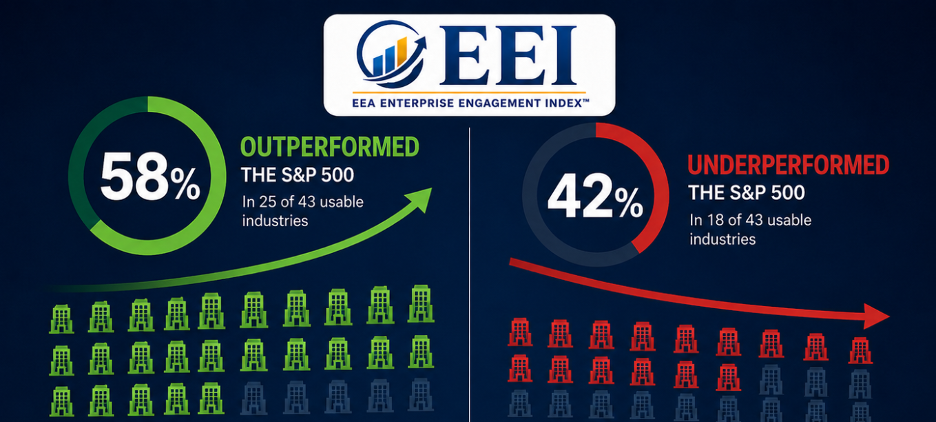
The expansion of the Enterprise Engagement Index from 11 to 47 industry studies strengthens the preliminary case that the financial effects of effective people and customer management may be measurable using publicly available information. The highest EEI scorer produces the strongest three-year stock performance in 25 of 43 usable industry comparisons, or 58%. Among industries with comparable Glassdoor data, the EEI leader has the highest employee rating in 15 of 34 cases, and shares the highest rating in four more, producing total alignment in 19 of 34 industries, or 56%.
Where reasonably comparable customer satisfaction information was available, the EEI leader ranks first in eight of 14 industries, or 57%. These findings do not prove causation or establish the EEI as a stock-prediction model. They do, however, suggest that an index based on employee productivity, profitability, Human Capital ROI, revenue to profit ration, and revenue growth may be capturing elements of organizational effectiveness that frequently appear in shareholder, employee, and customer outcomes as well.
Results at a Glance
| Comparison | Exact EEI Leader Match | Additional Ties | Usable Industries | Overall Alignment |
|---|---|---|---|---|
| Strongest three-year stock performance | 25 | — | 43 | 58% |
| Highest Glassdoor rating | 15 | 4 | 34 | 44% exact; 56% including ties |
| Highest comparable customer rating | 8 | — | 14 | 57% |
The EEI intentionally does not include stock performance, Glassdoor ratings, or customer satisfaction scores in its calculation. It is based on revenue per employee, profit per employee, Human Capital ROI, net income as a percentage of revenue, and three-year revenue growth. The analysis is not simply comparing financial outcomes with other financial outcomes already embedded in the score. It is testing whether companies that appear more effective at converting people and customer investments into economic value also produce stronger results in independent stakeholder and market measures.
 Where All the Measures Line Up
Several industries show particularly strong alignment. Costco, Arista Networks, CSX, and Netflix each lead their respective peer groups in EEI score, three-year stock performance, Glassdoor ratings and available customer satisfaction measures. Other EEI leaders that also produce the strongest shareholder performance include ASML, PulteGroup, Royal Caribbean, Steel Dynamics, JPMorgan Chase, Merck, Procter & Gamble, Argenx, Publicis Groupe, IBM, SharkNinja, IHG Hotels & Resorts, Chubb, Caterpillar, Schaeffler, and SK Hynix.
The pattern is economically plausible. The factors measured by the EEI—productivity, profitability, efficiency of people investment, and market-validated growth—are also characteristics investors frequently reward. The fact that three-year revenue growth represents 30% of the EEI score may contribute to the relationship, although stock performance remains entirely outside the calculation.
The Outliers May Be Just as Valuable
The lack of alignment in roughly four out of 10 stock comparisons does not necessarily undermine the EEI. Instead, the exceptions may raise some of the most useful questions. Microsoft slightly outscores Alphabet on the EEI, while Alphabet produced much stronger stock performance. Stryker leads the medical-device EEI analysis, but Boston Scientific generates stronger shareholder returns. NextEra Energy leads the utilities group by a wide margin but trails Iberdrola and Enel in stock performance. Prologis achieves the highest REIT EEI score, while Welltower produces the strongest market gains.
Such differences may reflect factors the EEI is not designed to measure, including starting valuation, interest rates, industry cycles, acquisitions, divestitures, restructuring, debt reduction, capital allocation, regulatory developments, and investor expectations about future markets. This reinforces the intended role of the EEI as a diagnostic and benchmarking tool rather than a stand-alone stock-selection model. A high EEI score accompanied by weak stock performance could identify an undervalued company—or risks not captured by the index. An IPO with a strong EEI score compared with peers may signal a better chance of long-term success. Strong stock performance accompanied by a weaker EEI score may indicate that investors are anticipating a turnaround, acquisition benefits, new technology, or future growth that has not yet appeared in operating results.
Employee Ratings Show a More Nuanced Relationship
The EEI leader holds the highest Glassdoor rating outright in 15 of 34 usable comparisons. When four industries with ties are included, the EEI leader ranks first or shares first place in 56% of the comparisons. The relationship is meaningful but far from universal. Glassdoor measures employee perceptions, while the EEI measures organizational outputs. Employee sentiment may affect productivity and performance over time, but survey ratings also can be influenced by leadership changes, layoffs, restructuring, local working conditions, the mix of employees submitting reviews, and differences in business models.
The exceptions raise useful questions. Why do some companies produce high productivity and profitability despite relatively weak employee ratings? Are strong financial results sustainable if employee sentiment remains low? Conversely, why do some highly rated employers fail to convert positive employee experiences into stronger growth or profitability? The EEI does not answer these questions. It helps identify where management, investors, and journalists may wish to look more closely.
Customer Satisfaction Shows Promise but Remains Harder to Measure
The top EEI company also leads available customer satisfaction measures in eight of 14 industries with sufficiently comparable information. The limited sample is an important finding. Customer data remain much less standardized than financial information. The studies use a mixture of ACSI, J.D. Power, Trustpilot, Google ratings, enterprise technology reviews, industry surveys, and other public proxies. Many business-to-business companies have no broadly comparable customer measure at all.
Despite these limitations, the 57% alignment rate supports continued study. In industries including big-box retail, auto insurance, consumer eyewear, travel platforms, medical devices, networking technology, railroads, and streaming media, the EEI leader also holds the strongest available customer rating.
What Management, Investors, and Journalists Can Learn
For management, the greatest value may come from investigating mismatches. A company with a high Glassdoor score but weak EEI performance may have a positive culture that is not being effectively translated into productivity, customer value, or growth. A company with a high EEI score but weaker employee ratings may need to determine whether strong financial outcomes are sustainable.
For investors, the EEI provides an additional lens for evaluating the operating quality behind market performance. It may help distinguish companies whose stock gains are supported by measurable productivity, profitability, and growth from those driven primarily by expectations, restructuring, acquisitions, or market momentum.
For journalists and analysts, the index provides a framework for asking questions that traditional financial reporting may overlook: How effectively does a company convert its investment in people into value? Are strong customer and employee ratings reflected in economic results? If not, why not?
A Promising Finding—But More Testing Is Needed
This review is a preliminary rank-alignment analysis, not a formal statistical validation. The underlying industry studies were conducted at different times and in some cases use estimates, proxies, differing stock-return periods, or varying customer-rating sources. The analysis therefore compares the relative ranking of companies within each industry rather than pooling absolute performance figures across all industries.
Two industries were excluded from the stock comparison because the highest EEI scorer is privately held but in preparation for an IPO, and one was excluded because stock-return measures were not presented on a consistent basis.
For now, the findings support a clear preliminary conclusion: companies that more effectively convert people and customer investments into productivity, profitability, and growth frequently—but not always—produce stronger outcomes for shareholders, employees, and customers. That may make the exceptions as valuable as the correlations.
Enterprise Engagement Alliance Services
 Celebrating our 17th year, the Enterprise Engagement Alliance helps organizations enhance performance through:
1. Information and marketing opportunities on stakeholder management and total rewards:
- ESM Weekly on stakeholder management since 2009. Click here to subscribe; click here for media kit.
- RRN Weekly on total rewards since 1996. Click here to subscribe; click here for media kit.
- EEA YouTube channel on enterprise engagement, human capital, and total rewards since 2020
 Management Academy to enhance future equity value for your organization.
3. Books on implementation: Enterprise Engagement for CEOs and Enterprise Engagement: The Roadmap.
4. Advisory services and research: Strategic guidance, learning and certification on stakeholder management, measurement, metrics, and corporate sustainability reporting.
5. Permission-based targeted business development to identify and build relationships with the people most likely to buy.
Contact: Bruce Bolger at TheICEE.org; 914-591-7600, ext. 230.