

EEI Analysis: The Hidden Value Creation Opportunity for Engagement and Total Rewards Professionals
 The latest Enterprise Engagement Alliance analysis of the financials of 89 publicly held companies research using the Enterprise Engagement Index suggests that engagement, recognition, incentives, loyalty, and workplace culture professionals may have far greater influence on enterprise value than most organizations realize.
A Clearer Way to Link Engagement Investments to Tangible Financial Results
What the EEI Findings Suggest About Employee Engagement
What the EEI Findings Suggest About Customer Loyalty
What This Means for Engagement and Total Rewards Professionals
Click here to subscribe to the ESM weekly e-newsletter.
For decades, engagement and total rewards professionals have struggled with a common challenge: proving their impact in financial terms. While organizations invest billions of dollars annually in employee experience, recognition, incentives, loyalty, communications, and culture initiatives, many executives still view these efforts as important but difficult to connect directly to business results.
The findings from the Enterprise Engagement Alliance's new Enterprise Engagement Index (EEI) suggest that this perception may significantly underestimate the value creation opportunity available to both internal practitioners and solution providers. The EEI is believed to be the first free, publicly available methodology designed to evaluate how effectively organizations convert investments in people and customers into business results using readily available public data.
Rather than relying on surveys, the index measures factors linked to organizational productivity and value creation, including revenue per employee, profit per employee, human capital return on investment (HCROI), ability to convert revenues into profitability, and revenue growth.
A Clearer Way to Link Engagement Investments to Tangible Financial Results
The EEI findings do not suggest that engagement or loyalty programs automatically create value. Rather, they suggest that organizations generating superior financial results may be doing a better job aligning the interests of employees, customers, managers, distribution partners, and shareholders. If that proves true over time, the opportunity for engagement and loyalty professionals is not simply to run better programs—it is to help organizations build systems that improve how people create value for customers and how customers create value for shareholders.
The logic behind the EEI is that employees can create more value when they effectively serve customers, and customers create value only when they remain loyal and profitable. Organizations that consistently align the interests of employees, customers, managers, distribution partners, and shareholders should, over time, produce superior productivity, growth, and financial performance.
The EEI attempts to measure the outcomes of that alignment rather than the programs themselves by applying a transparent formula to the analysis of easily available information from public companies or, for private companies, quickly accessible from their financial statements. Click here for the methodology and the analysis of 89 companies in 32 industries and growing.
Early analyses across dozens of companies in multiple industries find meaningful relationships between EEI scores and profitability, customer satisfaction, employee ratings, and stock market performance. While the research remains ongoing, the findings suggest that engagement-related practices may have a far more direct connection to enterprise value than traditionally recognized.
The EEI findings do not suggest that engagement or loyalty programs automatically create value. Rather, they suggest that organizations generating superior financial results may be doing a better job aligning the interests of employees, customers, managers, distribution partners, and shareholders. If that proves true over time, the opportunity for engagement and loyalty professionals is not simply to run better programs—it is to help organizations build systems that improve how people create value for customers and how customers create value for shareholders and to demonstrate the value created to top management and the board.
What the EEI Findings Suggest About Employee Engagement
- Large productivity differences exist between companies in the same industry. The biggest driver of EEI scores is often profit per employee and revenue per employee, suggesting that some organizations are creating significantly more value from similar workforces than their competitors. Those that are lagging clearly need help.
- Employee experience appears connected to financial outcomes. EEI scores show a meaningful correlation with Glassdoor ratings (approximately 0.60 in the initial analysis), suggesting that organizations viewed more favorably by employees often achieve stronger business performance. This conclusion is supported by the Human Capital Factor of Irrational Capital.
- Most organizations may be under-managing engagement as a business process. If two companies with similar products, technology, and market opportunities produce dramatically different results per employee, leadership, culture, communications, recognition, training, and alignment may be playing a larger role than commonly recognized.
- Engagement should be viewed as an operating system, not a program. The findings suggest value is created when employees understand goals, receive feedback, have appropriate tools, feel recognized, and see how their work contributes to results.
What the EEI Findings Suggest About Customer Loyalty
- Customer value appears closely connected to employee value creation. Companies with higher productivity and profitability often also achieve stronger customer satisfaction scores, supporting the idea that employee and customer experiences are interconnected.
- Revenue growth is a major differentiator. Since three-year revenue growth represents 30% of the EEI formula, companies that consistently attract and retain customers tend to score significantly higher. Companies in the same industry with lower sales growth have to ask—what’s wrong: is it the product, service, the marketing, the people or all of them.
- Customer loyalty may be one of the most overlooked value drivers. Most financial analyses focus on margins and earnings while giving little attention to customer retention, advocacy, and lifetime value—the factors that often drive sustainable growth. What is the company doing to enhance customer retention.
- Organizations that create loyal customers appear better positioned to create shareholder value. The EEI findings suggest that customer satisfaction and loyalty are not merely marketing metrics but potential indicators of future financial performance.
What This Means for Engagement and Total Rewards Professionals
- Recognition, incentives, and engagement programs should be evaluated based on business outcomes, not participation rates.
- Success depends on a holistic, systematic approach, rather than ad hoc initiatives, as long established in TQM.
- The greatest opportunity may be helping organizations improve productivity per employee rather than simply increasing satisfaction scores.
- Engagement professionals can potentially influence multiple EEI drivers simultaneously: productivity, retention, customer experience, revenue growth, and profitability.
- The findings suggest that the market may undervalue professionals who can measurably improve employee and customer engagement because their impact is often hidden within broader financial results.
- If future EEI research continues to validate these relationships, engagement and loyalty professionals could increasingly be viewed as contributors to enterprise value creation rather than administrators of HR, rewards, or customer programs.
Enterprise Engagement Alliance Services
 Celebrating our 17th year, the Enterprise Engagement Alliance helps organizations enhance performance through:
1. Information and marketing opportunities on stakeholder management and total rewards:
- ESM Weekly on stakeholder management since 2009. Click here to subscribe; click here for media kit.
- RRN Weekly on total rewards since 1996. Click here to subscribe; click here for media kit.
- EEA YouTube channel on enterprise engagement, human capital, and total rewards since 2020
 Management Academy to enhance future equity value for your organization.
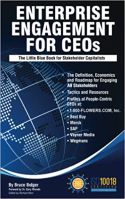
3. Books on implementation: Enterprise Engagement for CEOs and Enterprise Engagement: The Roadmap.
4. Advisory services and research: Strategic guidance, learning and certification on stakeholder management, measurement, metrics, and corporate sustainability reporting.
5. Permission-based targeted business development to identify and build relationships with the people most likely to buy.
Contact: Bruce Bolger at TheICEE.org; 914-591-7600, ext. 230.