

Stakeholder Capitalism: What It Is, Where It Came From, Why It Matters, and Why It Remains Controversial
.png) Here’s an update on the stakeholder capitalism primer first published in 2020. Almost seven years have passed since the Business Roundtable press release in August 2019 that sparked the debate about what was until then a little-known business strategy. Is it just good business, a radical risk, or simply virtue-signaling?
Here’s an update on the stakeholder capitalism primer first published in 2020. Almost seven years have passed since the Business Roundtable press release in August 2019 that sparked the debate about what was until then a little-known business strategy. Is it just good business, a radical risk, or simply virtue-signaling? The Challenge Begins With the Definition
A Much Longer History Than Most People Realize
The Business Roundtable and the Modern Debate
Why Supporters Believe It Matters
Why Critics Remain Skeptical
Regulation, Reporting, and the Future
Major Contributors to Stakeholder Capitalism Principles
Few business concepts have generated as much discussion and confusion in the business media in recent years as stakeholder capitalism. To supporters, it represents a practical framework for creating long-term value by harmonizing the interests of shareholders, employees, customers, suppliers, communities, and the environment. To critics, it is an ill-defined concept that can blur corporate accountability, encourage management discretion, and provide cover for political activism or public-relations campaigns.
The debate has not gone away because of the growing dissatisfaction with capitalism as it is practiced today. Growing economic inequality, combined with declining trust in business institutions, has fueled renewed debate about capitalism and alternative economic systems. According to the Congressional Budget Office, the top 1% of US households earned 103 times as much income as the bottom 20% in 2022, while wealth inequality has risen steadily for decades. At the same time, Gallup reports that Americans’ positive view of capitalism has fallen to a record low of 54%, while 39% now view socialism favorably, with support particularly strong among younger adults. Workplace and marketplace indicators also suggest widespread dissatisfaction: Gallup found that US employee engagement fell to a 10-year low in 2026, with only 31% of employees engaged. Customer satisfaction remains near historic lows, according to the American Customer Satisfaction Index.Together, these trends suggest growing concerns that current management systems are not effectively delivering employee and customer satisfaction—or the financial benefits, shared prosperity, and trust that often accompany them.
Early theorists embraced the notion that by fostering the proactive involvement of all stakeholders in an organization's mission, it could gain a competitive
 edge. Adding the term "stakeholder" in front of "capitalism" emphasizes the difference between a company focused on sustainably growing the pie for all stakeholders versus those focused on short-term gains for shareholders at the expense of other stakeholders. Based on the low levels of engagement and trust, short-term capitalism remains prevalent.
 The debate is complicated by the fact that stakeholder capitalism means different things to different people. Some associate it with the World Economic Forum's 1973 Davos Manifesto and stakeholder capitalism initiative; Environmental, Social and Governance (ESG) investing, or the Business Roundtable's 2019 Statement on the Purpose of a Corporation, which kicked off a spirited debate in business media circles in 2019. The perceived virtue-signaling gave birth to the term "woke" capitalism.
Others trace its roots back decades to management thinkers such as Peter Drucker, quality pioneer W. Edwards Deming, and stakeholder theory scholar R. Edward Freeman of the University of Virginia's Darden School of Business and his 1984 book, Strategic Management, a Stakeholder Approach, which remains in print.
Depending on the source and definition, stakeholder capitalism can appear either as a significant departure from traditional shareholder capitalism or as little more than a modern label for management principles that have existed for well more than half a century. More than 70 years after many of its foundational ideas first emerged, stakeholder capitalism remains less a settled doctrine than an ongoing debate about the purpose of business: to enhance returns for investors only by creating value for all stakeholders, or by maximizing short-term returns for shareholders at the expense of some stakeholders and potential risk of future performance?
What began as a discussion among management thinkers and business leaders is emerging into one of the defining debates in modern capitalism: what is the most sustainable path for value creation for investors, stakeholders, and society? Whether viewed as a practical framework for sustainable value creation or as an ambiguous concept vulnerable to misuse, stakeholder capitalism continues to influence how organizations, investors, regulators, and academics discuss the relationship between business performance and the people upon whom that performance ultimately depends.
Whether one calls it stakeholder capitalism or simply good capitalism, the real question is why aren’t more organizations strategically focused on harmonizing the interests of all stakeholders and shareholders critical for success, rather than battling over nomenclature?
The Challenge Begins With the Definition
.jpg)
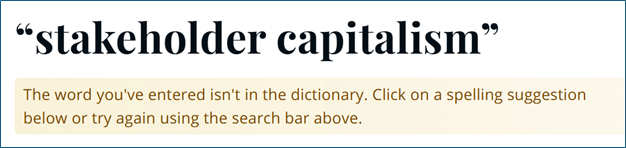
One reason stakeholder capitalism has become such a contentious topic is that there is no universally accepted definition in an official dictionary.
At its simplest, stakeholder capitalism refers to the idea that companies create sustainable value not only by serving shareholders but also by addressing the interests of the people and groups upon whom their success depends—employees, customers, suppliers, communities, and others. Beyond that broad concept, agreement quickly breaks down. Is it about harmonizing the interests of all stakeholders toward a common purpose, goals, objectives, and values. Or is it prioritizing the interests of stakeholders, the environment, and social issues over the interests of shareholders?
The confusion is compounded by the overlap between stakeholder capitalism and several related concepts. Stakeholder management, formalized through Freeman's landmark 1984 book Strategic Management: A Stakeholder Approach, focuses on managing relationships with groups critical to organizational success. Corporate Social Responsibility (CSR) generally focuses on voluntary social and environmental initiatives. The term ESG (environmental, social, governance) emerged from the United Nations' 2004 report Who Cares Wins, written by over a dozen of the world’s leading financial institutions. It encouraged investors to consider environmental, social, and governance factors in their decision-making and risk evaluations. Conscious Capitalism emphasizes purpose-driven leadership and stakeholder orientation, while the Shared Value movement founded by Michael Porter and Mark Kramer focuses on creating economic value by solving societal problems. While these concepts largely overlap, they are not synonymous, and much of the public debate stems from treating them as if they were.
In part because of the lack of a clear definition, the Business Roundtable announcement in August 2019 unleashed a business media firestorm of criticism from the right and the left. Unfortunately, none of the critics reference a specific definition in their opposition to stakeholder capitalism or the etymology or history of their interpretations. Each assumes his or her own definition is clearly understood.
Harvard Professors of Law Lucian Bebchuk and Roberto Tallarita, in their 2020 essay "The Illusory Promise of Stakeholder Governance," argue that stakeholder capitalism gives executives broad discretion to claim they are serving stakeholders while reducing accountability to shareholders, making it difficult to determine whether management is creating value for any stakeholder group. Following up on the Business Roundtable pledge, Bebchuk says that little public action was taken by the signatories and few even bothered to get board approval.
The Heritage Foundation, in "Stakeholder Capitalism: Theft, Path to Central Planning, or Both?", contends that stakeholder capitalism weakens property rights and market accountability by shifting corporate decision-making toward social and political objectives beyond the traditional purpose of business.
Economist Wayne Winegarden, a Senior Fellow and a Director at the Pacific Research Group, as discussed in ESM's review of stakeholder capitalism critics, argues that stakeholder capitalism creates conflicting obligations among stakeholder groups and lacks clear performance standards, making effective corporate governance more difficult.
From the perspective of progressives, New York Times journalist Peter S. Goodman, author of Davos Man: How the Billionaires Devoured the World, argues that stakeholder capitalism often serves as rhetoric that masks the concentration of corporate power and wealth, allowing business leaders to portray themselves as serving society while continuing practices that contribute to inequality and undermine democratic accountability. A summary of Goodman's critique can be found in ESM's coverage of Davos Man.
Together, these critics share a common concern: that stakeholder capitalism lacks a sufficiently clear operational definition and may reduce management accountability by expanding corporate objectives beyond measurable financial performance, though they differ significantly on whether the primary risk is excessive corporate power, weakened shareholder rights, or increased political influence by business.
The challenge is: none of the critics provide a clear definition of stakeholder capitalism nor any basis for their interpretation. Given the importance of defining the term, and anticipating this debate, the Enterprise Engagement Alliance set out to create a formal definition in early 2020. It conducted a detailed review of the literature in its extensive stakeholder management library and consulted with Alex Edmans, Professor of Finance at the London Business School and Martin Whittaker, CEO of JUST Capital, to create the following definition published on the London Business School Forbes page in August 2020: "Enhancing returns for investors only by creating value for customers, employees, distribution and supply chain partners, communities, and the environment.”
When the three critics mentioned above were asked via email at the time what they thought of the EEA definition published in Forbes, Bebchuk, Winegarden, and Goodman, all agreed. The EEA’s definition simply amounts to good business, is not new, and has nothing to do with their definitions of stakeholder capitalism. Not one of them articulated a clear definition upon which they based their criticism, nor a direct source of their interpretation of the field other than the Business Roundtable statement and Davos Manifesto. Neither the Davos Manifesto nor the Business Roundtable statements provide clear enough definitions to resolve the question: is it about harmonizing interests toward a clear purpose, goals, objectives, and values, or is it balancing the interests of some stakeholders or social issues at the expense of shareholders?
An executive at an organization that has opposed stakeholder capitalism, writing recently in an off-the-record email exchange, recommended that the EEA change the name of stakeholder capitalism to the "New Stakeholder Capitalism," to distance it from the "woke" characterization that has set it back. Since it is arguably the woke definition that is new, perhaps it should just be called good capitalism. (In that case, that would explain why there was no need for Business Roundtable members to get board approval for signing a commitment to what is just better business.)
A Much Longer History Than Most People Realize
Although stakeholder capitalism entered mainstream discussion after 2019, its roots stretch back decades. Management consultant Peter Drucker argued throughout his career that business success depended not only on financial performance but also on customer satisfaction, innovation, employee development, and responsible management. His ideas continue to influence management thinking through the Drucker Institute. These are foundational principles of stakeholder capitalism focused on enhancing organizational performance, not on diverting resources to address social issues.
The quality movement pioneered by W. Edwards Deming reinforced that message. Deming's work on systems thinking and continuous improvement emphasized that organizations achieve better results when they systematically address the needs of customers, employees, suppliers, and other parties essential to success. While he never used the phrase stakeholder capitalism, advocates see his work as another of its intellectual precursors.
An early use of the term stakeholder itself is often attributed to the Stanford Research Institute, which used the term in the 1960s to describe the various groups critical to organizational performance.
Another important public milestone came in 1973 when the newly formed World Economic Forum published its original Davos Manifesto. The document stated that management should serve customers, employees, shareholders, and society while harmonizing their interests. Decades later, World Economic Forum founder Klaus Schwab would further popularize the term stakeholder capitalism through his book Stakeholder Capitalism and the organization's ongoing initiatives, but neither the Davos Manifesto nor the book provides a formal definition either. Schwab became another target for opponents from the left and the right, either for hypocrisy and virtue signaling or for a nefarious attempt to pressure companies to redirect resources to address social or environmental issues. (Larry Fink, CEO of Blackrock, became another target when he published an annual letter in 2022 stating that stakeholder capitalism is simply good business and has nothing to do with woke. That did not stop him from getting caught up in the controversy. While not backing down on the principle, the backlash caused Fink to back off from using the term.)
The concept entered mainstream management scholarship in 1984 when Freeman published Strategic Management: A Stakeholder Approach. The book established stakeholder theory as a formal field within strategic management and remains one of the most cited works in business academia. It eventually lead to the 2012 creation of the Stakeholder Strategy Interest Group in the Strategic Management Society. In several interviews with the EEA, Freeman did not agree with the need for a formal definition other than underlining the fundamental principle of harmonizing the interests of all stakeholders toward a common purpose, goals, objectives and values.
Below is a more complete list of the contributors to stakeholder theory since the publication of Freeman's book. There is no evidence that any of these initiatives advocated for diverting profits away from shareholders to address social issues. It was and is all about how to enhance productivity, quality, and stakeholder experiences for the benefit of shareholders.
The Business Roundtable and the Modern Debate
Business awareness of stakeholder capitalism changed dramatically in August 2019 when the Business Roundtable revised its Statement on the Purpose of a Corporation. Signed by chief executives of many of America's largest companies, the statement declared that corporations should deliver value to customers, invest in employees, deal fairly with suppliers, support communities, and generate long-term value for shareholders.
Supporters viewed the announcement as overdue recognition that sustainable success depends on more than quarterly earnings and that it's impossible to optimize returns without fostering the proactive involvement of customers, employees, distribution and supply chain partners, and communities. Critics questioned whether the statement reflected meaningful changes in business behavior or merely a response to growing public scrutiny of corporations. Ironically, much of today's political debate surrounding stakeholder capitalism stems not from the academic literature, business practices and organizations that developed over several decades, but from reactions to this relatively brief corporate statement from the Business Roundtable followed up by the the World Economic Forum's January Davos meeting in which leading business leaders did indeed fly into Davos, as alleged by critics, to proclaim their commitment to stakeholder capitalism....only to drop it later
Why Supporters Believe It Matters
Supporters generally argue that stakeholder capitalism is not about sacrificing shareholder returns but about achieving them more sustainably. A growing body of research has explored whether organizations that effectively manage stakeholder relationships generate superior long-term performance. London Business School professor Alex Edmans, author of Grow the Pie, argues that companies can create greater shareholder value by creating value for society. The nonprofit research organization JUST Capital has spent years ranking companies based on how Americans believe businesses should treat workers, customers, communities, and shareholders. It helped launch the Goldman Sachs JUST Capital ETF that has consistently rivaled or outperformed its benchmark Russell 1000.
In 2017, Irrational Capital began development of the Human Capital Factor, which has since been independently validated by J.P. Morgan Analytics to signal a 4% alpha in share price return in companies with a high score. More recently, researchers at Oxford University's Wellbeing Research Centre examined the relationship between employee well-being and business performance and found a direct connection with stock market performance.
Supporters point to companies such as Costco, Whole Foods, Nucor Steel, Chick Fil A Texas Roadhouse, Delta Airlines, Wegman’s and Southwest Airlines under Herb Kelleher, Publix, and others as examples of organizations that built strong reputations and long-term financial performance through stakeholder-oriented management practices. These companies appear to practice the advice of the economist Milton Friedman in not publicizing their commitment to stakeholder capitalism principles. "Companies should invest in employees, training, workplace quality, and communities whenever doing so creates long-term value—but they should recognize it as sound business strategy rather than claim moral credit for it," Friedman is reported to have said.
The world of total quality management provides a clear example of the application of stakeholder capitalism principles to business. Quality in US manufacturing did not materially improve until the Japanese implemented total quality management practices advocated by Demings, which call for a strategic and systematic approach to harmonizing the interests and capabilities of all stakeholders involved with a company or project. By having a clear North Star, leaders reduce the pain of trade-offs by having a more transparent manner of making and explaining tough decisions.
Stakeholder capitalism, to some proponents, is simply the application of total quality management principles to the entire organization, not just manufacturing or engineering.
Why Critics Remain Skeptical
Critics raise several concerns. Again, without referencing a specific definition or etymology for their definition of the term, some argue that stakeholder capitalism lacks sufficient precision to guide management decisions. If executives are expected to serve multiple stakeholder groups simultaneously, critics ask, how should conflicts or tradeoffs among those groups be resolved?
Others worry about accountability. Shareholder returns provide a measurable benchmark against which management performance can be evaluated. A mandate to serve all stakeholders, critics contend, risks making management accountable to everyone and therefore accountable to no one.
Political concerns also arise from both directions. Critics on the right often argue that stakeholder capitalism can become a vehicle for advancing social or political objectives unrelated to business performance. Critics on the left sometimes view it as an effort to soften criticism of corporate power without addressing broader concerns about inequality or governance. Even some supporters acknowledge that stakeholder capitalism has been undermined by corporate rhetoric unsupported by measurable action, giving rise to accusations of greenwashing and virtue signaling.
Regulation, Reporting, and the Future .png)
While stakeholder capitalism remains largely voluntary in much of the world, regulation is beginning to play a larger role when it comes to disclosures by companies large enough to have an impact on society.
The European Union's Corporate Sustainability Reporting Directive (CSRD) requires extensive disclosures related to workforce practices, environmental impacts, governance, supply chains, and stakeholder relationships. Supporting standards are being developed by the European Financial Reporting Advisory Group (EFRAG)
At the same time, the International Organization for Standardization has expanded its focus on stakeholder-oriented management through voluntary standards such as ISO 10018 on people engagement and ISO 30414 on human capital reporting. These developments suggest that even as political debates continue, stakeholder-related measurement and disclosure are likely to become increasingly important in business management and investment analysis, especially outside the US.
In 2018, Sen. Elizabeth Warren, D., Sen., MA, introduced the Accountable Capitalism Act that would require significant disclosures of human capital information by large corporations. It went nowhere. On the other hand, during the first Trump Administration, Securities and Exchange Commissioner Jay Clayton enacted a new 10-K disclosure rule requiring public companies to report on human capital factors considered material to their businesses.
In 2020, under the first Trump administration, the U.S. Securities and Exchange Commission amended Regulation S-K to require public companies to disclose in their annual 10-K filings any human capital resources, measures, and objectives that are material to understanding how the business is managed and operated. The reports have since attracted little attention.
Major Contributors to Stakeholder Capitalism Principles
The ideas associated with stakeholder capitalism did not emerge from a single organization or ideology. Rather, they evolved over decades through the work of academics, management consultants, business leaders, investors, standards organizations, and advocacy groups.
Here is a summary of some of the most influential contributors:
- Peter Drucker for his early work in people-focused management. Starting in late 1940s.
- W. Edwards Deming, for his work in total quality management. Starting in 1950s
- Stanford Research Institute for its identification of the role of stakeholders in the 1960s.
- Klaus Schwab and the World Economic Forum (1973) for its early advocacy.
- R. Edward Freeman, author of Strategic Management: A Stakeholder Approach, 1984.
- Tom Peters for his early thinking in support of stakeholder management in the book In Search of Excellence (1982).
- Leonard Schlesinger and James Heskett and their 1990s work on the Service Value Profit Chain.
- Michael Porter and Mark Kramer and the Shared Value movement (circa 2011.)
- John Mackey and Conscious Capitalism (2007)
- B Lab (2007) for its creation of standards and benefits corporations, and its founders Jay Coen Gilbert, Bart Houlahan, and Andrew Kassoy.
- The International Organization for Standardization for creation of its ANNEX SL standards in 2012 and subsequent ISO 30414 human capital and ISO 10018 people engagement standards.
- JUST Capital (2014) for its work in ranking companies and creation of the Goldman Sachs ETV.
- Council for Inclusive Capitalism (2017) — A coalition of major corporations, investors, and EY formed to develop practical ways to measure how stakeholder investments contribute to long-term business value.
- Economics of Mutuality (2020) — An organization launched by Mars and partners that seeks to demonstrate how creating value for employees, communities, and other stakeholders can enhance long-term financial performance.
Click here for a list of research studies on the impact of stakeholder capitalism practices.
Click here for access to the Enterprise Engagement Index, a free formula to evaluate the ability of any company or industry to create financial value specifically through customers and employees.
Enterprise Engagement Alliance Services
 Celebrating our 17th year, the Enterprise Engagement Alliance helps organizations enhance performance through:
1. Information and marketing opportunities on stakeholder management and total rewards:
- ESM Weekly on stakeholder management since 2009. Click here to subscribe; click here for media kit.
- RRN Weekly on total rewards since 1996. Click here to subscribe; click here for media kit.
- EEA YouTube channel on enterprise engagement, human capital, and total rewards since 2020
 Management Academy to enhance future equity value for your organization.
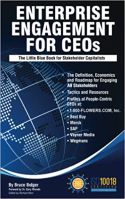
3. Books on implementation: Enterprise Engagement for CEOs and Enterprise Engagement: The Roadmap.
4. Advisory services and research: Strategic guidance, learning and certification on stakeholder management, measurement, metrics, and corporate sustainability reporting.
5. Permission-based targeted business development to identify and build relationships with the people most likely to buy.
Contact: Bruce Bolger at TheICEE.org; 914-591-7600, ext. 230.