

Among The Most Dangerous Words in Business
.jpg) One of the least discussed but most damaging forces in business and society may be the tendency to value ideas based on the status of the person presenting them rather than the quality of the idea itself. We can’t change that dangerous tendency in society, but we can change it in our own organizations.
One of the least discussed but most damaging forces in business and society may be the tendency to value ideas based on the status of the person presenting them rather than the quality of the idea itself. We can’t change that dangerous tendency in society, but we can change it in our own organizations. By Bruce Bolger
Bolger is Founder of the Enterprise Engagement Alliance.
The Power of a Fresh Perspective
The Lessons From Total Quality Management
Click here to subscribe to the ESM weekly e-newsletter.
Have you ever heard of the phenomena of authority bias, credentialism, gatekeeping, status bias, or “not invented here” syndrome? Whatever the label, the pattern is familiar: unless someone is already accomplished, influential, credentialed, or “inside the circle,” their ideas are often ignored, dismissed, or delayed until validated by someone within the circle or with greater perceived authority.
This dynamic may be unavoidable in society at large. Human beings use reputation and status as shortcuts for deciding whom to trust. In a world overflowing with opinions, credentials and experience can help separate expertise from noise. How many game-changing ideas never saw the light of day due to this phenomenon. But organizations that allow this instinct to dominate internally risk suffocating one of their greatest competitive advantages: the ability to learn from everyone.
The Power of a Fresh Perspective
I was reminded of this years ago when a new employee, on literally his first day, suggested a change in how we handled part of our business. The idea was so practical and immediately useful that we implemented it almost on the spot. He had no track record with us, no political capital, no seniority, and no established credibility. What he had was fresh eyes.
That experience reinforced an important lesson that organizations do not become smarter by limiting good ideas to those already validated by hierarchy. In fact, some of the most valuable observations often come from people closest to the friction points in an organization: frontline employees, new hires, customer service representatives, younger workers, channel partners, or customers themselves. These individuals frequently see inefficiencies, communication gaps, outdated assumptions, or unnecessary complexity that leadership teams may no longer notice, but are afraid to speak up.
Unfortunately, many organizations unintentionally train people to keep ideas to themselves. Employees quickly learn whether ideas are genuinely welcomed or whether participation is mostly symbolic. If there is no transparent system to encourage suggestions or if they are routinely ignored, filtered through layers of politics, or credited only when repeated by senior management, people stop contributing. The organization may still conduct surveys, town halls, and brainstorming sessions, but psychologically the message becomes clear: ideas flow downward, not upward.
This is one reason truly engaged organizations place such emphasis on suggestion systems, cross-functional communication, recognition, and leadership accessibility. The goal is not simply to “make employees feel heard.” It is to improve organizational intelligence. The irony is that businesses spend enormous amounts of money seeking innovation while often overlooking the most scalable and cost-effective source of ideas already available to them: their own stakeholders. The issue extends beyond employees. Companies that fail to listen to customers, distributors, franchisees, suppliers, or field teams because they are viewed as “outside” strategic decision-making often miss emerging risks and opportunities until competitors capitalize first.
The Lessons From Total Quality Management
Total quality management principles recognized this decades ago. Sustainable improvement requires systems that encourage proactive involvement from everyone connected to the process, not just those highest in the hierarchy. Organizations become stronger when information moves freely enough for good ideas to surface regardless of title or status. None of this means every idea is good or that expertise does not matter. Experience matters enormously. Leadership requires judgment. But the best organizations separate evaluation of the idea from evaluation of the person presenting it.
It is bad enough that this dynamic exists in society at large, where influence, credentials, networks, and visibility often determine whose ideas are heard. Most of us cannot control that reality. But we can control what happens inside our own organizations.
We can create cultures in which people are encouraged to contribute regardless of title, tenure, department, age, or status. We can reward curiosity instead of hierarchy, listening instead of politics, and practical insight instead of internal prestige. We can ensure that the person with the best idea does not need permission from status before being taken seriously. Because organizations that only listen upward eventually stop learning altogether.
Enterprise Engagement Alliance Services
 Celebrating our 17th year, the Enterprise Engagement Alliance helps organizations enhance performance through:
1. Information and marketing opportunities on stakeholder management and total rewards:
- ESM Weekly on stakeholder management since 2009. Click here to subscribe; click here for media kit.
- RRN Weekly on total rewards since 1996. Click here to subscribe; click here for media kit.
- EEA YouTube channel on enterprise engagement, human capital, and total rewards since 2020
 Management Academy to enhance future equity value for your organization.
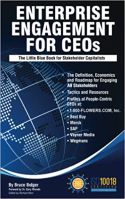
3. Books on implementation: Enterprise Engagement for CEOs and Enterprise Engagement: The Roadmap.
4. Advisory services and research: Strategic guidance, learning and certification on stakeholder management, measurement, metrics, and corporate sustainability reporting.
5. Permission-based targeted business development to identify and build relationships with the people most likely to buy.
Contact: Bruce Bolger at TheICEE.org; 914-591-7600, ext. 230.