

Part 2: Preliminary Five-Year Analysis Suggests the EEA EEI Provides Strong Predictor of Profitability
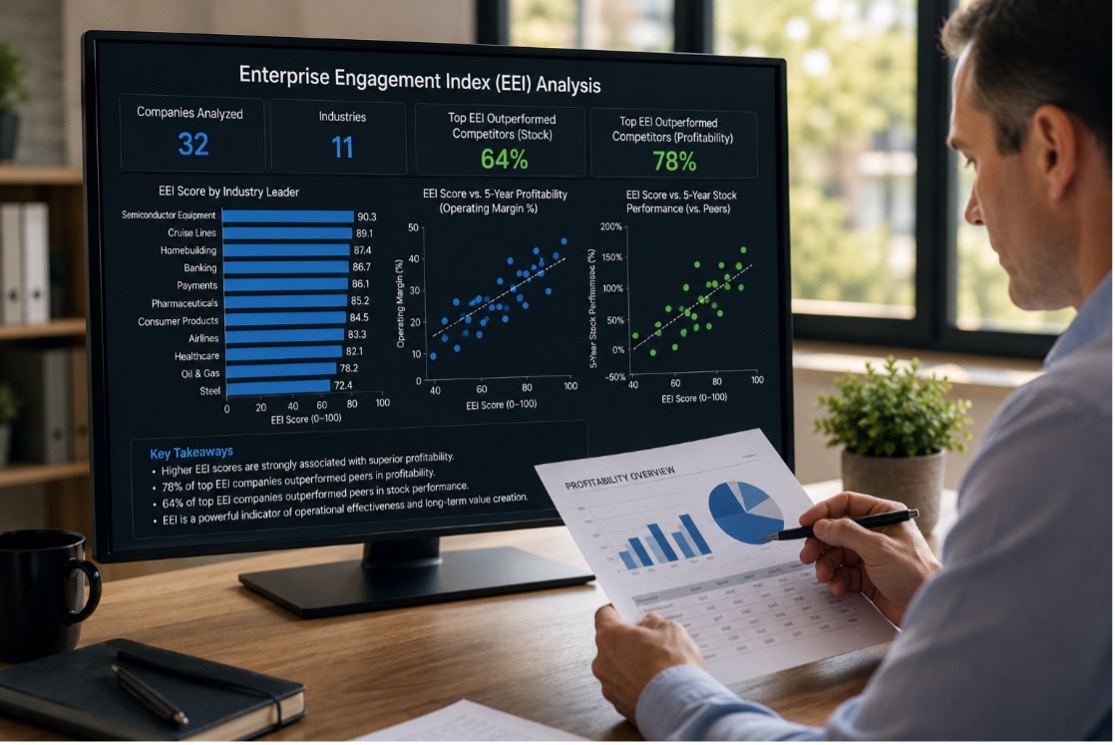 A preliminary five-year-style analysis of 32 public companies across 11 industries suggests that the new EEA Enterprise Engagement Index™ (EEI) may have significant value as an indicator of organizational effectiveness, profitability strength, and operational quality—while also revealing limitations as a stand-alone predictor of stock market performance.
Strongest Correlation: Profitability and Operational Quality
The Most Predictive EEI Components
What the EEI Appears to Predict Best
Where the EEI Was Least Effective at Predicting Stock Price Performance
EEI Is Designed to Work Best Within Industries Than Across Industries
Click here to subscribe to the ESM weekly e-newsletter.
The early findings indicate that companies with the highest EEI scores frequently demonstrated superior profit generation, stronger productivity per employee, higher operating margins, and, in many industries, stronger long-term shareholder returns than peers. In fact, in seven of the 11 industries analyzed—approximately 64% the company with the highest EEI score also produced the strongest stock market performance within its peer group over roughly the same period. Over 75% outperformed their competitors on profitability metrics.
The index is designed to be a S&P 500 index of companies based on how well they translate employee and customer investments into concrete value.
This analysis suggests the EEI is more predictive of actual profitability and operational quality than of stock price movements alone. Preliminary findings indicate that higher EEI scores reflect stronger directional relationship with superior margins, profit per employee, Human Capital ROI, and revenue growth than with broader stock market outperformance, which is often influenced by macroeconomic conditions, valuation multiples, sector rotation, commodity prices, interest rates, regulations, conflicts, and investor sentiment, etc.
It appears the factors identified by EEI provide useful metrics for organizations seeking strategies and tactics to promote both greater employee and customer engagement, as well as to detect future risks and opportunities.
The EEI, developed by the Enterprise Engagement Alliance Impact Council, evaluates how effectively organizations convert investments in people, customers, and stakeholder relationships into measurable financial outcomes using publicly available data. The framework combines revenue per employee, profit per employee, Human Capital ROI (HCROI), profitability ratios, and three-year revenue growth into a weighted score designed to measure organizational effectiveness rather than employee sentiment alone. It does not attempt to identify causations.
To help organizations use other data for further causation and correlation analysis, the EEA’s People Value Impact Indicator is being customized not only to support creation of the EEA EEI Index, but also for companies to enter additional survey, turnover, NPS (net promoter scores), and almost any data to better understand the source of strengths and weaknesses in the findings.
Strongest Correlation: Profitability and Operational Quality
The five-year performance analysis found the EEI was most effective at identifying companies with superior operational and profitability characteristics within industries. Across most industries studied, the EEI scores identify companies with:
- Higher profit per employee
- Stronger operating margins
- Better long-term revenue growth
- Higher productivity per employee
- More consistent shareholder returns over time
The clearest examples include:
| Industry | Highest EEI Company | Key Findings |
|---|---|---|
| Semiconductor Equipment | ASML | Highest profitability and strongest stock performance |
| Cruise Industry | Royal Caribbean | Strongest margins and dramatically superior shareholder returns over other cruise lines |
| Homebuilding | PulteGroup | Best operational and shareholder performance |
| Banking | JPMorgan Chase | Strongest banking profitability and market performance |
| Pharmaceuticals | Merck | Superior profitability and operational performance |
| Consumer Products | Procter & Gamble | Strongest profitability stability |
| Airlines | Delta/United vs. American | Higher EEI aligned with superior profitability and returns |
The strongest relationship appeared between EEI scores and profitability-related measures, especially:
- Profit per employee,
- Operating margin,
- HCROI,
- And sustained revenue growth.
The Most Predictive EEI Components
The study suggests some EEI factors may be materially more predictive than others.
Strongest predictive components.
- Profit per employee
- Operating margin/profitability ratio
- Three-year revenue growth
Moderately predictive: revenue per employee and HCROI.
The findings also suggest the EEI may ultimately prove most valuable as:
- An organizational quality indicator,
- A profitability diagnostic,
- A benchmarking tool,
- A risk-identification framework,
- A factor to consider in stock investments and mergers and acquisitions.
What the EEI Appears to Predict Best
The preliminary study suggests the EEI may be strongest at predicting:
1. Relative Profitability Within Industries
The strongest and most consistent relationship was between high EEI scores and superior profitability characteristics. Companies with high EEI scores demonstrate:
- Higher margins,
- Better capital efficiency,
- Greater value creation per employee,
- And better conversion of growth into profits.
- Banking,
- Payments,
- Pharmaceuticals,
- Consumer products,
- Semiconductor equipment,
- And airlines.
2. Organizational Efficiency
The EEI appears highly sensitive to operational quality. High-scoring companies repeatedly reflect:
- Better productivity systems,
- More scalable operating models,
- Better alignment between growth and profitability,
- And stronger conversion of labor investment into value creation.
3. Competitive Positioning
The EEI also appeared useful in identifying which companies within industries had structurally stronger business systems. For example:
- Visa and Mastercard dramatically outperformed American Express in productivity and profitability measures.
- Merck substantially outperformed Pfizer in margins, growth, and profit generation.
- JPMorgan significantly outperformed Citigroup on nearly every operating metric.
The framework also appeared effective at highlighting operational weakness before it became fully reflected in market narratives. Lower EEI companies often exhibited:
- Weak margins,
- Declining growth,
- Poor productivity,
- Lower returns on labor investment,
- And shareholder underperformance.
Where the EEI Was Least Effective at Predicting Stock Price Performance
The analysis found the EEI becomes less reliable as a stock performance predictor in industries where external macroeconomic or cyclical forces dominate valuation.
Commodity industries. The weakest correlation between EEI and stock performance occurred in:
- Oil and gas,
- Steel,
- And portions of healthcare.
Similarly, steel companies produced inconsistent relationships between EEI scores and stock returns because steel pricing cycles often overwhelm operational quality differences.
Mature defensive industries. The EEI also appears less predictive of stock performance in slower-growth defensive sectors such as:
- Healthcare,
- Pharmaceuticals,
- And consumer staples.
- Merck strongly outperformed pharmaceutical peers operationally but still lagged the S&P 500.
- Procter & Gamble generated excellent EEI characteristics yet modest relative stock market outperformance.
- Valuation multiples,
- Investor sentiment,
- Interest-rate sensitivity,
- Sector rotation,
- Momentum investing,
- Regulatory risk,
- or commodity cycles.
These metrics were useful but more sensitive to industry structure and accounting differences. For example, oil companies naturally produce extraordinary revenue per employee because of capital intensity, while banks and payments companies benefit from scalable digital models.
EEI Is Designed to Work Best Within Industries Than Across Industries
One of the clearest findings is that the EEI works best as a peer-comparison framework rather than a universal ranking system.
Comparing Royal Caribbean against Carnival or JPMorgan against Citigroup produced meaningful insights. Comparing Visa against Chevron or ASML against Delta Air Lines was less useful because industry economics differ dramatically.
The analysis suggests the EEI may ultimately benefit from:
- Industry-specific benchmark scales,
- Sector-adjusted weighting,
- Capital-intensity adjustments,
- And better HCROI standardization.
Enterprise Engagement Alliance Services
 Celebrating our 17th year, the Enterprise Engagement Alliance helps organizations enhance performance through:
1. Information and marketing opportunities on stakeholder management and total rewards:
- ESM Weekly on stakeholder management since 2009. Click here to subscribe; click here for media kit.
- RRN Weekly on total rewards since 1996. Click here to subscribe; click here for media kit.
- EEA YouTube channel on enterprise engagement, human capital, and total rewards since 2020
 Management Academy to enhance future equity value for your organization.
3. Books on implementation: Enterprise Engagement for CEOs and Enterprise Engagement: The Roadmap.
4. Advisory services and research: Strategic guidance, learning and certification on stakeholder management, measurement, metrics, and corporate sustainability reporting.
5. Permission-based targeted business development to identify and build relationships with the people most likely to buy.
Contact: Bruce Bolger at TheICEE.org; 914-591-7600, ext. 230.