

Recognition Alone Is Not Enough: Chester Elton Calls for Systems Thinking in Engagement
 After decades of advancing motivation, recognition, leadership and gratitude, Chester Elton reflects on a hard truth: despite widespread awareness of the problems, engagement levels remain stubbornly low. He now advocates for a more structured, systems-based approach—pointing to the Enterprise Engagement Alliance Academy, led academically by Gary Rhoads, Professor Emeritus, Marketing and Entrepreneurship at the Brigham Young University Marriott School of Business, as a practical path forward for professionals seeking measurable impact in their organizational, departmental, team or other leadership roles.
 By Chester Elton
The Limits of Standalone Initiatives
Why a Systems Approach Matters
A Fresh Path Forward for Engagement
From Inspiration to Implementation
Click here to subscribe to the ESM weekly e-newsletter.
Engagement requires a system.
For most of my career, I’ve been an advocate for recognition and gratitude in both the workplace and in life. I’ve seen firsthand how recognition, positive leadership, and gratitude can transform teams, elevate performance, and create more human-centered organizations. Today, I’m also deeply interested in how emerging AI tools can help embed gratitude into our daily lives and work flows—making it easier, more consistent, and more personalized--and I intend to focus the next phase of my work in this domain.
And yet, despite all the talk about these subjects of recognition and leadership over the last 30 years, I find myself asking a difficult question: why hasn’t more changed? We have more books, more speakers, more tools, and more awareness than ever before. The ideas of recognition, appreciation, and purpose-driven leadership are widely accepted. Dozens of technologies exist to support it. But when you look at the data—year after year—employee engagement remains stubbornly low. It may even be declining. Customer satisfaction isn’t much better, suggesting a potential link between the two.
That disconnect suggests something important: while the principles are sound, the way they are applied is often incomplete. What’s missing is a system. That’s why I support the Enterprise Engagement Alliance Impact Academy and its application of Total Quality Management (TQM) practices to people.
What to me is also compelling about the EEA Academy's systematic, holistic approach to the engagement of all stakeholders is how it aligns with the strategic HR approach of Dave Ulrich, Rensis Likert Professor of Human Resources at the Ross School at the University of Michigan. He has become the leading advocate of what he calls stakeholder HR, which he defines as the practice of designing and managing human resources to create value not just for employees, but for all stakeholders—customers, investors, and communities—by aligning people strategies with broader organizational outcomes. Engagement is just one subset of the many practices and tools involved with the much broader mission he identifies of managing all stakeholders--customers, all type of employees, distribution and supply chain partners, and communities.
The Limits of Standalone Initiatives
Over the years, I’ve come to realize that many well-intentioned efforts in recognition, culture, and leadership fail not because they are wrong—but because they are isolated from eachother but from other stakeholders. A recognition program here; a leadership workshop there; new perks added; a culture initiative launched with enthusiasm; a survey program, a customer loyalty or channel program etc. almost all ad hoc and rarely measured for actual impact. And then, what about the connection between our employees and external stakeholders--customers, distribution and supply chain partners, and communities. They are all people assets too, involved with the same overall organizational mission in one way or another.
Each of these initiatives can be valuable. But when they operate independently, without alignment to a broader system or other related stakeholders, or their impact measured, their benefits appear to be limited and short lived. Gratitude, for example, is powerful and has a personal payback like love, healthy diets, and exercise that need no measurement; but if, in an organization, practices are not connected to how goals are set, how performance is measured, how decisions are made, and how people are involved in the business—it becomes a nice idea rather than a sustained driver of a productive, wholesome culture. That realization has led me to update my thinking about what it really takes to create a culture in which everyone’s interests are focused on its purpose, goals, objectives, and values.
Why a Systems Approach Matters
As I have come to learn from the EEA application of Total Quality Management (TQM) principles to people—what the Enterprise Engagement Alliance calls enterprise engagement-- it illustrates to me the fundamental opportunity: engagement is not a program. It’s a system.
 In preparation for making my decision to recommend the EEA Impact Academy, I reviewed the enterprise engagement certification, the syllabus, a practice test, and of course have spoken with Gary Rhoads, EEA Academic Director, and have known Bruce Bolger, EEA founder for years. I reflected on the broader stakeholder approach to HR advocated by Dave Ulrich.
 .jpeg) When effectively implemented from the heart of the CEO, TQM has long been proven in operations, manufacturing, and quality improvement. It provides a disciplined way to align stakeholders and processes, measure outcomes, and continuously improve performance. Applying those same principles to people—how they are engaged, equipped, and aligned—offers a compelling and, frankly, overdue evolution. What I find particularly powerful about this approach is that it doesn’t replace the work many of us have been doing. It enhances it.
When effectively implemented from the heart of the CEO, TQM has long been proven in operations, manufacturing, and quality improvement. It provides a disciplined way to align stakeholders and processes, measure outcomes, and continuously improve performance. Applying those same principles to people—how they are engaged, equipped, and aligned—offers a compelling and, frankly, overdue evolution. What I find particularly powerful about this approach is that it doesn’t replace the work many of us have been doing. It enhances it.Gratitude still matters. Recognition still matters. Employee, customer and motivation of all stakeholders matter; communications, learning and surveys, etc. still matter. Great leadership matters more than ever. Applying TQM to people addresses the missing link from the leadership practices we have taught to more effective and measurable implementation and continuous improvement. For when managed strategically in an organization, they are all part of a coherent framework—one that connects actions to business objectives, stakeholder needs, measurable outcomes, and continuous improvement.
That all of this aligns with a framework developed completely independently for HR by Dave Ulrich gives it even more credence.
A Fresh Path Forward for Engagement
That’s why I’ve taken a close look at the Enterprise Engagement Alliance Impact Academy and its certification program. What stands out is not just the content, but the intent. This is not about replacing existing practices with a rigid methodology. Quite the opposite. It’s about providing a foundation—a system—that gives practitioners the freedom to apply their expertise more effectively in a way that can be transparently evaluated.
The program draws on proven frameworks, including TQM and ISO (International Organization for Standardization) people management standards, and the stakeholder HR thinking of Dave Ulrich, to help professionals design engagement strategies that are aligned, measurable, sustainable, and independently auditable. It addresses a critical gap in management: the lack of formal education on how to integrate all these elements into a cohesive whole. For managers at every level, in human resources, sales and marketing, operations, administration, and finance, etc. this represents a significant opportunity. Because the reality is that everything we’ve been advocating for—leadership, culture, gratitude, recognition, incentives, training, communications, etc.—cannot truly flourish unless all applied holistically and authentically, as part of that broader system envisioned by Dave Ulrich.
From Inspiration to Implementation
One of the challenges in people management has always been moving from inspiration to implementation and impact measurement. It’s relatively easy to get people excited about engagement and well-being. It’s much harder to help them design and execute programs that deliver consistent, measurable results over time that justify the investment in resources and time. That’s where structured education becomes essential.
What I appreciate about the Enterprise Engagement Alliance Academy is its focus on practical application. It’s not just about ideas—it’s about how to design systems, align stakeholders, and measure impact in a way that stands up to scrutiny at the executive and even investor level by using systems long proven in manufacturing, engineering, and in innovation. In an era when organizations are increasingly demanding proof of ROI, this kind of rigor is not optional. It’s necessary. Strategic engagement is easier to test and deploy than strategic HR, since many companies already run effective engagement strategies, most often in total quality management.
I remain deeply committed to the power of gratitude in our personal lives and in business that means for customers, employees, distribution and supply chain partners. I believe, perhaps more than ever, that recognizing and appreciating people is fundamental to both human fulfillment and organizational success. I also recognize that gratitude alone is not enough in organizations. If we want to see real change—if we want engagement levels to rise in a meaningful, sustained way that investors and boards can appreciate—we need to evolve how we approach the work. That means embracing systems thinking. It means aligning and integrating our efforts across siloes to elevate the value created for all stakeholders. It means committing to a higher standard of design and measurement. And it means being open to learning something new, even after years in the field.
Having spent years knowing the leaders involved at the EEA, and having followed the development of the broader issue of stakeholder HR envisioned by Dave Ulrich, I can attest to the foundational basis for this work and for the expertise, integrity, and commitment to advancing the field of people management. We all want the same outcome: organizations where all stakeholders feel valued, engaged, and empowered to do their best work or be the best customers or supply chain partners. The question is not whether that vision is possible. It’s whether we are willing to learn and adopt the already proven systems needed to make it real in people as it has accomplished in manufacturing.
Imagine the potential not only for value creation but for better lives.
Enterprise Engagement Alliance Services
 Celebrating our 17th year, the Enterprise Engagement Alliance helps organizations enhance performance through:
1. Information and marketing opportunities on stakeholder management and total rewards:
- ESM Weekly on stakeholder management since 2009. Click here to subscribe; click here for media kit.
- RRN Weekly on total rewards since 1996. Click here to subscribe; click here for media kit.
- EEA YouTube channel on enterprise engagement, human capital, and total rewards since 2020
 Management Academy to enhance future equity value for your organization.
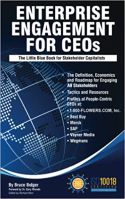
3. Books on implementation: Enterprise Engagement for CEOs and Enterprise Engagement: The Roadmap.
4. Advisory services and research: Strategic guidance, learning and certification on stakeholder management, measurement, metrics, and corporate sustainability reporting.
5. Permission-based targeted business development to identify and build relationships with the people most likely to buy.
Contact: Bruce Bolger at TheICEE.org; 914-591-7600, ext. 230.