

Trust, Proven: How Great Place To Work Turned Culture Into a Measurable Growth Engine
 For more than three decades, Great Place To Work has built one of the most compelling evidence bases in modern business: that trust isn’t a soft ideal—it’s a hard driver of performance. What began in 1990 as a simple insight—that great workplaces are defined by trust, pride, and camaraderie—has evolved into a global standard backed by data from more than 100 million employees. Here’s a story about its past and most importantly about its future and its determination that organization’s must be a great place to work for all.
 By Sarah Lewis Kulin
Executive Vice President Recognition and Research, Great Place To Work
What’s Involved With Getting Certified
Why Do Companies Go Through the Process?
30 Years of Data on Trends, Generational Shifts, and Financial Impact
The State of Progress of the GPTW Paradigm Since the 1990s
The Political-Economic Arc of GPTW Principles
Are We Heading Into a Better Climate for Work?
Click here to subscribe to the ESM weekly e-newsletter.
 Great Place To Work may be best known for powering Fortune magazine’s annual 100 Best Companies to Work For list, which comes out this year on April 1. The organization was founded in 1990 by Dr. Amy Lyman and journalist Robert Levering, who after years of researching exceptional companies concluded that what distinguished outlying companies’ success was an unusual degree of trust between employees and management. The original definition was simple and enduring: a great place to work is one where you trust the people you work for, have pride in what you do, and enjoy the people you work with.
 Today, it’s mission statement is to build a better world by helping every organization become a Great Place to Work For All. The mission has deepened meaningfully over time. The most significant evolution came when CEO Michael Bush, who took over in 2015, added "For All" to the mission statement. After analyzing survey data from Fortune 100 Best Companies winners and finding significant disparities along job role, gender, ethnicity, age, and hourly versus salaried lines, Bush concluded that you could not be a "Great Place to Work" while large segments of your workforce were having a decidedly not-great experience. The "For All" amendment was a direct response — ensuring the recognition framework measured consistency of experience across the whole organization, not just its dominant group.
Great Place To Work has always focused on helping organizations build better businesses — not just better places to work in an abstract sense, but materially higher-performing enterprises. What began as a framework for understanding workplace culture has become, over 30 years of data representing more than 100 million employees, one of the most robust evidence bases in management research for the link between high-trust cultures and financial outperformance.
What’s Involved With Getting Certified
Certification requires a two-step process: surveying employees with the Trust Index™ survey, and completing the Culture Brief™ — a company questionnaire about organizational background and structure. Positive employee responses (four or above on a five-point scale) are averaged to produce an organization-wide Trust Index score. Organizations in which an average of seven out of 10 employees confirm it’s a great workplace, and have submitted a Culture Brief, become Certified. Click here for more details on the certification process.
The Trust Index measures five dimensions of a high-trust culture that our research has found are essential to great workplaces and high performance. Three relate to leadership trust-building — credibility, respect, and fairness. Two assess employees' relationship to the organization itself — pride and a sense of camaraderie across its workforce. The survey consists of 60 statements on a consistency scale, demographic questions, and two open-ended questions. At the conclusion companies have deep insights into their unique organizational strengths, the highest-leverage areas to improve, how they stack up against peer benchmarks, and, if they’ve earned it, third-party validation of the quality of their workplace and leaders that they can use with their people, customers and job seekers. The process typically takes about one month from signup to certification badge. One mistake some companies make is to wait until they feel “ready” to be certified. This just slows them down because they are missing the benchmarking and actionable insight that will help them improve faster.
Certification is the entry point. If certified, companies will automatically be considered for dozens of Best Workplace™ lists. If companies with more than 1,000 employees wish to be considered for the Fortune 100 Best Companies list, they must also complete a Culture Audit with essay questions evaluated by our analysts against the For All™ model — which provides a deeper assessment of their strategy to impact employee experience.
Why Do Companies Go Through the Process?
Fundamentally, Great Place To Work offers an incredibly efficient method for companies to improve engagement, business performance and achieve external branding goals through a single proven process that creates access to the benchmarks, insights, and the positive branding of being named a leading workplace in the world.
The companies that work with us seek data-driven facts to drive their priorities and are skeptical of generalities connecting workplace culture and performance. For example, the 100 Best Companies to Work for list is often pointed to as evidence that general employee engagement, satisfaction or happiness matter to financial performance – but in fact it’s a very specific set of metrics and analysis that determines ranking on this list, namely Great Place To Work’s Trust Index™ and analysis models.
Companies want access to those metrics because of the ROI they know it drives. Numerous studies demonstrate that the high-trust companies determined using Great Place To Work rubrics deliver stock performance that beats the market average, with the best companies more than tripling market returns. Companies embodying the Great Place To Work model report half the turnover of the typical US workplace. A 2025 report found that companies on the 100 Best Companies list earn an average of 8.5 times the revenue per employee than US companies broadly. These benefits are not limited to large or public companies. Small companies’ annual revenue growth is more than seven times higher when leaders perform well on these trust metrics.
Beyond the financial case, there's a talent market argument. In a 2023 market study, job seekers were 15 times more likely to choose a company if they knew it had been certified as a great workplace by its employees. Overall, companies use the process to gain internal diagnostics and credible public validation. The Trust Index data identifies specific leadership behaviors driving or undermining culture and performance, enabling targeted interventions informed by the practices of the best companies in the world and a chance for highly rated companies to be seen by talent and customers among their peers.
30 Years of Data on Trends, Generational Shifts, and Financial Impact
Thirty-plus years of data from over 100 million employee surveys has consistently pointed to trust as the foundational metric in creating great workplaces and great performing businesses.
Alex Edmans' research provides independent academic validation. His research out of London Business School published in peer-reviewed journals demonstrated that companies that rank highly on Great Place To Work metrics significantly outperformed peers in stock returns over long time horizons — providing the kind of longitudinal financial evidence that moved the conversation from HR philosophy to capital allocation. Research by leading investment firms have also consistently reinforced this: companies recognized by Great Place To Work have outperformed the S&P by a factor of approximately three over comparable periods.
On generational trends: the fundamental drivers of a great workplace — trust, fairness, purpose, belonging — have held remarkably stable across generations. Generations have far more in common than is unique throughout their life stages. What has shifted is the threshold of expectation and what delivery of those expectations look like. For Gen Z and Millennials, open communication, ethical leadership, and flexibility are no longer differentiators — they're basic prerequisites. These generations view sustainable work schedules and genuine respect for well-being as baseline markers of a healthy culture, not perks.
One of the most striking shifts we’ve seen is in how employees of all job levels view what great leadership means. Examining how people describe leaders over a 17‑year period, the emphasis has moved away admiring leaders as role models, independent innovators or valuing their reputations. Instead, great leaders are ones that best activate and engage their people. They are described as team players, servant leaders, excellent communicators and mentors. Great leaders are increasingly characterized by listening, encouragement, the ability to communicate purpose and change management skills. In short, employees no longer define great leaders at a distance based on the authority they hold, but by how well they engage and influence their people. That shift reflects a broader reality of modern work: trust is the core currency of effective leadership.
That evolution matters even more as companies race to adopt AI — and we’re already seeing it play out in our work with clients. AI doesn’t just change how work gets done; it amplifies fear, ambiguity, and mistrust when leadership falls short. The organizations best positioned for success are led by leaders who create clarity, earn trust, and bring people rapidly through disruption. The market is already seeing that AI is exposing a hard truth: Companies that treat AI purely as a technical rollout and rely on command and control to implement it are struggling; those that pair rapid changes with strong, human‑centered leadership have the speed and leverage to pull ahead.
The State of Progress of the GPTW Paradigm Since the 1990s
Meaningful but incomplete progress best characterizes the state of the movement. In 1990, the idea that trust and employee experience were business performance variables — not soft HR considerations — was genuinely radical. Today it is mainstream. The 100 Best Companies list is one of the most visible rankings in American business. Expectations around employee experience, workplace culture, purpose, and even belonging are embedded in nearly every major company's public commitments, a key component of shareholder calls, and annual reports.
But the gap between rhetoric and practice remains significant. GPTW data has repeatedly shown that the Great Place to Work effect on business performance can be quantified and created — but only through sustained, consistent leadership behavior, not through declarations or programs. The organizations that have genuinely closed the gap tend to be ones that treat culture as a discipline with metrics and accountability — not a values statement on a wall.
The Political-Economic Arc of GPTW Principles
The GPTW framework was established in the same era that shareholder primacy was at its strongest. The trajectory since then has been real but turbulent. The 2000s and 2010s saw a genuine accumulation of evidence and institutional momentum — the UN Global Compact, B Corp certification, Edmans' research, Shared Value, the Business Roundtable's stakeholder capitalism statement. Each represented a different facet of the same underlying argument: that the shareholder-only model was both empirically incomplete and structurally fragile.
The current US backlash against ESG and DEI as "woke capitalism" for their focus on non-financial business considerations just doesn’t make sense. The important distinction for GPTW's work: the backlash is largely directed at ESG as an investment framework and DEI as a compliance mandate. The underlying proposition — that high-trust workplaces produce better business outcomes — is not politically contested.
GPTW's data-grounded, employee-centered methodology has always been less vulnerable to this kind of political attack than frameworks built on ideological framing because the best companies demonstrate that creating great workplaces for all is just great business.
Are We Heading Into a Better Climate for Work?
We’ve been doing this work for decades, during bull and bear markets, through election cycles and in countries across the political and economic spectrum. The climate always demands outstanding leadership, which is what creating great workplaces is fundamentally about. The presenting reason companies seek to engage with us does change depending upon macro trends like whether leaders are challenged by competing for talent in a tight labor market, navigating cost-cutting and increased productivity demands in a down economy, or attempting to rapidly out-innovate peers adopting industry-disrupting technology – but fundamentally if you have employees, the business climate always demands strong leadership.
In today’s US climate, organizations and practitioners in this space need to lead with the business case more rigorously than ever, and to be heard must often resist the temptation to frame employee-centered management as a values or social justice argument. The evidence has never been stronger. Trust is increasingly recognized not as a soft benefit but as a key driver of long-term financial success — consistently demonstrating outperformance in revenue, stock performance, innovation, agility, and economic resilience. That is an argument that can be made across the political spectrum and in any economic context.
Enterprise Engagement Alliance Services
 Celebrating our 17th year, the Enterprise Engagement Alliance helps organizations enhance performance through:
1. Information and marketing opportunities on stakeholder management and total rewards:
- ESM Weekly on stakeholder management since 2009. Click here to subscribe; click here for media kit.
- RRN Weekly on total rewards since 1996. Click here to subscribe; click here for media kit.
- EEA YouTube channel on enterprise engagement, human capital, and total rewards since 2020
 Management Academy to enhance future equity value for your organization.
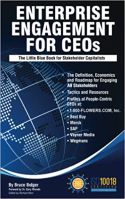
3. Books on implementation: Enterprise Engagement for CEOs and Enterprise Engagement: The Roadmap.
4. Advisory services and research: Strategic guidance, learning and certification on stakeholder management, measurement, metrics, and corporate sustainability reporting.
5. Permission-based targeted business development to identify and build relationships with the people most likely to buy.
Contact: Bruce Bolger at TheICEE.org; 914-591-7600, ext. 230.