

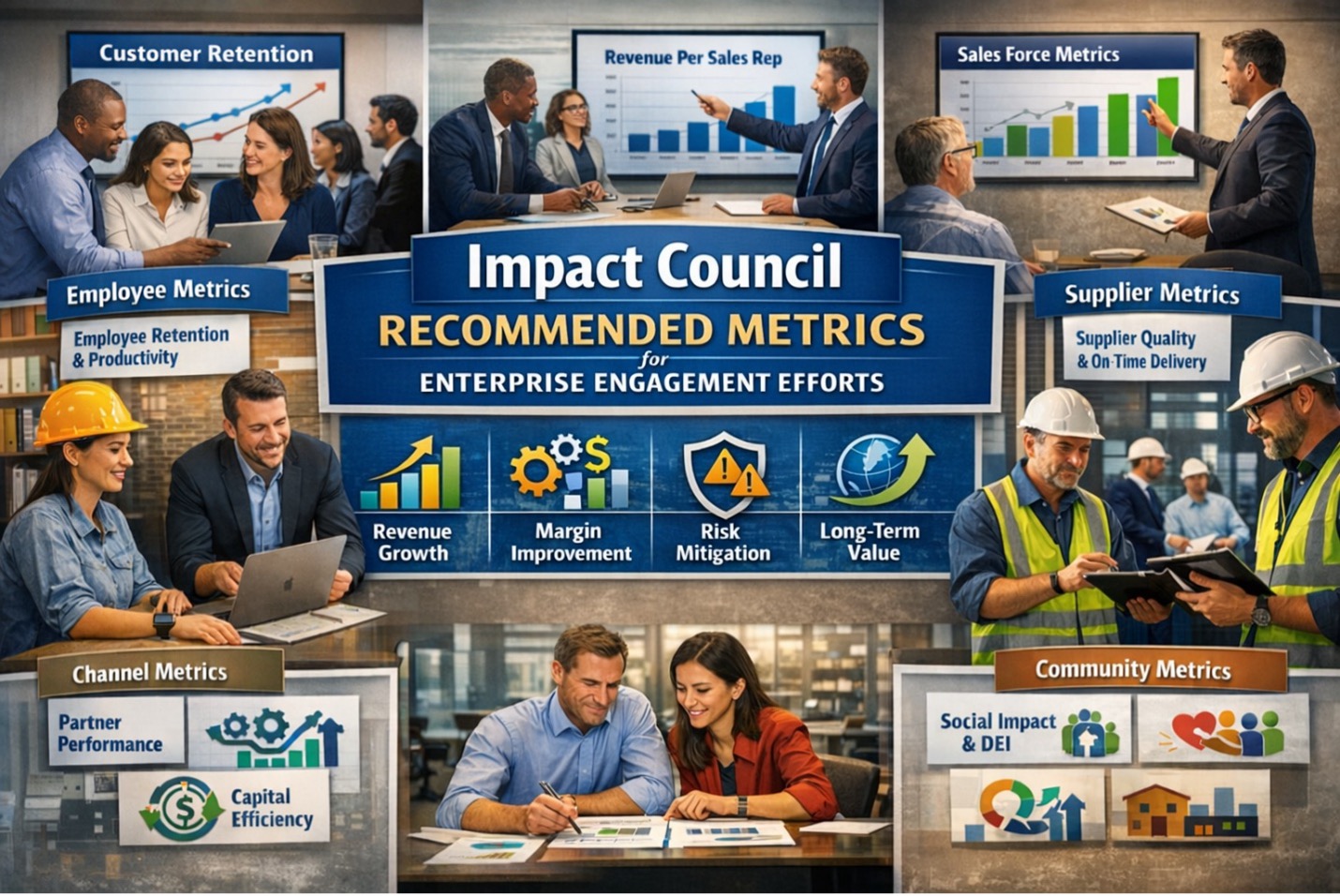
Impact Council Recommended Metrics for Enterprise Engagement Efforts
How the Metrics Were Selected
Customer Metrics
Sales Force Metrics
Non-Sales Employee Metrics
Channel Metrics
Supplier Metrics
Community/Society Metrics
Program Specific Metrics
Click here to subscribe to the ESM weekly e-newsletter.
 As a result of increasing talk about the importance of effective program design, measurement, and continuous improvement in engagement, a growing number of solution providers have begun to tout their commitment to impact measurement.
 The Impact Council has a two-part mission to ensure that marketers don’t turn impact measurement into another buzzword:
1) Create and continually build upon a library of Effective Practices and Impact Metrics anyone can use to design more meaningful strategies and tactics;
2) Develop and share meaningful metrics organizations can use for inspiration to develop their own metrics aligned with their purpose, goals, objectives.
These recommended metrics are designed to help organizations apply better metrics to their people strategies. They are not designed to replace current international or ISO disclosure standards. Rather, they select from those metrics and others specifically relevant to organizational value creation through people for the purposes of driving enhanced performance, not for voluntary or required disclosers.
For most of the categories, over a half-dozen or more metrics are suggested. Obviously, each organization will select the metrics most relevant to its purpose, goals, objectives, and values, and may be inspired by these to create others most appropriate to their purpose.
Developing and sharing metrics remains an ongoing EEA project. Readers are invited to submit their suggestions to Bruce Bolger, EEA Founder, at Bolger@TheEEA.org.
How the Metrics Were Selected
To select meaningful metrics for engagement program design from the hundreds available in multiple international standards, we started with the following CFO priorities.
1. Sustainable revenue growth. Not just top-line spikes — durable, repeatable growth driven by retention, pricing power, and expansion.
2. Margin expansion. Improving operating margin through productivity, efficiency, and cost discipline.
3. Capital efficiency. Maximizing return on invested capital (ROIC) and ensuring every dollar deployed produces incremental value.
4. Cash flow stability. Predictable revenue, costs, reduced volatility, and minimized operational risk.
5. Risk mitigation Reducing exposure to talent loss, supplier failure, reputational damage, and compliance breakdowns.
6. Long-term equity value creation. Improving enterprise value through durable competitive advantage, human capital strength, and stakeholder trust.
Each metric listed is selected because it meets at least one of the following financial criteria:
1. Direct Link to Revenue
- Customer Lifetime Value (CLV)
- Revenue per sales employee
- Revenue per active channel partner
2. Direct Link to Margin
- Human Capital ROI (HCROI)
- Cost per incremental revenue dollar
- Cost-to-serve per customer segment
3. Predictive of Retention (Revenue Durability)
- Customer retention rate
- Employee retention rate
- Partner retention rate
4. Indicator of Productivity
- Human Capital Value Add (HCVA)
- Revenue per employee
- Cycle time efficiency--meeting deadlines
5. Indicator of Risk Reduction
- Supplier defect rate
- Revenue concentration risk ratio
- Regulatory incident frequency
6. Leading Indicators of Future Performance
- Expressed engagement or appreciation scores
- Recognition-to-retention correlation
- Incentive behavioral change rate
These metrics are designed to help senior management assess whether engagement investments — including incentive, recognition programs, incentive travel, and motivational events, training, communications, DEI, etc. — are driving measurable enterprise value creation.
ISO, the International Organization for Standardization, has published a series of standards containing standardized mathematical calculations for some of these metrics.
Customer Metrics
Here are metrics predictive of revenue durability, pricing power, and brand equity.
1. Customer Lifetime Value (CLV) growth rate. Tracks trends in lifetime profitability per customer cohort. Predictive of future revenue and enterprise value.
2. Customer retention/churn rate. Retention is one of the strongest predictors of margin expansion and equity value.
3. Revenue per customer (by segment). Measures yield quality. Rising revenue per retained customer indicates engagement effectiveness.
4. Customer Acquisition Cost (CAC) to CLV ratio. Determines whether marketing engagement is building sustainable value or destroying capital.
5. Net Revenue Retention (NRR). Revenue growth from existing customers (expansion – churn).
Strong predictor of durable growth.
6. Customer Engagement Index. Composite of usage frequency, participation in loyalty programs, web site engagement, social media, event attendance, and feedback engagement.
7. Customer Referral Rate. Measures advocacy-driven growth through actions, not just surveys.
8. Cost-to-Serve per customer segment. Helps assess whether engagement reduces friction and service costs.
9. Brand trust expressed by engagement scores. Survey-based expressed commitment or preference strength.
10. Customer profitability by engagement tier. Compares highly engaged vs low-engagement customers.
11. Cost to replace a customer. Multiplied by number of lost customers.
12. Customer service satisfaction scores. A measure of the level of satisfaction of customer with service inquiries measured against average call resolution times.
13. Customer diversity. A measure of how well the customer base mirrors the demographic or regional opportunities of the organization.
Sales Force Metrics
These metrics are predictive of revenue growth and margin expansion.
1. Revenue per sales employee. Core productivity measure.
2. Sales Human Capital ROI (HCROI) calculation. (Revenue – Non-labor costs – Compensation) ÷ Compensation. Measures return on sales compensation investment.
3. Sales retention rate. High turnover erodes pipeline stability and increases replacement costs.
4. Incentive ROI per sales cohort. Incremental revenue attributable to incentive programs by employee, team.
5. Quota attainment distribution. Percentage of reps hitting quota and overperformance tier distribution.
6. Sales engagement assessment post and after program. How does the team feel before and after the program.
7. Sales engagement-to-performance correlation. Statistical link between engagement scores and sales output over time.
8. Pipeline velocity. Speed from opportunity creation to close.
9. Training investment per salesperson vs. performance lift. Measures effectiveness of motivational events, training, and enablement programs.
10. Cost per incremental revenue dollar. Evaluates sales incentive efficiency.
11. Recognition participation vs. retention correlation. Tests whether recognition programs contribute to salesforce stability.
12. Cost to replace salespeople. Multiplied by number of salespeople.
13. Sales force diversity. A measure of how well the sales force mirror the demographic or regional opportunities of the organization.
Non-Sales Employee Metrics
These metrics are predictive of productivity, quality, innovation, and cost management.
1. Human Capital Value Add (HCVA). (Revenue – Non-labor operating expenses) ÷ total number of employees indicates value created per employee.
2. Human Capital ROI (HCROI). (Revenue – Non-labor expenses – Labor cost) ÷ Labor cost
Measures return on workforce investment.
3. Revenues/profits per employee. Key productivity benchmark.
4. Employee retention/voluntary turnover rate. Turnover impacts replacement costs, internal and external service and productivity
5. Engagement Score/eNPS or actual number/value of referrals.
Expressed commitment level; strong predictor of retention and discretionary effort.
6. Quality defect rework rate. Correlates engagement to operational quality.
7. Absenteeism rate. High engagement typically reduces absence costs.
8. Innovation rate. New ideas implemented per employee or revenue from new products.
9. Internal mobility rate. Measures organizational adaptability and skill growth.
10. Recognition impact Index. Retention and productivity variance between recognized vs non-recognized employees.
11. Cost to replace employees. Multiplied by number of people.
12. Wellness metrics. In addition to other relevant metrics above: harassment or discrimination claims, increase in mental health issues, etc.
13. Diversity. A measure of how well employees mirror the demographic or regional opportunities of the organization.
Channel Metrics
These are predictive of market expansion and revenue scalability.
1. Revenue per active distribution partner. Measures channel productivity.
2. Partner retention rate. Predicts distribution stability.
3. Partner engagement index. Participation in training, events, incentive programs, or promotional programs, as well as engagement survey responses.
4. Channel incentive ROI. Incremental sales attributable to channel incentive programs.
5. Time-to-activation for new partners. Measures onboarding effectiveness.
6. Co-marketing fund utilization efficiency. Participation in and return on co-op marketing investments.
7. Partner profitability contribution. Gross margin by partner tier.
8. Partner satisfaction and trust score. Predictive of long-term collaboration.
9. Revenue concentration risk ratio. Measures reliance on top partners.
10. Channel cost-to-revenue ratio. Evaluates efficiency of partner engagement spend.
11. Cost to replace a channel partner. Multiplied by number of partners lost.
12. Distribution partner diversity. A measure of how well distribution partners mirror the demographic or regional opportunities of the organization.
Supplier Metrics
These are predictive of quality stability and cost control.
1. On-time delivery rate. Predictive of operational reliability.
2. Supplier defect rate or costs. Direct impact on quality and warranty costs.
3. Cost savings from supplier collaboration. Quantifies innovation or efficiency gains.
4. Supplier retention/stability Index. Reduces supply chain risk.
5. Procurement cost per unit. Engagement can improve cost competitiveness.
6. Supplier engagement score. Survey-based collaboration measure.
7. Joint innovation revenue contribution. Revenue derived from supplier co-development.
8. Contract compliance rate. Reduces legal and operational risk.
9. Risk diversification index. Measures supply chain concentration.
10. ESG/sustainability compliance score. Increasingly material to investor perception of risks.
11. Cost to replace supplier. Multiplied by cost of replacement.
12. Supplier diversity. A measure of how well suppliers mirror the demographic or regional opportunities of the organization.
Community/Society Metrics
Predictive of reputation, trust, and long-term license to operate.
1. Brand Trust Index. Community perception measurement.
2. Social Investment ROI. Measured economic return of community investments, in terms of brand awareness or activations; talent recruitment, sales, or other material impact related to the purpose of the effort.
3. Community Engagement Participation Rate. Employee/community involvement in initiatives.
4. Reputation Risk Index. Sentiment and media analysis.
5. Talent, customer, distribution partner or supplier attraction rate in local markets. Measures employer brand strength.
6. Regulatory incident frequency. Predictive of operational risk.
7. Volunteer hours vs. retention correlation. Links purpose engagement to employee loyalty.
8. Social impact per dollar invested. Efficiency of community programs measured against targeted outcomes.
9. Diversity. Having a demographic makeup of stakeholders consistent with the demographic opportunities of the organization in terms of attracting investors, customers, talent, distribution and supply chain partners, and supportive communities.
Program Specific Metrics
Here are suggested metrics across Incentive Programs, Recognition, Incentive Travel, Motivational Events subject to further refinement. Still to come: communications, training, innovation, DEI, etc.
Incentive Programs
- Incremental revenue per incentive dollar.
- Behavior change rate (target behavior adoption %).
- Cost per incremental performance unit.
- Retention impact of participants.
- Profit/sales contribution lift vs. control group.
- Level of engagement post and after the effort.
- Outcome of performance reviews if any.
- Participation in mentorship/training programs.
- Training test results.
- Participation in communications.
- Recognition frequency per employee and/or manager.
- Retention differential (recognized vs. not).
- Percent participating in manager or peer recognition, measured against tenure, performance reviews, etc.
- Productivity differential (revenues/costs per employee or other employee metrics above.)
- Engagement score uplift.
- Internal promotion rate of recognized employees.
- Outcome of performance reviews, if any are used.
- Participation rate in training vs. use of recognition tools.
- Participation in communications.
In addition to the metrics for incentive programs:
- Post-event performance lift (90–180 days).
- Participant retention rate.
- Revenue/profit growth of participants vs. non-participants.
- Engagement score change.
- Cost per sustained performance gain.
- Activation rate (behavior adoption post-event).
- Engagement lift duration.
- Revenue/productivity impact over time.
- Net promoter score of event/return rate.
- Cost per point engagement improvement.
- Post event participation in offered programs.
- Participation in communications pre- and post-event.
Enterprise Engagement Alliance Services
 Celebrating our 17th year, the Enterprise Engagement Alliance helps organizations enhance performance through:
1. Information and marketing opportunities on stakeholder management and total rewards:
- ESM Weekly on stakeholder management since 2009. Click here to subscribe; click here for media kit.
- RRN Weekly on total rewards since 1996. Click here to subscribe; click here for media kit.
- EEA YouTube channel on enterprise engagement, human capital, and total rewards since 2020
 Management Academy to enhance future equity value for your organization.
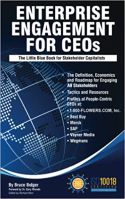
3. Books on implementation: Enterprise Engagement for CEOs and Enterprise Engagement: The Roadmap.
4. Advisory services and research: Strategic guidance, learning and certification on stakeholder management, measurement, metrics, and corporate sustainability reporting.
5. Permission-based targeted business development to identify and build relationships with the people most likely to buy.
Contact: Bruce Bolger at TheICEE.org; 914-591-7600, ext. 230.