

Meaningful Content and Permission: Marketings Last Credibility Anchors in the Age of AI and Impact Scrutiny
By Bruce Bolger
The Credibility Crisis: When Impact Measurement Becomes Existential
AI Isn’t the Disruption — Weak Strategy Is
Content Strategy: From Nice-to-Have to Mission-Critical
Permission Marketing: The Most Measurable Relationship Channel
Why Most Marketers Still Miss the Point
The Bottom Line: Impact Starts With Substance — and Engagement Validates It
Click here to subscribe to the ESM weekly e-newsletter.
According to new research from Gartner, more than 40% of CMOs (chief marketing officers) pushing for larger brand budgets will lose influence with the C-suite because they fail to demonstrate measurable impact. Meanwhile, Stefano Puntoni, writing for Harvard Business Review, argues that AI is fundamentally reshaping how consumers search and decide — and marketers who cling to fluff over substance will be left behind. The solution? A relentless focus on credible, measurable content and permission-based relationships that even the largest companies continue to overlook.
How do I do know? You know it too: You can measure it by the tremendous volume of meaningless, self-serving spam that fills you inbox from almost every major company you've ever done business with. One in a 100 at best does anything to help or usefully inform you other than by touting the next deal.
The Credibility Crisis: When Impact Measurement Becomes Existential 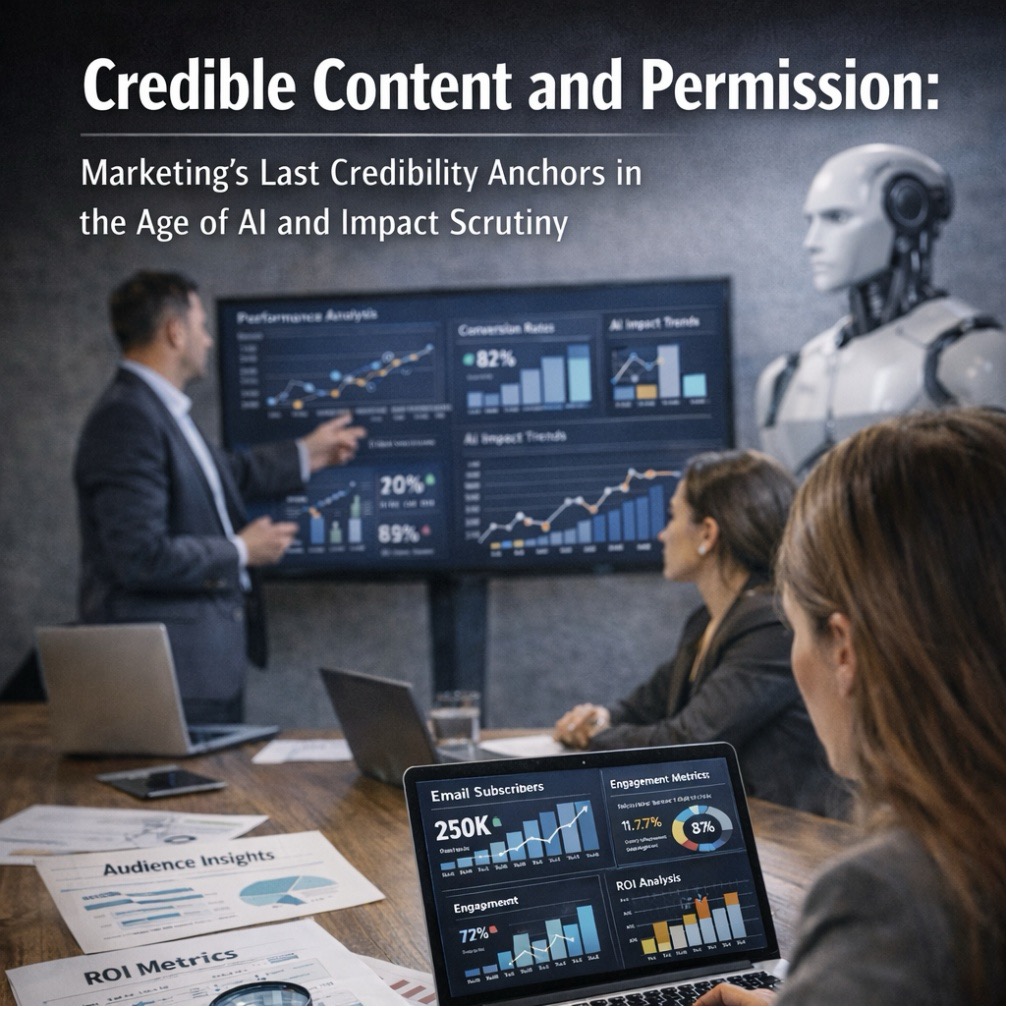
According to the Gartner report, by 2027 more than 40% of CMOs who push for larger brand budgets will lose influence with the C-suite because they are unable to demonstrate sufficient returns on their investments — a stark warning for marketing leaders who rely on intuition and reputation more than measurable results. To anyone in human resources, this sounds familiar. Gartner’s survey of senior marketing leaders found that 84% of companies are trapped in a “brand doom loop” — where underfunded measurement leads to unclear impact, rising skepticism, and tighter budgets. In such a loop, companies are half as likely to exceed growth targets compared to those that can actually evaluate brand value.
Gartner Vice President of Research Sharon Cantor Ceurvorst explains that underfunded measurement breeds C-suite skepticism and starves brand investment. The implications are profound: if CMOs can’t articulate where value comes from, they lose credibility.
AI Isn’t the Disruption — Weak Strategy Is
In the Harvard Business Review article, Stefano Puntoni, Marketing Professor at Wharton and Co-Director of the Wharton Human-AI Research initiative, makes a compelling point: AI is reshaping marketing on two fronts — how people search for information and what drives purchase decisions. According to Puntoni, conversational AI and agentic systems are increasingly displacing traditional websites and search as the starting point for discovery. This shift means that surface-level marketing content — the fluff that flows from slogans and broad claims — is no longer sufficient. Instead, discovery and decision engines reward objective, qualified, and credible content because AI relies on richness of context and factual relevance to make recommendations.
In other words: AI doesn’t make marketing obsolete — it exposes which type of marketing actually works: a focus on selling or on helping.
Content Strategy: From Nice-to-Have to Mission-Critical
Content has always played a role in brand building, but in the AI era, scale, authenticity and credibility matter more than ever. If AI assistants and discovery platforms are filtering and serving information based on relevance and authority, then the quality and quantity of that content directly influences visibility, trust and ultimately conversion. This shift means content can no longer be an afterthought — it must be strategic, evidence-based, measurable, and continuously refreshed. Marketers who produce content that AI and audiences recognize as credible don’t just rise above the noise — they own narratives on platforms that are increasingly algorithmic, context-driven, and impact-oriented.
Permission Marketing: The Most Measurable Relationship Channel
One of the biggest lessons from both Gartner’s warning and Puntoni’s AI insight is that traditional reach mechanics are less reliable and less measurable. In contrast, permission marketing — where individuals opt in to receive content directly — provides the strongest foundation for measurement: marketers know who their audience is, when they engage, and how that engagement changes over time. Opt-in newsletters, communities, and first-party subscription relationships are not just privacy-friendly — they are transparent, directly attributable, and defensible with the C-suite.
Many of the people who read Seth Godin’s foundational book on Permission Marketing appear to have read only the first part of the story: getting permission. Most appear to have ignored what to do with that permission.
Implemented with the purpose of helping and not selling, permission marketing insulates brands from AI-driven intermediaries. When brands cultivate direct relationships, they reduce reliance on external platforms and algorithms, gaining ownership of data, trust, and long-term impact metrics. In a world where first-party data is becoming scarce and AI platforms increasingly mediate discovery, owning that relationship is a competitive advantage and a measurement anchor.
The challenge is that most marketers use permission to spam us with offers, product news, and other self-serving content day after day. Some of the world’s best-known brands are also the best-known spammers because they have not a clue of how to use content to engage people.
Why Most Marketers Still Miss the Point
Despite the clear evidence, too many CMOs are doubling down on broad brand budgets without tying them to measurable outcomes. Gartner’s research highlights that many marketing leaders aren’t even leading core brand positioning activities — much less coherently linking strategy to measurable business results. This disconnect — between strategy and measurement, between content quality and outcomes — is precisely why many CMOs risk losing influence.
Despite all the claims of Google and social media advertising, spray and pray remains the predominant marketing method in a world of inadequate meaningful relationship building strategies or impact measurement. Organizations frequently overlook the best measurement of all: the number and quality from a commercial standpoint of the people who engage in its communications and the rate at which they become customers and so on.
The Bottom Line: Impact Starts With Substance — and Engagement Validates It
Marketing is at a crossroads. AI-driven discovery and decision models favor objectivity, depth, and relevance. C-suite scrutiny demands measurable returns. And the pathway that bridges those demands is strategic content anchored in measurable, permission-based relationships at a time when few marketers demonstrate much understanding of permission marketing.
For marketers who insist that brand and creativity define success, the reality is stark: without credible content and permission channels that deliver measurable insights, strategy is just noise. In an era of AI amplification and rigorous impact measurement, substance isn’t just valuable — it’s irreplaceable.
The challenge: most marketers have no training in creating or conveying objective, insight, and relevant information in the perpetual attempt to move us through their pipelines and funnels.
For an EEA report on effective permission marketing, click here.
Enterprise Engagement Alliance Services
 Celebrating our 17th year, the Enterprise Engagement Alliance helps organizations enhance performance through:
1. Information and marketing opportunities on stakeholder management and total rewards:
- ESM Weekly on stakeholder management since 2009. Click here to subscribe; click here for media kit.
- RRN Weekly on total rewards since 1996. Click here to subscribe; click here for media kit.
- EEA YouTube channel on enterprise engagement, human capital, and total rewards since 2020
 Management Academy to enhance future equity value for your organization.
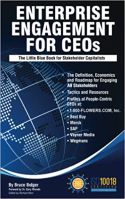
3. Books on implementation: Enterprise Engagement for CEOs and Enterprise Engagement: The Roadmap.
4. Advisory services and research: Strategic guidance, learning and certification on stakeholder management, measurement, metrics, and corporate sustainability reporting.
5. Permission-based targeted business development to identify and build relationships with the people most likely to buy.
Contact: Bruce Bolger at TheICEE.org; 914-591-7600, ext. 230.