

Gallup Survey Engagement Continues to Fall, With Costs Buried in Balance Sheets
 According to this latest US Gallup survey, employee engagement continues to ratchet down, with enormous costs buried in corporate balance sheets unequipped to expose the waste.
Younger Workers Are Disengaging—and the Financial Impact Is Compounding
Engagement Is Declining Because Basic Needs Are Being Missed
Performance Clarity Is a Hidden Engagement—and Value Driver
What Gallup Says Leaders Must Do Next
Click here to subscribe to the ESM weekly e-newsletter.
Employee engagement apparently is similar to waste and defects in manufacturing in the 1980s, when companies just buried the cost in their financials until competition from Japan exposed it.
Declining employee engagement should be a major CEO concern, as it is increasingly linked to weaker financial performance and reduced shareholder value. Multiple studies now show that companies with more engaged and happier employees deliver higher profits, stronger return on equity, and superior stock performance, raising the stakes of Gallup’s latest finding that US employee engagement has fallen sharply from its 2020 peak
Yet, in a report authored by Gallup’s Jim Harter, Chief Scientist of Workforce Management, just 31% of US employees are actively engaged at work in 2025, down from 36% in 2020. Each percentage-point decline represents roughly 1.6 million workers, meaning the engagement slide since 2020 equates to approximately 8 million fewer engaged employees—a workforce shift with measurable economic consequences, according to Gallup and other research.
That financial connection is increasingly supported by market-facing research. A Human Capital Factor (HCF) ratings system developed by Irrational Capital—and validated by the quantitative analytics team at J.P. Morgan—found that companies scoring higher on human capital factors demonstrate a greater potential for future equity value growth and stronger return on equity The findings suggest that employee engagement and culture are not soft metrics, but leading indicators of financial performance.
Workers Are Disengaging—and the Financial Impact Is Compounding .png)
Gallup’s data show the steepest engagement declines among Generation Z and millennials, the very cohorts that represent the future leadership and productivity pipeline. Engagement among Gen Z and younger millennials dropped eight points between 2020 and 2025, while older millennials declined nine points. By contrast, baby boomers saw no change.
According to Harter, these declines are driven by fundamental breakdowns in how work is experienced. Younger employees report sharp drops in feeling cared about and in having opportunities to learn and grow—two factors that Gallup has long tied to performance, retention, and discretionary effort.
In 2025, only 41% of Gen Z and younger millennials strongly agreed that someone at work cares about them as a person, down from 54% in 2020. Agreement that they had opportunities to learn and grow fell to 37%, down 11 points over the same period.
Independent academic research reinforces the financial implications of this disengagement. A study conducted by the Oxford University Wellbeing Research Centre found that companies with happier employees generate higher profits, stronger company valuations, and better long-term stock performance than their peers. The study provides empirical evidence that employee wellbeing is directly correlated with shareholder returns—not merely a cultural benefit.
Engagement Is Declining Because Basic Needs Are Being Missed
Gallup’s analysis shows that engagement erosion across the workforce centers on clarity, communication, and respect. Since 2020, the largest declines across Gallup’s Employee Engagement Index have been in clarity about expectations and feeling cared about as a person. Qualitative responses reveal that 35% of employees say better communication would most help them understand what is expected of them at work. Employees are asking for clearer direction from leadership, transparency around strategy, and more consistent conversations about performance and career paths.
Similarly, when asked what would help them feel more cared about, employees most often point to supportive relationships, respect, and being listened to, followed by pay and job security. These findings suggest that disengagement is not driven solely by compensation pressures, but by everyday leadership behaviors that shape trust and motivation.
Performance Clarity Is a Hidden Engagement—and Value Driver
Gallup also found widespread confusion about what constitutes exceptional performance, even among leaders. Fewer than one-third of leaders strongly agree they have a clear definition of excellence in their role, and only about one in five managers and individual contributors say the same.
This matters financially. Gallup found that employees with clear performance expectations are nearly four times as likely to be engaged, and leaders with that clarity are almost three times as likely to be engaged. Engagement, in turn, has been repeatedly linked to productivity, retention, customer outcomes—and now, increasingly, equity performance.
The connection between people metrics and financial value creation was also highlighted in The Human Capital Factor: Turning People Metrics into Durable Alpha for Investors and Companies, a feature discussion hosted by the Enterprise Engagement Alliance Stakeholder Management Forum. The panel found broad agreement among investors, executives, and analysts that human capital factors are highly predictive of future equity value, even though most organizations are still early in learning how to operationalize them.
What Gallup Says Leaders Must Do Next
Gallup concludes that the post-pandemic engagement decline reflects stalled—or reversed—progress in clarifying expectations, developing people, and improving the daily work experience. Younger workers are especially vulnerable because they rely more heavily on feedback, coaching, and visible growth paths. To reverse the trend, Gallup urges leaders to:
- Restore role and performance clarity, especially during periods of change.
- Improve manager-led communication and feedback.
- Invest in development and career growth, particularly for early-career employees.
- Rebuild cultures where employees feel heard, respected, and genuinely cared about.
As engagement declines, so too may the financial performance companies depend on. Organizations that reconnect people strategy to performance outcomes will be best positioned to protect both their workforce—and their balance sheets.
Enterprise Engagement Alliance Services
 Celebrating our 17th year, the Enterprise Engagement Alliance helps organizations enhance performance through:
1. Information and marketing opportunities on stakeholder management and total rewards:
- ESM Weekly on stakeholder management since 2009. Click here to subscribe; click here for media kit.
- RRN Weekly on total rewards since 1996. Click here to subscribe; click here for media kit.
- EEA YouTube channel on enterprise engagement, human capital, and total rewards since 2020
 Management Academy to enhance future equity value for your organization.
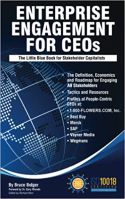
3. Books on implementation: Enterprise Engagement for CEOs and Enterprise Engagement: The Roadmap.
4. Advisory services and research: Strategic guidance, learning and certification on stakeholder management, measurement, metrics, and corporate sustainability reporting.
5. Permission-based targeted business development to identify and build relationships with the people most likely to buy.
Contact: Bruce Bolger at TheICEE.org; 914-591-7600, ext. 230.