

Stakeholder Capitalism vs. Shareholder Primacy: A Surprisingly Aligned Debate Between Stefan Padfield and Bruce Bolger
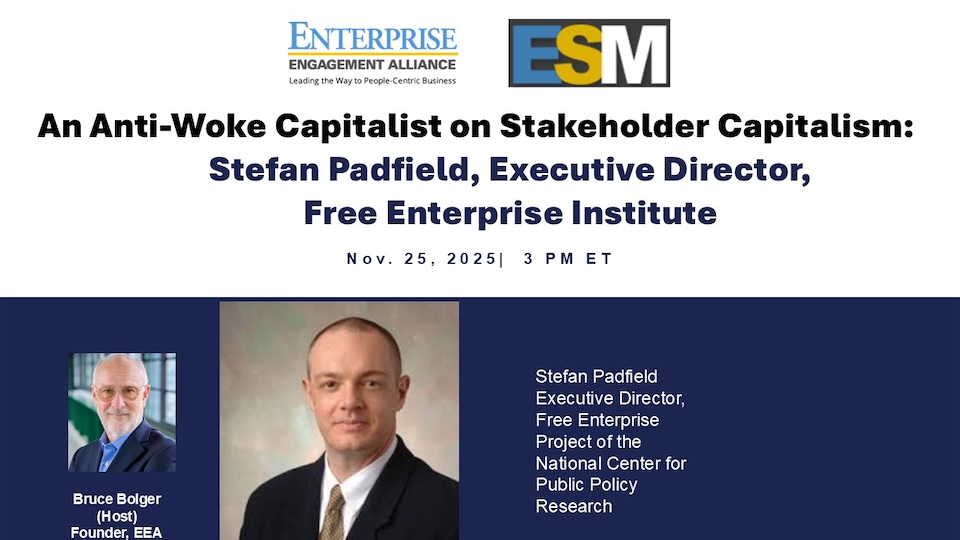 In a civil exchange, a proponent of shareholder capitalism and of stakeholder capitalism explore the tension between stakeholder capitalism, ESG, DEI, and traditional shareholder-value maximization. Despite their different starting points, the two discover more alignment than disagreement.
Padfield’s Position: Defending Capitalism With a Clear Yardstick
Bolger’s Position: Stakeholder Management Is Better Capitalism, Not Politics
Where They Agree
Where They Disagree
Click here to subscribe to the ESM weekly e-newsletter.
Stefan Padfield—Executive Director of the Free Enterprise Project at the National Center for Public Policy Research, is a staunch proponent of shareholder capitalism. While he sees merit in elements of stakeholder capitalism, the term he says is too tainted to use. Bruce Bolger, Founder of the Enterprise Engagement Alliance, publisher of ESM, argues that stakeholder management is simply a better form of capitalism, that an already ambiguous definition was deliberately turned into a straw man by opponents, and that term shareholder capitalism today has become hopelessly tainted.
The dialogue raises an important question for modern capitalism: Can stakeholder principles and shareholder primacy coexist—and even reinforce each other—if stripped of politics and grounded in value creation?
Padfield’s Position: Defending Capitalism With a Clear Yardstick
Padfield’s central argument is straightforward:
Shareholder wealth maximization—within ethical and legal boundaries—remains the most reliable, objective, and accountable guiding principle for corporate governance. From his perspective:
1. Capitalism already requires stakeholder considerations. A rational profit-oriented business must consider employees, customers, suppliers, communities, and reputation. These inputs are already baked in to maximizing long-term shareholder value, he says.
2. Stakeholder capitalism is tainted. Padfield views the modern stakeholder-capitalism movement as:
· Vague and easily exploited
· A way to justify corporate political agendas
· A “blank check” that allows managers to spend shareholder resources on causes unrelated to value creation
· A rhetorical gateway to socialism or government-directed corporate behavior
3. ESG and DEI suffer from lack of discipline. Padfield argues that:
· Few ESG initiatives undergo basic ROI or Net Present Value analysis (a calculation of return on investment)
· DEI has largely turned into race-based preferences, stigmatizing recipients and risking legal violations
· Much corporate action has been driven by echo chambers, PR teams, and political pressure—not finance or strategy
4. Better accountability is the fix—not new ideologies. Padfield supports:
· Enforcement of existing laws (fraud, pollution, discrimination).
· Targeted regulation to protect markets
· Transparent, shareholder-centric evaluation of all initiatives—including ESG and human-capital investments
His team at the Free Enterprise Project is already filing shareholder proposals requiring companies to document ROI calculations for ESG and DEI programs—efforts he believes could produce an “earthquake” in corporate governance.
Bolger’s Position: Stakeholder Management Is Better Capitalism, Not Politics
Bolger agrees with Padfield’s critique of the press releases and related virtue-signaling about stakeholder capitalism, but argues that is due to its misuse by corporate PR departments, activists, and poorly trained executives. The authentic version going back to W. Edwards Deming and Peter Drucker, he insists, has nothing to do with politics or social engineering.
1. Current shareholder capitalism is inefficient and wasteful. Bolger notes that many companies deliberately extract value from stakeholders for the benefit of shareholders or worse yet offload costs on to communities and tax payers. He notes that most companies:
· Do not measure human capital or the cost of poor service or misleading advertising
· Overlook employee value on balance sheets because it's buried under “goodwill”
· Accept high turnover, poor customer experience, and quality problems
· Fail to quantify the economic impact of people management
This negligence creates massive inefficiencies and destroys long-term value, he believes.
2. True stakeholder management is Total Quality Management for people. Drawing on the work of W. Edwards Deming, Bolger describes stakeholder capitalism as:
- A systematic method of harmonizing stakeholder and shareholder interests toward a common, transparent purpose, goals, objectives and values.
- A philosophy used by high-performing companies like Costco, Delta, Southwest (historically), Wegmans, and others In this framing, stakeholder capitalism is: Simply better capitalism—not a political project.
3. DEI needs to be replaced with opportunity-based approaches. Bolger strongly criticizes the wave of post-George Floyd corporate DEI initiatives, but, unlike Padfield, maintains that companies still need diverse workforces for business—not moral—reasons. He advocates for:
· Race-neutral, economically targeted opportunities especially for children, young people, and seniors
· Company-run academies and training for disadvantaged communities
· Talent-pipeline development driven by labor-market needs
· Measurable human-capital ROI analysis and appropriate actions to optimize performance through people
4. ESG should focus on risk mitigation, not activism. Bolger shares the example of PCB contamination in the Hudson River—costs now borne by modern shareholders—which reinforces his view that ignoring environmental externalities ultimately harms investors as well as people and society. His version of ESG is practical:
· Lower risk
· Protect long-term enterprise value
· Avoid harming people and communities that companies rely on
Where They Agree
Despite the differences, the two speakers agree on major points:
1. Virtue signaling has damaged both sides. Corporate responses to the 2008 financial crisis, George Floyd, ESG pressures, and the Business Roundtable statement were largely hypocritical, unmeasured, and counterproductive.
2. Companies should stay out of unrelated politics. Corporate activism not tied to the business mission harms trust and confuses responsibilities.
3. Better metrics are essential. Both want:
· ROI on human-capital practices
· Hard metrics for culture, turnover, productivity, and stakeholder value
4. Government plays a role but should be limited. Both support:
· Anti-fraud, anti-pollution, anti-discrimination enforcement
· Predictable rules for markets
· Avoiding government overreach into corporate purpose
5. Capitalism needs better communication. They agree younger generations are rejecting capitalism, and business leaders must communicate its value more clearly—not through moralizing but through action and performance.
Where They Still Disagree
1. The Term “Stakeholder Capitalism” Itself
· Padfield: The label is irreparably damaged and routinely exploited to justify political agendas.
· Bolger: The term was hijacked but can be reclaimed; it describes genuine management science that predates the activism.
2. Risk of Slippery Slopes
· Padfield: Stakeholder language invites creeping socialism.
· Bolger: That’s a misunderstanding; misusers are the problem, not the concept.
3. Interpretation of DEI
· Padfield: DEI has become discriminatory and should be replaced with race-neutral approaches.
· Bolger: Agrees about misuses but insists business-driven diversity remains essential for competitiveness.
Both sides agree that a core failure of modern capitalism is measurement—especially human-capital measurement.
· Padfield wants ROI analysis for ESG/DEI to expose weak initiatives.
· Bolger wants standardized people-management metrics to drive better performance.
Their shared conclusion: The next competitive revolution will be built on quantifying stakeholder value—not preaching it. This unanticipated convergence—coming from two ideological opposites—may be the most important sign yet that the future of capitalism will be data-driven stakeholder management grounded in shareholder returns, not political activism.
Enterprise Engagement Alliance Services
 Celebrating our 15th year, the Enterprise Engagement Alliance helps organizations enhance performance through:
1. Information and marketing opportunities on stakeholder management and total rewards:
- ESM Weekly on stakeholder management since 2009. Click here to subscribe; click here for media kit.
- RRN Weekly on total rewards since 1996. Click here to subscribe; click here for media kit.
- EEA YouTube channel on enterprise engagement, human capital, and total rewards since 2020
 Management Academy to enhance future equity value for your organization.
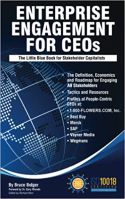
3. Books on implementation: Enterprise Engagement for CEOs and Enterprise Engagement: The Roadmap.
4. Advisory services and research: Strategic guidance, learning and certification on stakeholder management, measurement, metrics, and corporate sustainability reporting.
5. Permission-based targeted business development to identify and build relationships with the people most likely to buy.
Contact: Bruce Bolger at TheICEE.org; 914-591-7600, ext. 230.