

New Big-Data Study Finds Correlation Between Strong Cultures, Fewer Managers
 A recent academic study finds that companies with stronger, more widely shared cultures tend to have fewer managers per employee—suggesting that culture and hierarchy may be alternative ways to align people.
Methodology
Key Findings
Implications and Caveats for ESM Readers
Click here to subscribe to the ESM weekly e-newsletter.
 When culture and purpose are real—shared, lived, and reinforced—organizations can do more with fewer layers of control, while better aligning the interests of all stakeholders, according to a new Strategic Management Journal study: Are Less Hierarchical Firms Organized Around Stronger Cultures? Evidence From Big Data by Arianna Marchetti, Assistant Professor at Singapore Management University and Phanish Puranam, Professor of Strategy at INSEAD, Fontainebleau, France.
The authors set out to test a question: If organizations flatten their hierarchies, can a strong culture take over much of the coordinating and controlling work traditionally done by managers? Using a uniquely large data set—1.5 million Glassdoor employee reviews and 42 million online professional profiles for 23,000 US firms—the researchers show a clear pattern: firms with stronger cultures rely on a lower share of managers in their workforce.
The study finds no evidence that hierarchy automatically fragments culture. Instead, the data support the idea that both strong culture and managerial hierarchy can produce “integration of effort”—the cooperation and coordination needed for performance. Organizations can lean more on one or the other, but they are, in effect, different tools for achieving similar ends, the authors believe.
The authors note important caveats: the analysis is correlational, not causal, meaning these factors are inter-related but may not be a cause of one another. Glassdoor reviewers may not perfectly represent entire workforces, and managerial status they admit is inferred from profile data.
Methodology
To move beyond anecdotes about famously “flat” companies, the authors used two large-scale data sources:
Culture from Glassdoor. The authors analyzed the “pros” sections of 1.5 million Glassdoor reviews as signals of what employees most value about their organizations. Using topic modeling (Latent Dirichlet Allocation), they identified the main themes employees talk about and then measured cultural strength as the degree to which:
· Employees focus intensely on a relatively small set of attributes, and
· Employees agree with one another about which attributes matter most.
They define a strong culture as one in which people care a lot about the same things, not just any things.
Hierarchy from professional profiles. Drawing on 42 million career profiles from workforce analytics firm Revelio Labs, the authors built a four-level seniority scale that distinguishes managers from non-managers. Managerial intensity is defined as the share of employees in each firm who occupy senior roles that typically involve supervision.
They linked the Glassdoor and Revelio data at the firm level and controlled for a wide set of factors that could influence both hierarchy and culture: revenue, size, age, industry, geography, employee tenure, skill diversification, and even detailed “cultural content” (e.g., innovation, customer focus, etc.).
To probe the mechanisms, they also created a text-based measure of integration of effort—how much reviews emphasize cooperation and coordination—and used matching and interaction tests to see whether the negative relationship between culture and hierarchy holds when firms appear to have similar levels of integration.
Key Findings
1. Stronger cultures, fewer managers. Across nearly 23,000 firms, there is a robust negative relationship between cultural strength and managerial intensity. In practical terms, organizations where employees strongly share a focused set of values and norms typically have leaner layers of management.
2. Culture and hierarchy as alternative “control systems.” When the authors compare firms that appear to achieve similar levels of integration of effort, the negative association between culture and hierarchy persists. This supports the functional equivalence view: both strong culture and managerial hierarchy can align behavior and decisions, but firms that excel at one tend to need less of the other.
3. Little evidence that hierarchy fragments culture. If hierarchy directly weakened culture by creating isolated silos, we would expect its effect to diminish in older firms or in firms with longer-tenured employees, where informal networks can cut across formal reporting lines. The study instead finds the opposite pattern, weakening the case for a simple “hierarchy destroys culture” story.
Implications and Caveats for ESM Readers
For CEOs, CHROs, and engagement strategists focused on stakeholder management, the message is straightforward:
· You can’t successfully “de-layer” without culture. Efforts to reduce the number of managers are most likely to succeed when accompanied by deliberate investments in culture-building—clear values, careful selection, socialization, and consistent reinforcement.
· Culture strength matters as much as culture content. The study shows that it’s the shared intensity of culture that reduces the need for supervisory control, not any particular set of values. For stakeholder-focused organizations, this means pairing strong, coherent culture with content that emphasizes purpose, inclusion, ethics, customer experience, and other stakeholder outcomes.
· Different contexts call for different mixes. In highly regulated or routine environments, a denser managerial hierarchy may remain necessary. In more innovative or knowledge-driven settings, organizations may be able to trade some managerial headcount for stronger culture and empowerment—if they are willing to invest in it.
Enterprise Engagement Alliance Services
 Celebrating our 15th year, the Enterprise Engagement Alliance helps organizations enhance performance through:
1. Information and marketing opportunities on stakeholder management and total rewards:
- ESM Weekly on stakeholder management since 2009. Click here to subscribe; click here for media kit.
- RRN Weekly on total rewards since 1996. Click here to subscribe; click here for media kit.
- EEA YouTube channel on enterprise engagement, human capital, and total rewards since 2020
 Management Academy to enhance future equity value for your organization.
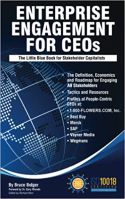
3. Books on implementation: Enterprise Engagement for CEOs and Enterprise Engagement: The Roadmap.
4. Advisory services and research: Strategic guidance, learning and certification on stakeholder management, measurement, metrics, and corporate sustainability reporting.
5. Permission-based targeted business development to identify and build relationships with the people most likely to buy.
Contact: Bruce Bolger at TheICEE.org; 914-591-7600, ext. 230.