Channel Impact Measurement: From Spiffs to Strategy How a Holistic Incentive Program Drives Growth
 This theoretical case study is designed to demonstrate how the principles of holistic engagement process design long proven in total quality management can easily be tested. This article hypothesizes what would happen if a company shifted its dealer incentive program budget from short-term spiffs (cash incentives) to a comprehensive engagement strategy. This case study shows how organizations can easily test the benefits of a more systematic approach to engagement.
In response to the increasing demand for measurability in the world of engagement, the
Enterprise Engagement Alliance in conjunction with its
Impact Council is developing a set of open-source processes and metrics to help organizations measure the impact of almost any type of people engagement process. Statistical process controls were first proposed for this use by the American Productivity and Quality Center in a report entitled, “
Master Measurement Model” for the Incentive Research Foundation in the early 2000s.
The EEA freely shares the methodology because it’s already used in probably over one million companies as part of total quality management practices. In fact, the concept of using statistical process controls involving people is baked into the
14 Management Principles of W. Edward Deming, one of the early innovators in management consulting and total quality management.
The
Enterprise Engagement Alliance Impact Academy provides formal training on the implementation of this process and provides customizable ROI templates and the PVIC software analytics tools to help companies and solution providers better analyze impact and correlations. For organizations seeking an outside expert, the
International Center for Enterprise Engagement is the first to offer these services.
, organizations can easily test the benefits of a more systematic approach to engagement.
1. An Example of Holistic Program Design
2. Comprehensive Impact Metrics
3. Results Backed by Data That Speaks for Itself
Key Insights: Why Holistic Incentives Win
Insights or the Industry
Click here to subscribe to the ESM weekly e-newsletter.
This hypothetical case study, based on years of research and recommendations from industry organizations such as the Incentive Research Foundation,
Incentive Marketing Association, and the Enterprise Engagement Alliance, illustrates the ease with which a holistic channel engagement process can be tested and measured. It is designed to demonstrate how organizations can measure the impact of effective design, implementation, and metrics in any people management endeavor as well as demonstrate the ability to test a holistic approach. It is based on practices long proven and regularly used in total quality management around the world.
In response to the increasing demand for measurability in the world of engagement, the
Enterprise Engagement Alliance in conjunction with its
Impact Council is developing a set of open-source processes and metrics to help organizations measure the impact of almost any type of people engagement process. Statistical process controls were first proposed for this use by the American Productivity and Quality Center in a report entitled, “
Master Measurement Model” produced for the Incentive Research Foundation in the early 2000s.
The EEA freely shares the methodology because it’s already used in probably over one million companies as part of total quality management practices, including in hospitals where people play a critical role in quality and safety. In fact, the concept of using statistical process controls for managing people endeavors is baked into the
14 Management Principles of W. Edward Deming, one of the early innovators in management consulting and total quality management.
The
Enterprise Engagement Alliance Impact Academy provides formal training on the implementation of this process and provides customizable ROI templates and the PVIC analytics tools to help companies and solution providers better analyze impact and correlations. For organizations seeking an outside expert, the
International Center for Enterprise Engagement is the first to offer these services.
1. An Example of Holistic Program Design
For years, this farm equipment company relied on spiffs — short-term cash sales performance incentives — to motivate retailers and wholesalers. Spiffs delivered quick bursts of revenue but failed to build long-term dealer commitment, skills, or network health. The channel management questioned the sustainability of the spiff approach and implemented a holistic system for two years until the company was sold to a private equity firm. The CEO shut the program down believing it was too complicated, so that the impact of the program and its elimination could be tracked the year after.
Their strategy aligns with this recent Enterprise Engagement Alliance YouTube show on
channel engagement effective practices.
.png)
As an alternative to straight cash incentives for sales, channel management reallocated its marketing budget over two years:
-
70% dedicated to a holistic incentive program,
-
30% retained for spiffs.
The goal: Measure whether a balanced approach could deliver better ROI, engagement, and sustainable growth — and prove it with statistical process controls.
Establish the framework. Understanding that businesses and people are complex, a holistic approach starts with determining the purpose, goals, and objectives of the effort and specifically how the customer or internal customers will benefit—in this case the dealer owners and salespeople. What value will you create for them; how will your proposition be communicated and absorbed over time in a crowded market; how will people be made to feel appreciated for their efforts so that you stand out from your competitors over time; how will the impact be measured.
Listen. The company held a meeting with a group of its leading distribution partners as well as a few who did not do business with it to identify the factors they felt affected their commitment to one brand over another.
Feedback. The process found that the dealers valued above all efforts to help them build overall sales, not simply rob sales from one brand to buy other. This, they said, included: co-op marketing that enabled them to draw more people into their warehouses and stores; more effective sales training not just on the products but on the categories they serve based on seasonality; more engaging communications to make sure salespeople had the critical information they needed at the point of sale; and tangible rewards and other efforts to introduce an element of purpose and fun to what can be a tough job.
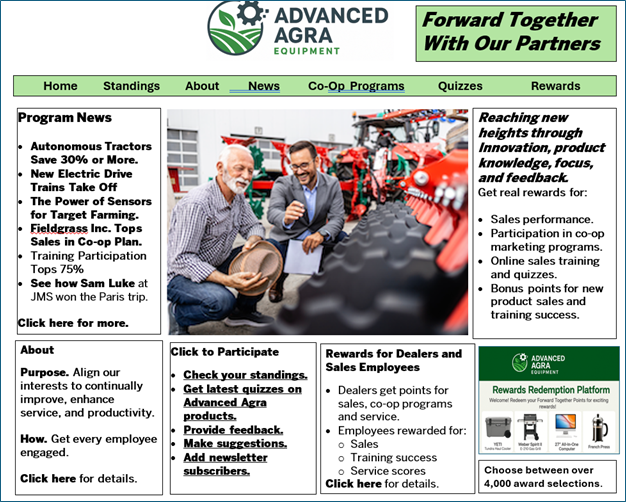
Develop the plan. The company hired an engagement agency to design a program supported by an enterprise engagement echnology to align all of the key tactics on a single platform to harmonize interests.
-
An optional co-op marketing program for dealers to not only support the manufacturer's brand but also that of the wholesaler.
-
An enterprise engagement smart phone app with an information, communications and training platform providing regular bursts of concise useful information and training not only about its brand but the category, enabling salespeople to earn points for successful completion and learn about how other salespeople succeed in this category.
-
The app provided information not only on the brand but also on the category, providing an objective information hub available at the point of sale.
-
The strategy. The agency created an overall story and theme for the brand based on its history, culture, unique selling benefits, and features identified by customers as of most value to their farms. It wove a year-long campaign into sound bites of useful information, success stories, challenges across the communications and training platform, all focusing on helping rather than selling to the salespeople.
-
The rewards. To offset the potential negative impact of reducing cash spiffs, the company introduced a dramatic incentive travel program with an attention-getting destination for the top performing dealers and salespeople and significant others; an online catalog of the latest, most popular brands, retail gift cards, and individual travel for which salespeople could use their points, including the ability to use their spiffs toward the rewards.
-
Impact metrics. The company selected five key metrics to focus on for the program:
-
Overall distributor sales and profits and average per distributor
-
Overall distributor sales engagement scores
-
Successful completion of training
-
Participation in co-op marketing program
-
Engagement in communications
2. Comprehensive Impact Metrics
The channel management team worked with the agency to create a formal impact metrics template in Excel based on all the data it already had available in
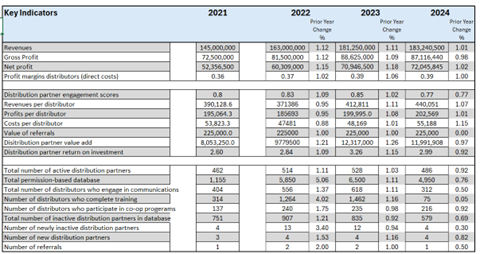
the organization, including:
-
Financials: revenues and profits in its wholesale division.
-
Engagement: training participation, communications, co-op marketing activity, feedback and engagement survey scores with salespeople through the platform. These were organized into Excel templates as a baseline for measurement.
-
The engagement agency employed an analytics platform enabling it to quickly track and compare results over time, looking to see if the co-op, training, and communications effort had any impact on dealer sales, profits, and engagement.
3. Results Backed by Data That Speaks for Itself
Rather than wait until the end of the program each year, the team used the measurement platform to track results all along, so that it did not have to wait until the end of the year to see if the effort failed to drive participation in the co-op, communications, and training program, or to affect engagement. Because the metrics platform remained in place, the company could see what happened after the elimination of the program.
Growth and Return on Investment
-
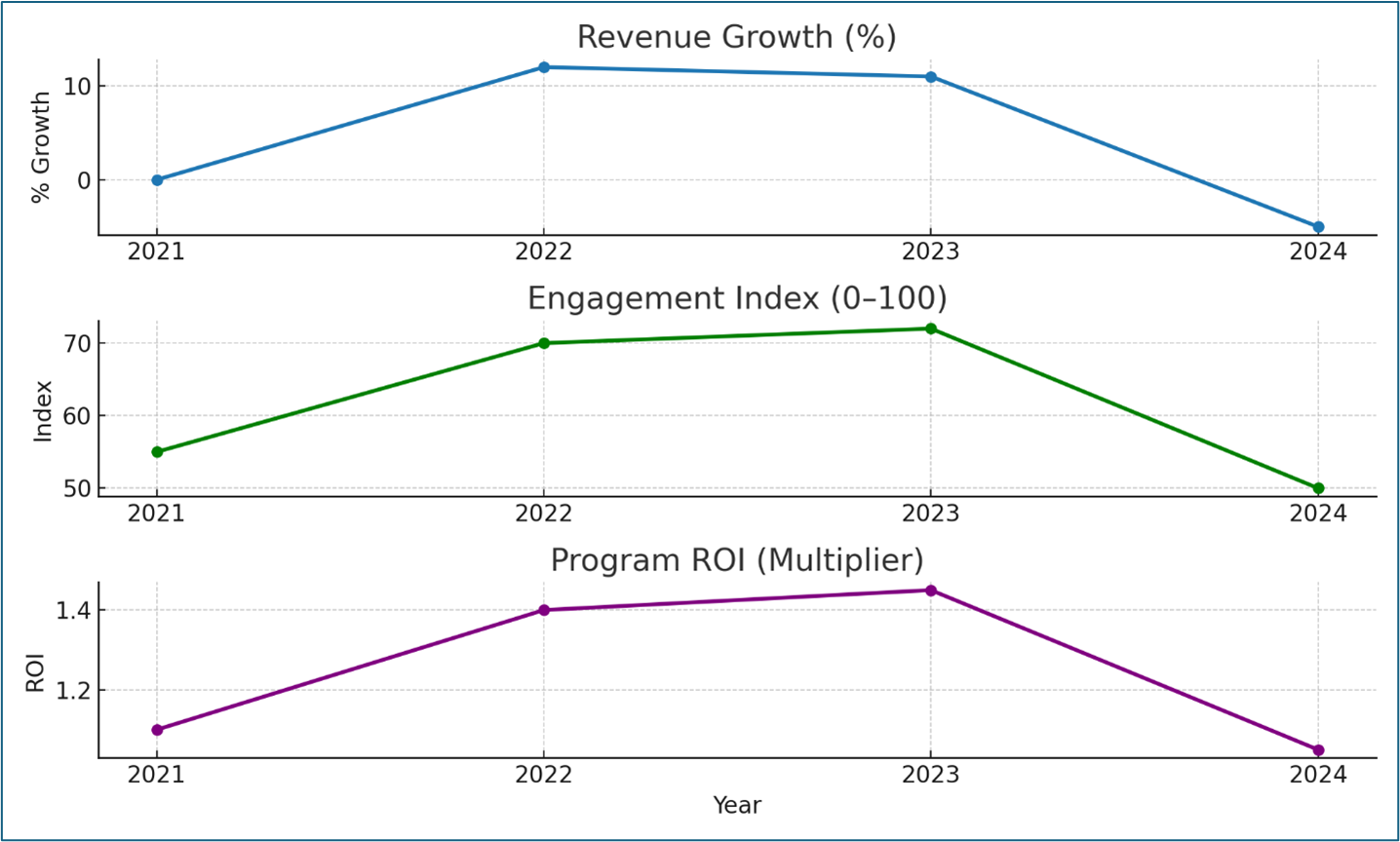
During the integrated program years (2022–23):
-
Revenue grew by 12% and by 11% during the two years of the program.
-
Net profit grew by 15% and 18% respectively.
-
In 2024, when spiffs were reinstated as the primary driver:
-
Revenue growth slowed to +1%
-
Direct marketing expense ROI fell to 3%
Partner Economics
Profits per distributor improved along with value-added services and ROI during the incentive program years, only to fall again when the program was halted.
Engagement
-
Engagement scores climbed from 0.76 to 0.85, then dropped back to 0.77 in 2024.
-
Training completions surged from 314 to1,462, collapsing to just 75 under the spiff-only strategy.
-
Communications, co-op participation, and partner collaboration spiked during the integrated program — then fell sharply afterward.
Network Health
-
Active distributors rose from 462 to 528 during the program, then dropped to 486.
-
Referrals: remained generally flat — revealing a future growth opportunity to tap or the generally unlikeness of dealers referring other dealers in general.
Key Insights: Why Holistic Incentives Win
The results should come as no surprise. A program that relies largely on compensation to motivate dealers and salespeople overlooks the basic psychology
of ownership and sales. Both owners and salespeople seek not just compensation but all the information and capabilities needed to enhance their businesses or performance and if possible more engaging experiences along the way.
While continuation of the program likely would have yielded more insights, the analysis shows that integrated incentive programs do more than drive transactions — they create a virtuous cycle of growth by addressing all the factors that connect engagement to performance:
-
A sense of purpose: A conviction that participation will help my business or career.
-
Skills and knowledge: The information and tools I need to help customers.
-
Stronger relationships: Ongoing communication and co-op support to keep partners aligned.
-
Long-term ROI: Growth compounds when partners are engaged beyond short-term deals.
-
The impact of tangible rewards: Inspiring top performers with a bucket-list trip with a significant others to aspire to and offering the middle 60% the ability to enjoy some fun to share with their family and friends helped the brand stand out from the others.
By contrast, spiffs alone maintain sales activity but do not address all the factors that engage people in doing those things that if done more of will yield tangible, sustainable results.
Insights for the Industry
This theoretical case study demonstrates how any company can use holistic design principles, planning practices and statistical process controls to design, implement and measure the effectiveness of any engagement strategy — whether testing incentive programs, partner training, or communication campaigns.
Best practices include:
-
Listening to the customer to identify what helps their business as well as yours.
-
Setting up clean data templates from the start.
-
Using correlation analysis to prove what’s working.
-
Applying global standards for authority and comparability.
It’s easy to test the process. Today’s modern engagement agencies provide the communications, learning, technology and rewards platforms to support this model, and most organizations have more than enough data to measure the actual impact.
Enterprise Engagement Alliance Services
 Celebrating our 15th year, the Enterprise Engagement Alliance helps organizations enhance performance through:
1. Information and marketing opportunities on stakeholder management and total rewards:
2. Learning: Purpose Leadership and Stakeholder
Celebrating our 15th year, the Enterprise Engagement Alliance helps organizations enhance performance through:
1. Information and marketing opportunities on stakeholder management and total rewards:
2. Learning: Purpose Leadership and Stakeholder Management Academy to enhance future equity value for your organization.
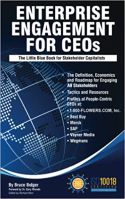
3. Books on implementation: Enterprise Engagement for CEOs and Enterprise Engagement: The Roadmap.
4. Advisory services and research: Strategic guidance, learning and certification on stakeholder management, measurement, metrics, and corporate sustainability reporting.
5. Permission-based targeted business development to identify and build relationships with the people most likely to buy.
Contact: Bruce Bolger at TheICEE.org; 914-591-7600, ext. 230.
Management Academy to enhance future equity value for your organization.
3. Books on implementation: Enterprise Engagement for CEOs and Enterprise Engagement: The Roadmap.
4. Advisory services and research: Strategic guidance, learning and certification on stakeholder management, measurement, metrics, and corporate sustainability reporting.
5. Permission-based targeted business development to identify and build relationships with the people most likely to buy.
Contact: Bruce Bolger at TheICEE.org; 914-591-7600, ext. 230.



 ESM News Alert for the latest news. Subscribe here.