Articles
Finance Professor: ESG is Important, But "Nothing Special"
 Alex Edmans, a Professor of Finance at the London Business School, contends in this working finance paper that when properly understood the political polarization around Environment, Social, Governance is moot. It’s simply another way to add value that should be considered in the same context as other value creators.
“ESG is both extremely important and nothing special,” writes Alex Edmans in his report ironically titled, “
The End of ESG,” published by ECGI (European Corporate Governance Institute.)
The author contends, “It’s extremely important because it’s critical to long-term value, and thus any practitioner or academic should take it seriously, not just those with “ESG” in their job title or list of research interests. Thus, ESG doesn’t need a specialized term, as that implies it’s a niche. It’s nothing special since it’s no better or worse than other intangible assets that drive long-term value and create positive externalities for wider society, such as management quality, corporate culture, and innovative capability.”
As a result, he argues, “Companies shouldn’t be praised more for improving their ESG performance than these other intangibles; investor engagement on ESG factors shouldn’t be put on a pedestal compared to engagement on other value drivers. We want great companies, not just companies that are great at ESG.”
He believes that investors or companies “who greenwash are correctly being held to account. But so should other investors who fail to walk the talk, such as actively managed funds that closet index or systematically underperform. Clients of non-ESG funds deserve the same protection as clients of ESG funds.”
He suggests that “practitioners shouldn’t rush to do something special for ESG factors that they wouldn’t for other drivers of value, such as demands that every company tie executive pay to them, force a firm to report them even if not relevant for its particular business, or reduce complex intangibles to simple quantitative metrics.”
He concludes, “Many of the controversies surrounding ESG become moot when we view it as a set of long-term value factors. It’s no surprise that ESG ratings aren’t perfectly correlated because it’s legitimate to have different views on the quality of a company’s intangibles. We don’t need to get into angry fights between ESG believers and deniers, nor politicize the issues, because reasonable people can disagree on how relevant a characteristic is for a company’s long-term success.”
Master the “S” of Environmental, Social, Governance (ESG), A.k.a. Stakeholder Capitalism
The Enterprise Engagement Alliance at
TheEEA.org is the world’s first and only organization that focuses on outreach, certification and training, and advisory services to help organizations achieve their goals by fostering the proactive involvement of all stakeholders. This includes customers, employees, distribution and supply chain partners, and communities, or anyone connected to an organization’s success.
Training and Thought Leadership
Engagement Digital Media and Marketplaces
Video Learning
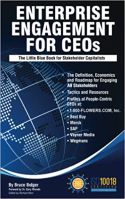
Books
Enterprise Engagement Advisory Services
-
Organizations of all types develop strategic Stakeholder Capitalism and Enterprise Engagement processes and human capital management and reporting strategies; conduct human capital gap analyses; design and implement strategic human capital management and reporting plans that address DEI (Diversity, Equity, and Inclusion), and assist with managed outsourcing of engagement products and services.
-
Human resources, sales and marketing solution providers profit from the emerging discipline of human capital management and ROI of engagement through training and marketing services.
-
Investors make sense of human capital reporting by public companies.
-
Buyers and sellers of companies in the engagement space or business owners or buyers who seek to account for human capital in their mergers and acquistions.
Click here for complete information on Enterprise Engagement Alliance benefits and to join.
For more information: Contact Bruce Bolger at
Bolger@TheICEE.org or call 914-591-7600, ext. 230.










 ESM News Alert for the latest news. Subscribe here.