Your portal to
enterprise engagement

Books

Resources for Books - Corporate-cultureclear search
Sorry, no results matched your search.


Save Link

Former CFO Publishes Novels to Tell the Story of Responsible Business Leadership

Nick ShepherdThe Great Toys “Saga” series uses a novel format to bring to life the leadership issues related to employee engagement and culture.
 
Nick Shepherd, an Ontario, Can.--based former CFO, spent almost his entire career in finance before publishing the books Understanding and Reporting Human Capital and the Cost of Poor Culture, among others. He has now published two novels that tell through a fictionalized story of how “CEOs can reposition their organizations in a holistic way to revitalize the behaviors needed for creativity and innovation – the very drivers of strategic success. CEO’s, board members and leaders concerned about calls for renewed capitalism, responsible business, and other changes to the way we do business will benefit from following Steve’s own personal journey of trials, tribulations, successes and learning events as he repositions his business for success.”
           
No Fun At Great ToysExplains the author, the two books, No Fun at Great Toys, and Fun Returns to Great Toys tell the story of Steve who is appointed CEO of their family business, after his brother dies unexpectedly. Steve finds a demotivated and demoralized organization that has been depleted of its innovation and creativity through several years of cost-cutting. The stories tell of Steve’s efforts to understand the problems and rebuild the business into a successful, vibrant, enthusiastic, and responsible business, that returns to growth and profitability.         
 
Shepherd says he wrote the books because “Business has access to literally millions of how to books written by experts in every subject imaginable. There are also legions of management consultants available who will offer solutions to any type of business problem. The challenge is that for many issues there is no silver bullet, no turnkey, broad-base fits-all approach. Educational programs such as MBAs have realized this for many years and used case studies as a holistic approach of putting business problems into a context that reflects reality.”
 
 [return to top]


Master the “S” of Environmental, Social, Governance (ESG), A.k.a. Stakeholder Capitalism
 
The Enterprise Engagement Alliance at TheEEA.org is the world’s first and only organization that focuses on outreach, certification and training, and advisory services to help organizations achieve their goals by fostering the proactive involvement of all stakeholders. This includes customers, employees, distribution and supply chain partners, and communities, or anyone connected to an organization’s success.
 
Training and Thought Leadership 
Engagement Digital Media and Marketplaces
Video Learning
The EEA Human Capital Management and ROI of Engagement YouTube channel features a growing library of 30- to 60-minute panel discussions with leading experts in all areas of engagement and total rewards.
 
Books
Enterprise Engagement Advisory Services 
The Engagement Agency helps:
Click here for complete information on Enterprise Engagement Alliance benefits and to join.  

For more information: Contact Bruce Bolger at Bolger@TheICEE.org or call 914-591-7600, ext. 230. 


Save Link

Former CFO Publishes Novels to Tell the Story of Responsible Business Leadership

Nick ShepherdThe Great Toys “Saga” series uses a novel format to bring to life the leadership issues related to employee engagement and culture.
 
Nick Shepherd, an Ontario, Can.--based former CFO, spent almost his entire career in finance before publishing the books Understanding and Reporting Human Capital and the Cost of Poor Culture, among others. He has now published two novels that tell through a fictionalized story of how “CEOs can reposition their organizations in a holistic way to revitalize the behaviors needed for creativity and innovation – the very drivers of strategic success. CEO’s, board members and leaders concerned about calls for renewed capitalism, responsible business, and other changes to the way we do business will benefit from following Steve’s own personal journey of trials, tribulations, successes and learning events as he repositions his business for success.”
           
No Fun At Great ToysExplains the author, the two books, No Fun at Great Toys, and Fun Returns to Great Toys tell the story of Steve who is appointed CEO of their family business, after his brother dies unexpectedly. Steve finds a demotivated and demoralized organization that has been depleted of its innovation and creativity through several years of cost-cutting. The stories tell of Steve’s efforts to understand the problems and rebuild the business into a successful, vibrant, enthusiastic, and responsible business, that returns to growth and profitability.         
 
Shepherd says he wrote the books because “Business has access to literally millions of how to books written by experts in every subject imaginable. There are also legions of management consultants available who will offer solutions to any type of business problem. The challenge is that for many issues there is no silver bullet, no turnkey, broad-base fits-all approach. Educational programs such as MBAs have realized this for many years and used case studies as a holistic approach of putting business problems into a context that reflects reality.”
 
 [return to top]


Master the “S” of Environmental, Social, Governance (ESG), A.k.a. Stakeholder Capitalism
 
The Enterprise Engagement Alliance at TheEEA.org is the world’s first and only organization that focuses on outreach, certification and training, and advisory services to help organizations achieve their goals by fostering the proactive involvement of all stakeholders. This includes customers, employees, distribution and supply chain partners, and communities, or anyone connected to an organization’s success.
 
Training and Thought Leadership 
Engagement Digital Media and Marketplaces
Video Learning
The EEA Human Capital Management and ROI of Engagement YouTube channel features a growing library of 30- to 60-minute panel discussions with leading experts in all areas of engagement and total rewards.
 
Books
Enterprise Engagement Advisory Services 
The Engagement Agency helps:
Click here for complete information on Enterprise Engagement Alliance benefits and to join.  

For more information: Contact Bruce Bolger at Bolger@TheICEE.org or call 914-591-7600, ext. 230. 


Save Link

Former CFO Publishes Novels to Tell the Story of Responsible Business Leadership

Nick ShepherdThe Great Toys “Saga” series uses a novel format to bring to life the leadership issues related to employee engagement and culture.
 
Nick Shepherd, an Ontario, Can.--based former CFO, spent almost his entire career in finance before publishing the books Understanding and Reporting Human Capital and the Cost of Poor Culture, among others. He has now published two novels that tell through a fictionalized story of how “CEOs can reposition their organizations in a holistic way to revitalize the behaviors needed for creativity and innovation – the very drivers of strategic success. CEO’s, board members and leaders concerned about calls for renewed capitalism, responsible business, and other changes to the way we do business will benefit from following Steve’s own personal journey of trials, tribulations, successes and learning events as he repositions his business for success.”
           
No Fun At Great ToysExplains the author, the two books, No Fun at Great Toys, and Fun Returns to Great Toys tell the story of Steve who is appointed CEO of their family business, after his brother dies unexpectedly. Steve finds a demotivated and demoralized organization that has been depleted of its innovation and creativity through several years of cost-cutting. The stories tell of Steve’s efforts to understand the problems and rebuild the business into a successful, vibrant, enthusiastic, and responsible business, that returns to growth and profitability.         
 
Shepherd says he wrote the books because “Business has access to literally millions of how to books written by experts in every subject imaginable. There are also legions of management consultants available who will offer solutions to any type of business problem. The challenge is that for many issues there is no silver bullet, no turnkey, broad-base fits-all approach. Educational programs such as MBAs have realized this for many years and used case studies as a holistic approach of putting business problems into a context that reflects reality.”
 
 [return to top]


Master the “S” of Environmental, Social, Governance (ESG), A.k.a. Stakeholder Capitalism
 
The Enterprise Engagement Alliance at TheEEA.org is the world’s first and only organization that focuses on outreach, certification and training, and advisory services to help organizations achieve their goals by fostering the proactive involvement of all stakeholders. This includes customers, employees, distribution and supply chain partners, and communities, or anyone connected to an organization’s success.
 
Training and Thought Leadership 
Engagement Digital Media and Marketplaces
Video Learning
The EEA Human Capital Management and ROI of Engagement YouTube channel features a growing library of 30- to 60-minute panel discussions with leading experts in all areas of engagement and total rewards.
 
Books
Enterprise Engagement Advisory Services 
The Engagement Agency helps:
Click here for complete information on Enterprise Engagement Alliance benefits and to join.  

For more information: Contact Bruce Bolger at Bolger@TheICEE.org or call 914-591-7600, ext. 230. 


Save Link

Enterprise Engagement: The Roadmap, 3rd Edition

Enterprise Engagement: The Roadmap, 3rd Edition has been completely updated with new information, illustrations and new chapters. Authored and edited by dozens of experts in general management, marketing, sales, data management, business and academia, the Textbook’s methodology has been endorsed by leading companies as a means of achieving both strategic and tactical organizational goals related to sales, marketing, human resources, vendor management, and community relations. A proven strategy to:
  • Increase long-term profitability
  • Maximize customer loyalty and referrals
  • Capture the commitment of dealers, agents and distributors
  • Increase sales and improve customer service
  • Maximize quality, productivity, quality and wellness
  • Foster greater prosperity through a focus on people 
 
Enterprise Engagement: The Roadmap, 3rd Edition also provides formal preparation for the Enterprise Engagement Certification program. To order a copy, click here.

Bruce Bolger, Allan Schweyer & Richard Kern . 242 pp. Cost: $36

Save Link

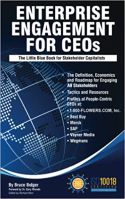
Enterprise Engagement for CEOs Outlines Stakeholder Capitalism Implementation

The Enterprise Engagement Alliance’s newly updated Enterprise Engagement for CEOs: The Little Blue Book for Stakeholder Capitalists provides boards and senior management with a short course on how to turn theory into action. A recent survey by the Conference Board found that 92% of CEOs agree with the shift to Stakeholder Capitalism and 82% say they have begun the implementation process. 
 
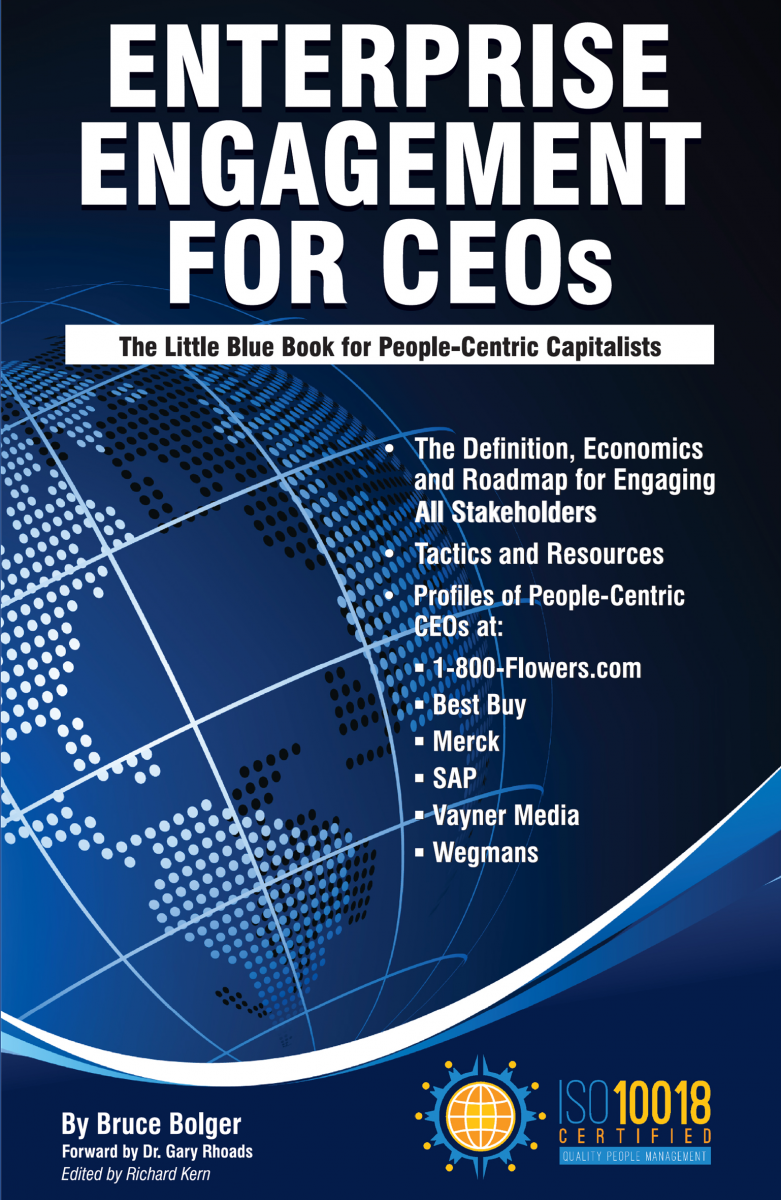
EE for CEOs new coverEnterprise Engagement for CE0s: The Little Blue Book for Stakeholder Capitalists provides a practical overview of how to implement the “S” of Environmental, Social, Governance (ESG), increasingly known as Stakeholder Capitalism. Click here to order in paperback or Kindle.  
 
The book provides a short, practical overview of how to use Enterprise Engagement principles to increase profitability and lower costs by establishing a brand that attracts and retains highly committed, focused, and capable customers, employees, distribution and supply chain partners, and communities. The processes are based on the proven approach applied by ISO (International Organization for Standardization) standards to help enhance quality, environmental, and safety practices in manufacturing.
 
For those seeking a comprehensive textbook on all aspects of implementation, see: Enterprise Engagement: The Roadmap—How to Implement Stakeholder Capitalism and Enhance Organizational Results Through a Strategic Approach to People Management.
 
This increasingly important approach to business is not about “woke” capitalism; donating more money to charities or lowering an organization’s carbon footprint in reaction to societal pressures. It’s backed by over 30 years of academic research and ISO (International Organization for Standardization)-based business practices aimed at enhancing sustainable returns for shareholders by creating value for customers, employees, supply chain and distribution partners, communities, and the environment—otherwise known as Environmental, Social, Governance (ESG) management, increasingly known as Stakeholder Capitalism. 
 
Multiple books have documented the economics of Stakeholder Capitalism, including the book by that name authored by Klaus Schwab of the World Economic Forum or The Heart of Business, by Hubert Joly, former CEO of Best Buy, another committed Stakeholder Capitalist. Enterprise Engagement for CEOs is designed for management that seeks to move from theory to practical applications. Based on the experience of literally millions of companies that have used or use ISO standards in one way or other, success depends on having a CEO-led strategic and systematic approach to achieving goals by strategically and systematically addressing the interests of all stakeholders.  

Enterprise Engagement for CEOs is for boards, executives, management in all areas, and educators seeking to go beyond the talk to focus on the actual implementation process. The enterprise approach to engaging all stakeholders in a systematic way is based on extensive academic work and case studies of successful organizations going back to the early work of R. Edward Freeman, Professor of Business Administration, that demonstrate the ability to enhance performance and lower costs by:
Establishing a clear organizational purpose baked into the culture and business plans.
Strategically aligning the interests and activities related to all stakeholders, rather than having them siloed between marketing, sales, human resources, operations, finance, etc.
Baking people strategies and tactics into the organization’s business operating system.
Creating a culture of continuous improvement that encourages the voice of all stakeholders, including front-line workers and other employees; customers; supply chain and distribution partners, and communities. 
Having a formal system for managing people investments, the strategies and tactics, and performance metrics. 
 
Click here to order Enterprise Engagement for CEOs in paperback or Kindle.  
 

Master the “S” of Environmental, Social, Governance (ESG), A.k.a. Stakeholder Capitalism
 
The Enterprise Engagement Alliance at TheEEA.org is the world’s first and only organization that focuses on outreach, certification and training, and advisory services to help organizations achieve their goals by fostering the proactive involvement of all stakeholders. This includes customers, employees, distribution and supply chain partners, and communities, or anyone connected to an organization’s success.
 
Training and Thought Leadership 
  • Founded in 2008, the Enterprise Engagement Alliance provides outreach, learning and certification in Enterprise Engagement, an implementation process for the “S” or Social of Stakeholder Capitalism and Human Capital Management and measurement of engagement across the organization.
  • The Enterprise Engagement Alliance provides a training and certification program for business leaders, practitioners, and solution providers, as well as executive briefings and human capital gap analyses for senior leaders.
  • The EEA produces an education program for CFOs for the CFO.University training program on Human Capital Management.
  • Join the EEA to become a leader in the implementation of the “S” of ESG and Stakeholder Capitalism. 
EE for CEOsEngagement Digital Media and Marketplaces
Video Learning
The EEA Human Capital Management and ROI of Engagement YouTube channel features a growing library of 30- to 60-minute panel discussions with leading experts in all areas of engagement and total rewards.
 
EE RoadmapBooks
Enterprise Engagement Advisory Services 
The Engagement Agency helps:
  • Organizations of all types develop strategic Stakeholder Capitalism and Enterprise Engagement processes and human capital management and reporting strategies; conduct human capital gap analyses; design and implement strategic human capital management and reporting plans that address DEI (Diversity, Equity, and Inclusion), and assist with managed outsourcing of engagement products and services.
  • Human resources, sales and marketing solution providers profit from the emerging discipline of human capital management and ROI of engagement through training and marketing services.
  • Investors make sense of human capital reporting by public companies.
  • Buyers and sellers of companies in the engagement space or business owners or buyers who seek to account for human capital in their mergers and acquistions
For more information: Contact Bruce Bolger at Bolger@TheICEE.org or call 914-591-7600, ext. 230.


Save Link

Now Available: The Essential Guide to Implementation of Stakeholder Capitalism

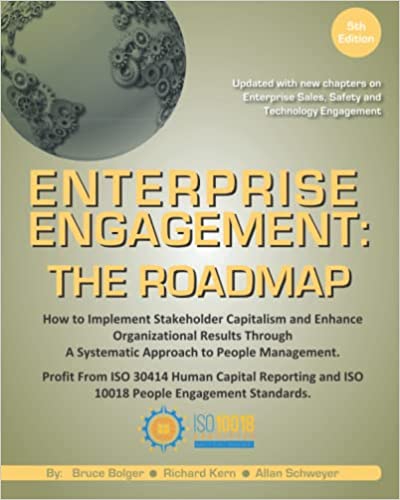
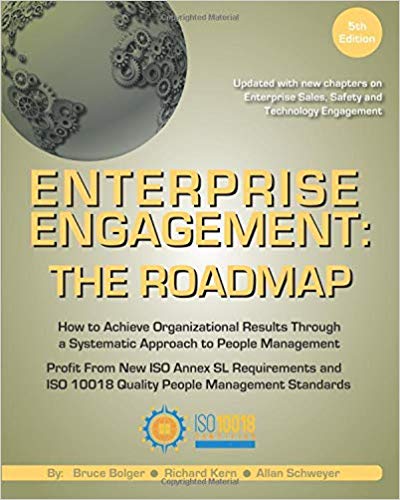
Last week, the Enterprise Engagement Alliance released its updated Enterprise Engagement for CEOs: The Little Blue Book for Stakeholder Capitalists. This week, it has published its updated Enterprise Engagement: The Roadmap—How to Implement Stakeholder Capitalism to provide management at all levels a comprehensive implementation guide with detailed information on the theory, economics, and practices of Stakeholder Capitalism and human capital management across the enterprise. 
EE Roadmap new cover
 
While Enterprise Engagement for CEOs provides an abbreviated overview of the principles of Stakeholder Capitalism and profiles of some of the CEOs who have practiced it at their organizations, Enterprise Engagement: The Roadmap offers a practical detailed implementation guide that includes information on the principles and economics, as well as on almost all of the tactics involved. 
 
The challenge facing the Stakeholder Capitalism movement is that it is not taught in any schools nor even in executive education program and that it requires organizations to break down the siloes between finance, marketing, human resources, operations, and other business units that hamper efficiency and create poor experiences for customers and employees alike. 
EE for CEOs
 
Stakeholder Capitalism enhances returns for investors by creating value for customers, employees, supply chain and distribution partners, communities, and the environment and should not be confused with “woke” capitalism or Corporate Social Responsibility. See ESM: Stakeholder Capitalism—A Primer.
 
Enterprise Engagement: The Roadmap aims to address the knowledge gap with a desk reference covering almost all the key areas of the field. Writes Grace Swanson, Vice President, Human Capital at Accumold, a leading precision manufacturer, “By the time I finished reading Enterprise Engagement: The Roadmap my copy was filled with Post-it notes highlighting information I knew I would need to reference later. This book provides a complete guide to almost everything an organization needs to implement a strategic approach to engaging everyone in organizational goals in a systematic way.”               
 
Gary Rhoads, retired Stephen Mack Covey Professor of Marketing Emeritus at the Marriot School of Business at Brigham Young University and Chairman of Xvoyant, a sales engagement technology firm, “As a professor of marketing and entrepreneurship for most of my career, and founder of two leading companies in sales and marketing management, I know that delivering promises is one of the most critical strategies for success. Yet too many organizations fail to address the importance of engaging all stakeholders in organizational goals. Enterprise Engagement: The Roadmap is the only book I know that focuses on how to apply a strategic and tactical approach to engagement across the enterprise in a systematic way.” 
          
Adds Barbara Porter, Managing Director, Ernst & Young, "I have spent much of my career helping organizations develop great cultures, and in the end a successful strategy requires a CEO-led approach to connecting employees, managers, customers, vendors, suppliers, the community—everyone inside and outside the organization who has a stake in its success. I have repeatedly referenced almost every chapter in Enterprise Engagement: The Roadmap since the first edition came out, as it’s the only book I know of that puts together in one place all the tactics needed to address engagement to achieve organizational results.” 
 
As shown in the table of contents below, the book covers almost every topic involved with the implementation of Stakeholder Capitalism, including career opportunities and the potential impact on government. The edition now includes appendices on human capital management, reporting, and analysis. 
 
Here is the table of contents: 
 
Part I: Introduction to Stakeholder Capitalism, Enterprise Engagement, ISO
Intro: Enterprise Engagement and ISO Annex SL and ISO 10018 and ISO 30414
Standards – A Practical Framework for Implementation and Measurement
Chapter 1  ISO 10018: People Engagement
Chapter 2 The Role of ISO Standards in Business and People Management
Chapter 3  Economics of Enterprise Engagement
Chapter 4  Culture and the Enterprise Brand
Chapter 5   Breaking Down Organizational Silos
 
Part II: Audiences of Engagement
Intro: The Audience Challenge
Chapter 6 Customer Engagement
Chapter 7 Channel Partner Engagement
Chapter 8 Employee Engagement
Chapter 9 Sales Engagement
Chapter 10  Volunteer & Community Engagement
Chapter 11  Supply Chain Engagement
Chapter 12 The Employee / Customer Link
Chapter 13 Case Study: Northwell Health
 
Part III: Tools of Engagement
Intro: Tools and Tactics
Chapter 14 Employee Assessment
Chapter 15  Communication
Chapter 16 Permission Management
Chapter 17 Content Marketing
Chapter 18 Learning and Training
Chapter 19  Gamification
Chapter 20 Collaboration and Innovation
Chapter 21  Rewards & Recognition
Chapter 22 Loyalty
Chapter 23  Recognition in the Era of Employee Engagement
Chapter 24 Diversity and Community
Chapter 25 Wellness
Chapter 26  Enterprise Safety Engagement
Chapter 27  Enterprise Technology Engagement
Chapter 28 Meetings and Motivational Events 
Chapter 29 Travel Rewards and Engagement
Chapter 30 The Importance of an Engaging Environment
Chapter 31  Trade Shows & Conferences: Engaging the Stakeholders
Chapter 32  Technology: The Heart of the Problem, The Core of the Solution
Chapter 33 Measuring Enterprise Engagement and Performance
Chapter 34 Big Data and Analytics
Chapter 35 Case Study: UnitedHealth Group
 
Part IV: Applications of Engagement
Intro: The Enterprise Engagement Framework
Chapter 36  Keys to Implementation
Chapter 37  Budgeting and ROI
Chapter 38 Engagement Careers
Chapter 39 Engagement and Nonprofits
Chapter 40 Implications for Government
Chapter 41  Engagement, Human Capital and the Accounting Profession
Chapter 42 Enterprise Engagement and ISO 30414 Human Capital Reporting Standards
 
Appendix 1  Sample Engagement Business Plan
Appendix 2  An Explanation of Tracer Audit Methodology
Appendix 3  ISO 10018 Audit
Appendix 4 Human Capital Evaluation Checklist
Appendix 5 Example of a “Model” Company
 
 
For More Information
Bruce Bolger
Founder, Enterprise Engagement Alliance
914-591-7600, ext. 230
Bolger@The ICEE.org 
 

Master the “S” of Environmental, Social, Governance (ESG), A.k.a. Stakeholder Capitalism
 
The Enterprise Engagement Alliance at TheEEA.org is the world’s first and only organization that focuses on outreach, certification and training, and advisory services to help organizations achieve their goals by fostering the proactive involvement of all stakeholders. This includes customers, employees, distribution and supply chain partners, and communities, or anyone connected to an organization’s success.
 
Training and Thought Leadership 
  • Founded in 2008, the Enterprise Engagement Alliance provides outreach, learning and certification in Enterprise Engagement, an implementation process for the “S” or Social of Stakeholder Capitalism and Human Capital Management and measurement of engagement across the organization.
  • The Enterprise Engagement Alliance provides a training and certification program for business leaders, practitioners, and solution providers, as well as executive briefings and human capital gap analyses for senior leaders.
  • The EEA produces an education program for CFOs for the CFO.University training program on Human Capital Management.
  • Join the EEA to become a leader in the implementation of the “S” of ESG and Stakeholder Capitalism. 
Engagement Digital Media and Marketplaces
Video Learning
The EEA Human Capital Management and ROI of Engagement YouTube channel features a growing library of 30- to 60-minute panel discussions with leading experts in all areas of engagement and total rewards.
 
Books
Enterprise Engagement Advisory Services 
The Engagement Agency helps:
  • Organizations of all types develop strategic Stakeholder Capitalism and Enterprise Engagement processes and human capital management and reporting strategies; conduct human capital gap analyses; design and implement strategic human capital management and reporting plans that address DEI (Diversity, Equity, and Inclusion), and assist with managed outsourcing of engagement products and services.
  • Human resources, sales and marketing solution providers profit from the emerging discipline of human capital management and ROI of engagement through training and marketing services.
  • Investors make sense of human capital reporting by public companies.
  • Buyers and sellers of companies in the engagement space or business owners or buyers who seek to account for human capital in their mergers and acquistions
For more information: Contact Bruce Bolger at Bolger@TheICEE.org or call 914-591-7600, ext. 230.
 

Save Link

Enterprise Engagement: The Roadmap, 3rd Edition

Enterprise Engagement: The Roadmap, 3rd Edition has been completely updated with new information, illustrations and new chapters. Authored and edited by dozens of experts in general management, marketing, sales, data management, business and academia, the Textbook’s methodology has been endorsed by leading companies as a means of achieving both strategic and tactical organizational goals related to sales, marketing, human resources, vendor management, and community relations. A proven strategy to:
  • Increase long-term profitability
  • Maximize customer loyalty and referrals
  • Capture the commitment of dealers, agents and distributors
  • Increase sales and improve customer service
  • Maximize quality, productivity, quality and wellness
  • Foster greater prosperity through a focus on people 
 
Enterprise Engagement: The Roadmap, 3rd Edition also provides formal preparation for the Enterprise Engagement Certification program. To order a copy, click here.

Bruce Bolger, Allan Schweyer & Richard Kern . 242 pp. Cost: $36

Save Link

Global Agency Founder to Help Companies "Build Corporate Soul"

Ralf Specht, founding partner of Spark44, an international ad agency he helped grow into a $100 million plus company with 1,200 employees, now turns his attention to promote “a framework that aligns value-creating employee action with broader corporate strategy through shared understanding and shared purpose.” 
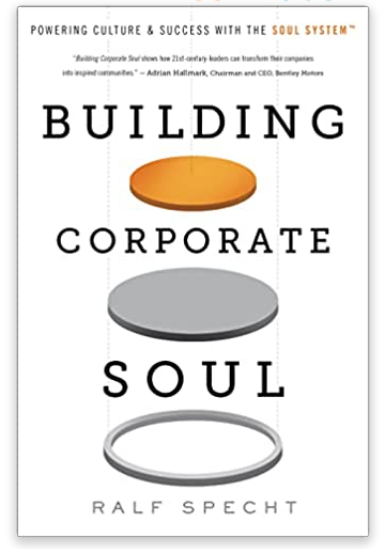
Building Corporate Soul
 
To regular readers of ESM, the theme of Building Corporate Soul: Powering Culture and Success with the Soul System™ sounds familiar. Corporate soul, the author Ralf Specht writes, “is a function of aligning value-creating employee behaviors with corporate strategy through understanding and shared purpose.” 
 
Specht says he knows that many books already focus on values and principles. His book, he says, is designed to provide “a strong outline for implementation.” In 12 chapters, he provides a step-by-step implementation process CEOs and business leaders can use based on his own management experience and research on other companies.
 
To support the return-on-investment of “soul,” he created a Soul Index “comprised of companies that have a shared understanding of vision, mission, values and spirit, and corresponding shared behaviors of leadership, ecosystem drivers, compensation, recruitment, development, partnerships, and followers centered on shared purpose.” The companies selected, ranging from Adobe, Salesforce, Microsoft, and Amazon, to Workday, Hilton, Apple, SAP and American Express, significantly outperformed all the major stock indices from 2016 to 2021, the five years he tracked. 
 
The book defines the concept of the corporate soul. It provides a description of the author’s soul system; outlines the role of purpose; discusses how to understand the soul of your company; lead with soul; nurture the soul ecosystem; promote its drivers, reward soul supporters; hire for soul; develop soul leaders, allies, and followers, and concludes with some of the author’s personal reflections.
 
Ralph SpechtHere’s a recent Q&A with Specht about his book. 
 
ESM: This all makes sense. Why isn’t it being done now?
 
RS. It is being done. But it is not being done by the majority of businesses. Everybody in the world by now has understood what exponential growth is. That is what I see is happening at this moment. There is a fast-growing dynamic in place; companies the world over do realize that they have to do things differently. 
 
The book includes the Soul Index, a performance ranking that is predominantly based on employee data about satisfaction and engagement at work as well as CEO approval data combined with business and brand success data. The results speak volumes. Companies that rank in the top 20 are delivering better returns than their peers. Happier employees drive better products and services as well as more satisfied customers. It´s an equation that gets more and more acceptance. Recent data by JUST Capital in the US are confirming the trend. Soul Index winner Adobe is also the number one on Benefits & Work-Life Balance as well as Diversity, Equity, & Inclusion. 
 
The focus on corporate culture is growing and the recent moves from the Securities & Exchange Commission (SEC) will drive listed companies to consider the implications of any actions on their workforce more than ever before. There will be a better world – hence my vision is to make soulless companies a thing of the past.
 
ESM: Who is going to lead the way to making this happen? What role do you wish to play and how?
 
RS: Change is coming from many different players. There are the government bodies like the SEC that could have a huge impact if they finally commit to it. The power of employees should not be underestimated. The ´Great Resignation´ or ´Great Reshuffle´ as it is more rightfully named is actually nothing but a movement – although it is not organized like a movement but by millions of individual decisions – of workers who vote with their feet as a consequence of feeling undervalued by their companies or managers. They do not feel any sense of belonging to their company. Those businesses that do not have corporate soul – and their leaders are realizing that they need to act. Otherwise, there won´t be a company in the future.
 
I do much more believe in the concept of ´carrot´ rather than ´stick´. The carrot for any CEO is that a company of which the employees say ´our firm has got soul´ tastes so good because it means it is a highly successful company. Look at prime examples like Microsoft and Salesforce – you can see that the leadership has fully understood why it is critical and what needs to be done to make it tangible for all stakeholders.
 
My book is a reach for a book. It is written by a global business leader informed by the latest studies from academia and consultancies – it brings together practitioner realism with the theoretic wisdom. It is the basis for my engagement in this space in consulting companies and organizations to fully understand that thriving cultures, cultures with soul, are more successful than others. One of the options I am currently looking into is to open a Leadership Academy that focuses on implementing successful human-centric corporate cultures.
 
ESM. You come from the advertising business, and yet you barely mention the field. What role do you think advertising/marketing play in the current state of affairs, and what can or should advertising do about it?
 
RS. True. Because ´Corporate Soul´ is not an advertising or marketing idea. I spent more than two decades with McCann – their mantra has always been ´Truth Well Told´. Today, this is more relevant than ever. But too often, ´brand purpose´ has become a fig leaf concept for CMO´s (chief marketing officers) and their agencies to market products or services. But ´purpose´ is not a marketing concept. 
 
´Purpose´ is at the core of how to lead a company. It is the key to align corporate strategy and corporate behaviors with that ´purpose´. Hence the Soul System framework defines it as ´shared purpose´. Shared by the entire board and shared with all stakeholders, especially staff. That is the critical first step. Then all corporate functions get involved – marketing being one of them and then agencies come into play.
 
Agencies need to ask the ´Truth Well Told´ questions:
Is your purpose just an answer that sounds good to the questions consumers have? 
Is it a truth that is grounded in the very essence and reality of the company that is bringing this brand to market? 
Is it real or is it just wishful thinking?
If it is not real, they need to advise their clients on the risk that they are about to enter for their firm. As we all know, it takes a lot of time to earn trust and build a sound reputation. But you can destroy it faster than you think. But agencies are not the ultimate decision makers. CMOs have a real responsibility here – and given their often short-lived tenure these days, one can see the pressures that they are dealing with.
 
ESM. Your book makes no mention of human capital reporting or the greater ESG or Stakeholder Capitalism movement. 
 
RS. When I wrote the book, it has been my intention to celebrate companies that have built corporate soul. Real-life cases of established firms like Lego, Hilton Hotels or Bentley Motors that have returned to the foundations of their founders’ beliefs on why the firm had been in business in the first place. Or start-up companies that are characterized by the innate energy, drive and focus of their founders to design a company that is better than any competitor in the field.
 
It´s my belief that learning from great and successful examples is the most infectious way to support the (Stakeholder Capitalism) movement. In my view, we need to make the leadership behaviors which build soul synonymous with the behaviors which build success. If we are successful in doing so, then the movements will all benefit. The value proposition is about success, because that is a language leaders understand. But the language of success needs to evolve and corporate soul needs to become the new language of success.
 
ESM: Do you think companies with corporate soul should publish human capital and sustainability reports to demonstrate this commitment? 
 
RS. Absolutely. But there needs to be a clear framework for these – similar to accounting standards. We need human capital standards so that is easier for all stakeholders to compare sectors and companies. In the future, I am expecting that investor roadshows will no longer be a CEO and CFO show. We will see the Chief Talent Officer playing a key role at an equal level. Something we are not seeing in many companies at this day and age. But this will change as the largest stakeholder groups such as customers and employees will increasingly want to see the real facts when it comes how a corporation deals with its human capital.
 
“Our people are our biggest asset.” How often have we heard that statement since former Xerox CEO Anne M. Mulcahy spoke these words at the 2003 Life Management Conference? The time has come to make this not just nice words, but a reality.
 
About the Author
Ralf Specht is the author of “Building Corporate Soul”. He developed the Soul System™, a framework designed to power culture and success for any business.

After two decades with McCann Erickson in various executive roles, he was a founding partner of Spark44, an innovative, industry-first joint venture with Jaguar Land Rover. Under his leadership as CEO, Spark44 grew to a 1,200 people business in 18 countries. He is the author of Building Corporate Soul: Powering Culture & Success with the Soul System™ from Fast Company Press. 

Connect with Specht on LinkedIn and buildingcorporatesoul.com.


Click here to get ESM news delivered each week.


Master the “S” of Environmental, Social, Governance (ESG), A.k.a. Stakeholder Capitalism
 
The Enterprise Engagement Alliance at TheEEA.org is the world’s first and only organization that focuses on outreach, certification and training, and advisory services to help organizations achieve their goals by fostering the proactive involvement of all stakeholders. This includes customers, employees, distribution and supply chain partners, and communities, or anyone connected to an organization’s success.
 
Training and Thought Leadership 
  • Founded in 2008, the Enterprise Engagement Alliance provides outreach, learning and certification in Enterprise Engagement, an implementation process for the “S” or Social of Stakeholder Capitalism and Human Capital Management and measurement of engagement across the organization.
  • The Enterprise Engagement Alliance provides a training and certification program for business leaders, practitioners, and solution providers, as well as executive briefings and human capital gap analyses for senior leaders.
  • The EEA produces an education program for CFOs for the CFO.University training program on Human Capital Management.
  • Join the EEA to become a leader in the implementation of the “S” of ESG and Stakeholder Capitalism. 
EE for CEOsEngagement Digital Media and Marketplaces
Video Learning
The EEA Human Capital Management and ROI of Engagement YouTube channel features a growing library of 30- to 60-minute panel discussions with leading experts in all areas of engagement and total rewards.
 
EE RoadmapBooks
Enterprise Engagement Advisory Services 
The Engagement Agency helps:
  • Organizations of all types develop strategic Stakeholder Capitalism and Enterprise Engagement processes and human capital management and reporting strategies; conduct human capital gap analyses; design and implement strategic human capital management and reporting plans that address DEI (Diversity, Equity, and Inclusion), and assist with managed outsourcing of engagement products and services.
  • Human resources, sales and marketing solution providers profit from the emerging discipline of human capital management and ROI of engagement through training and marketing services.
  • Investors make sense of human capital reporting by public companies.
  • Buyers and sellers of companies in the engagement space or business owners or buyers who seek to account for human capital in their mergers and acquistions
For more information: Contact Bruce Bolger at Bolger@TheICEE.org or call 914-591-7600, ext. 230.
 

Save Link

Now Available: The Essential Guide to Implementation of Stakeholder Capitalism

Last week, the Enterprise Engagement Alliance released its updated Enterprise Engagement for CEOs: The Little Blue Book for Stakeholder Capitalists. This week, it has published its updated Enterprise Engagement: The Roadmap—How to Implement Stakeholder Capitalism to provide management at all levels a comprehensive implementation guide with detailed information on the theory, economics, and practices of Stakeholder Capitalism and human capital management across the enterprise. 
EE Roadmap new cover
 
While Enterprise Engagement for CEOs provides an abbreviated overview of the principles of Stakeholder Capitalism and profiles of some of the CEOs who have practiced it at their organizations, Enterprise Engagement: The Roadmap offers a practical detailed implementation guide that includes information on the principles and economics, as well as on almost all of the tactics involved. 
 
The challenge facing the Stakeholder Capitalism movement is that it is not taught in any schools nor even in executive education program and that it requires organizations to break down the siloes between finance, marketing, human resources, operations, and other business units that hamper efficiency and create poor experiences for customers and employees alike. 
EE for CEOs
 
Stakeholder Capitalism enhances returns for investors by creating value for customers, employees, supply chain and distribution partners, communities, and the environment and should not be confused with “woke” capitalism or Corporate Social Responsibility. See ESM: Stakeholder Capitalism—A Primer.
 
Enterprise Engagement: The Roadmap aims to address the knowledge gap with a desk reference covering almost all the key areas of the field. Writes Grace Swanson, Vice President, Human Capital at Accumold, a leading precision manufacturer, “By the time I finished reading Enterprise Engagement: The Roadmap my copy was filled with Post-it notes highlighting information I knew I would need to reference later. This book provides a complete guide to almost everything an organization needs to implement a strategic approach to engaging everyone in organizational goals in a systematic way.”               
 
Gary Rhoads, retired Stephen Mack Covey Professor of Marketing Emeritus at the Marriot School of Business at Brigham Young University and Chairman of Xvoyant, a sales engagement technology firm, “As a professor of marketing and entrepreneurship for most of my career, and founder of two leading companies in sales and marketing management, I know that delivering promises is one of the most critical strategies for success. Yet too many organizations fail to address the importance of engaging all stakeholders in organizational goals. Enterprise Engagement: The Roadmap is the only book I know that focuses on how to apply a strategic and tactical approach to engagement across the enterprise in a systematic way.” 
          
Adds Barbara Porter, Managing Director, Ernst & Young, "I have spent much of my career helping organizations develop great cultures, and in the end a successful strategy requires a CEO-led approach to connecting employees, managers, customers, vendors, suppliers, the community—everyone inside and outside the organization who has a stake in its success. I have repeatedly referenced almost every chapter in Enterprise Engagement: The Roadmap since the first edition came out, as it’s the only book I know of that puts together in one place all the tactics needed to address engagement to achieve organizational results.” 
 
As shown in the table of contents below, the book covers almost every topic involved with the implementation of Stakeholder Capitalism, including career opportunities and the potential impact on government. The edition now includes appendices on human capital management, reporting, and analysis. 
 
Here is the table of contents: 
 
Part I: Introduction to Stakeholder Capitalism, Enterprise Engagement, ISO
Intro: Enterprise Engagement and ISO Annex SL and ISO 10018 and ISO 30414
Standards – A Practical Framework for Implementation and Measurement
Chapter 1  ISO 10018: People Engagement
Chapter 2 The Role of ISO Standards in Business and People Management
Chapter 3  Economics of Enterprise Engagement
Chapter 4  Culture and the Enterprise Brand
Chapter 5   Breaking Down Organizational Silos
 
Part II: Audiences of Engagement
Intro: The Audience Challenge
Chapter 6 Customer Engagement
Chapter 7 Channel Partner Engagement
Chapter 8 Employee Engagement
Chapter 9 Sales Engagement
Chapter 10  Volunteer & Community Engagement
Chapter 11  Supply Chain Engagement
Chapter 12 The Employee / Customer Link
Chapter 13 Case Study: Northwell Health
 
Part III: Tools of Engagement
Intro: Tools and Tactics
Chapter 14 Employee Assessment
Chapter 15  Communication
Chapter 16 Permission Management
Chapter 17 Content Marketing
Chapter 18 Learning and Training
Chapter 19  Gamification
Chapter 20 Collaboration and Innovation
Chapter 21  Rewards & Recognition
Chapter 22 Loyalty
Chapter 23  Recognition in the Era of Employee Engagement
Chapter 24 Diversity and Community
Chapter 25 Wellness
Chapter 26  Enterprise Safety Engagement
Chapter 27  Enterprise Technology Engagement
Chapter 28 Meetings and Motivational Events 
Chapter 29 Travel Rewards and Engagement
Chapter 30 The Importance of an Engaging Environment
Chapter 31  Trade Shows & Conferences: Engaging the Stakeholders
Chapter 32  Technology: The Heart of the Problem, The Core of the Solution
Chapter 33 Measuring Enterprise Engagement and Performance
Chapter 34 Big Data and Analytics
Chapter 35 Case Study: UnitedHealth Group
 
Part IV: Applications of Engagement
Intro: The Enterprise Engagement Framework
Chapter 36  Keys to Implementation
Chapter 37  Budgeting and ROI
Chapter 38 Engagement Careers
Chapter 39 Engagement and Nonprofits
Chapter 40 Implications for Government
Chapter 41  Engagement, Human Capital and the Accounting Profession
Chapter 42 Enterprise Engagement and ISO 30414 Human Capital Reporting Standards
 
Appendix 1  Sample Engagement Business Plan
Appendix 2  An Explanation of Tracer Audit Methodology
Appendix 3  ISO 10018 Audit
Appendix 4 Human Capital Evaluation Checklist
Appendix 5 Example of a “Model” Company
 
 
For More Information
Bruce Bolger
Founder, Enterprise Engagement Alliance
914-591-7600, ext. 230
Bolger@The ICEE.org 
 

Master the “S” of Environmental, Social, Governance (ESG), A.k.a. Stakeholder Capitalism
 
The Enterprise Engagement Alliance at TheEEA.org is the world’s first and only organization that focuses on outreach, certification and training, and advisory services to help organizations achieve their goals by fostering the proactive involvement of all stakeholders. This includes customers, employees, distribution and supply chain partners, and communities, or anyone connected to an organization’s success.
 
Training and Thought Leadership 
  • Founded in 2008, the Enterprise Engagement Alliance provides outreach, learning and certification in Enterprise Engagement, an implementation process for the “S” or Social of Stakeholder Capitalism and Human Capital Management and measurement of engagement across the organization.
  • The Enterprise Engagement Alliance provides a training and certification program for business leaders, practitioners, and solution providers, as well as executive briefings and human capital gap analyses for senior leaders.
  • The EEA produces an education program for CFOs for the CFO.University training program on Human Capital Management.
  • Join the EEA to become a leader in the implementation of the “S” of ESG and Stakeholder Capitalism. 
Engagement Digital Media and Marketplaces
Video Learning
The EEA Human Capital Management and ROI of Engagement YouTube channel features a growing library of 30- to 60-minute panel discussions with leading experts in all areas of engagement and total rewards.
 
Books
Enterprise Engagement Advisory Services 
The Engagement Agency helps:
  • Organizations of all types develop strategic Stakeholder Capitalism and Enterprise Engagement processes and human capital management and reporting strategies; conduct human capital gap analyses; design and implement strategic human capital management and reporting plans that address DEI (Diversity, Equity, and Inclusion), and assist with managed outsourcing of engagement products and services.
  • Human resources, sales and marketing solution providers profit from the emerging discipline of human capital management and ROI of engagement through training and marketing services.
  • Investors make sense of human capital reporting by public companies.
  • Buyers and sellers of companies in the engagement space or business owners or buyers who seek to account for human capital in their mergers and acquistions
For more information: Contact Bruce Bolger at Bolger@TheICEE.org or call 914-591-7600, ext. 230.
 

Save Link

Enterprise Engagement: The Roadmap, 3rd Edition

Enterprise Engagement: The Roadmap, 3rd Edition has been completely updated with new information, illustrations and new chapters. Authored and edited by dozens of experts in general management, marketing, sales, data management, business and academia, the Textbook’s methodology has been endorsed by leading companies as a means of achieving both strategic and tactical organizational goals related to sales, marketing, human resources, vendor management, and community relations. A proven strategy to:
  • Increase long-term profitability
  • Maximize customer loyalty and referrals
  • Capture the commitment of dealers, agents and distributors
  • Increase sales and improve customer service
  • Maximize quality, productivity, quality and wellness
  • Foster greater prosperity through a focus on people 
 
Enterprise Engagement: The Roadmap, 3rd Edition also provides formal preparation for the Enterprise Engagement Certification program. To order a copy, click here.

Bruce Bolger, Allan Schweyer & Richard Kern . 242 pp. Cost: $36

Save Link

<i>The Enemy of Engagement</i>: Put an End to Workplace Frustration--and Get the Most from Your Employees

Frustrated employees represent 20% or more of the total workforce, leading to a major loss in performance, talent and revenue. Frustration wears down motivated, dedicated employees who really care about their jobs but can’t get the organizational support they need to get things done. Focused on making contributions, these employees often hide their frustration, leaving managers in the dark about their discontent. “Frustrated employees really want to succeed in their role, but become aggravated by organizational barriers or a lack of resources,” says Mark Royal, Senior Consultant at Hay Group and co-author of the new book The Enemy of Engagement. “Managers must ask the right questions and address the issue promptly, or risk losing top talent who care deeply about the organization.” Royal’s co-author and colleague, Tom Agnew, says that frustration isn’t just an employee issue, it’s an organizational issue, adding that “Managers must listen for clues and serve as the voice for frustrated employees.” For more information on The Enemy of Engagement, contact Andrea Friedman at 212-584-5476 or Andrea@blisspr.com

240 pages. Hardcover. Cost: $19.80

Save Link

Enterprise Engagement: The Roadmap, 3rd Edition

Enterprise Engagement: The Roadmap, 3rd Edition has been completely updated with new information, illustrations and new chapters. Authored and edited by dozens of experts in general management, marketing, sales, data management, business and academia, the Textbook’s methodology has been endorsed by leading companies as a means of achieving both strategic and tactical organizational goals related to sales, marketing, human resources, vendor management, and community relations. A proven strategy to:
  • Increase long-term profitability
  • Maximize customer loyalty and referrals
  • Capture the commitment of dealers, agents and distributors
  • Increase sales and improve customer service
  • Maximize quality, productivity, quality and wellness
  • Foster greater prosperity through a focus on people 
 
Enterprise Engagement: The Roadmap, 3rd Edition also provides formal preparation for the Enterprise Engagement Certification program. To order a copy, click here.

Bruce Bolger, Allan Schweyer & Richard Kern . 242 pp. Cost: $36

Save Link

Enterprise Engagement: The Roadmap, 3rd Edition

Enterprise Engagement: The Roadmap, 3rd Edition has been completely updated with new information, illustrations and new chapters. Authored and edited by dozens of experts in general management, marketing, sales, data management, business and academia, the Textbook’s methodology has been endorsed by leading companies as a means of achieving both strategic and tactical organizational goals related to sales, marketing, human resources, vendor management, and community relations. A proven strategy to:
  • Increase long-term profitability
  • Maximize customer loyalty and referrals
  • Capture the commitment of dealers, agents and distributors
  • Increase sales and improve customer service
  • Maximize quality, productivity, quality and wellness
  • Foster greater prosperity through a focus on people 
 
Enterprise Engagement: The Roadmap, 3rd Edition also provides formal preparation for the Enterprise Engagement Certification program. To order a copy, click here.

Bruce Bolger, Allan Schweyer & Richard Kern . 242 pp. Cost: $36

Save Link

Enterprise Engagement for CEOs Outlines Stakeholder Capitalism Implementation

The Enterprise Engagement Alliance’s newly updated Enterprise Engagement for CEOs: The Little Blue Book for Stakeholder Capitalists provides boards and senior management with a short course on how to turn theory into action. A recent survey by the Conference Board found that 92% of CEOs agree with the shift to Stakeholder Capitalism and 82% say they have begun the implementation process. 
 
EE for CEOs new coverEnterprise Engagement for CE0s: The Little Blue Book for Stakeholder Capitalists provides a practical overview of how to implement the “S” of Environmental, Social, Governance (ESG), increasingly known as Stakeholder Capitalism. Click here to order in paperback or Kindle.  
 
The book provides a short, practical overview of how to use Enterprise Engagement principles to increase profitability and lower costs by establishing a brand that attracts and retains highly committed, focused, and capable customers, employees, distribution and supply chain partners, and communities. The processes are based on the proven approach applied by ISO (International Organization for Standardization) standards to help enhance quality, environmental, and safety practices in manufacturing.
 
For those seeking a comprehensive textbook on all aspects of implementation, see: Enterprise Engagement: The Roadmap—How to Implement Stakeholder Capitalism and Enhance Organizational Results Through a Strategic Approach to People Management.
 
This increasingly important approach to business is not about “woke” capitalism; donating more money to charities or lowering an organization’s carbon footprint in reaction to societal pressures. It’s backed by over 30 years of academic research and ISO (International Organization for Standardization)-based business practices aimed at enhancing sustainable returns for shareholders by creating value for customers, employees, supply chain and distribution partners, communities, and the environment—otherwise known as Environmental, Social, Governance (ESG) management, increasingly known as Stakeholder Capitalism. 
 
Multiple books have documented the economics of Stakeholder Capitalism, including the book by that name authored by Klaus Schwab of the World Economic Forum or The Heart of Business, by Hubert Joly, former CEO of Best Buy, another committed Stakeholder Capitalist. Enterprise Engagement for CEOs is designed for management that seeks to move from theory to practical applications. Based on the experience of literally millions of companies that have used or use ISO standards in one way or other, success depends on having a CEO-led strategic and systematic approach to achieving goals by strategically and systematically addressing the interests of all stakeholders.  

Enterprise Engagement for CEOs is for boards, executives, management in all areas, and educators seeking to go beyond the talk to focus on the actual implementation process. The enterprise approach to engaging all stakeholders in a systematic way is based on extensive academic work and case studies of successful organizations going back to the early work of R. Edward Freeman, Professor of Business Administration, that demonstrate the ability to enhance performance and lower costs by:
Establishing a clear organizational purpose baked into the culture and business plans.
Strategically aligning the interests and activities related to all stakeholders, rather than having them siloed between marketing, sales, human resources, operations, finance, etc.
Baking people strategies and tactics into the organization’s business operating system.
Creating a culture of continuous improvement that encourages the voice of all stakeholders, including front-line workers and other employees; customers; supply chain and distribution partners, and communities. 
Having a formal system for managing people investments, the strategies and tactics, and performance metrics. 
 
Click here to order Enterprise Engagement for CEOs in paperback or Kindle.  
 

Master the “S” of Environmental, Social, Governance (ESG), A.k.a. Stakeholder Capitalism
 
The Enterprise Engagement Alliance at TheEEA.org is the world’s first and only organization that focuses on outreach, certification and training, and advisory services to help organizations achieve their goals by fostering the proactive involvement of all stakeholders. This includes customers, employees, distribution and supply chain partners, and communities, or anyone connected to an organization’s success.
 
Training and Thought Leadership 
  • Founded in 2008, the Enterprise Engagement Alliance provides outreach, learning and certification in Enterprise Engagement, an implementation process for the “S” or Social of Stakeholder Capitalism and Human Capital Management and measurement of engagement across the organization.
  • The Enterprise Engagement Alliance provides a training and certification program for business leaders, practitioners, and solution providers, as well as executive briefings and human capital gap analyses for senior leaders.
  • The EEA produces an education program for CFOs for the CFO.University training program on Human Capital Management.
  • Join the EEA to become a leader in the implementation of the “S” of ESG and Stakeholder Capitalism. 
EE for CEOsEngagement Digital Media and Marketplaces
Video Learning
The EEA Human Capital Management and ROI of Engagement YouTube channel features a growing library of 30- to 60-minute panel discussions with leading experts in all areas of engagement and total rewards.
 
EE RoadmapBooks
Enterprise Engagement Advisory Services 
The Engagement Agency helps:
  • Organizations of all types develop strategic Stakeholder Capitalism and Enterprise Engagement processes and human capital management and reporting strategies; conduct human capital gap analyses; design and implement strategic human capital management and reporting plans that address DEI (Diversity, Equity, and Inclusion), and assist with managed outsourcing of engagement products and services.
  • Human resources, sales and marketing solution providers profit from the emerging discipline of human capital management and ROI of engagement through training and marketing services.
  • Investors make sense of human capital reporting by public companies.
  • Buyers and sellers of companies in the engagement space or business owners or buyers who seek to account for human capital in their mergers and acquistions
For more information: Contact Bruce Bolger at Bolger@TheICEE.org or call 914-591-7600, ext. 230.


Save Link

New Books Focus on Gratitude, Culture, Experience-Led Enterprises, and People ROI

Four new books focus on: how gratitude can improve morale, efficiency and profitability; strategies to reduce organizational griping; a new approach to maximize the customer experience through a holistic approach, and how to better measure the value of human capital. 
 
Leading-with-Gratitude
A series of new books are now available on how to humanize the workplace.
 
In Chester Elton and Adrian Gostick’s new book, “Leading With Gratitude,’ the authors share research that shows that “gratitude boosts employee engagement, reduces turnover, and leads team members to express more gratitude to one another—strengthening team bonds.” The authors assert that studies “have also shown that gratitude is beneficial for those expressing it and is one of the most powerful variables in predicting a person’s overall well-being—above money, health, and optimism.” As an example, the authors site the WD-40 Company, whose leadership “gave thousands of managers training in expressing gratitude to their employees” and, as a result, “saw record increases in revenue.” The authors share eight ways that managers can show employees they are valued. 
 
They highlight leaders such as Alan Mulally of Ford and Hubert Joly of Best Buy who they say have successfully incorporated the practice of gratitude into their leadership roles. The authors believe that showing gratitude “isn’t just about being nice, it’s about being smart—really smart—and it’s a skill that everyone can easily learn.” Elton and Gostick are the principles of The Culture Works, a culture advisory firm, and are well-known public speakers and authors.
[return to top]

Turning Complaints Into Culture Change

-No-Complaining-Org-CultIn “How to Create a ‘No Complaining’ Organizational Culture…And Why it Will Be Good for Everyone,” author Scott Maurer provides what he says is a practical system that everyone in all levels of and organization can follow to pursue healthy sustainable culture change.  Mauer is founder of Remedium Solutions, a culture advisory service. His approach focuses on teaching employees to recognize that frequent complaining among employees is a signal for the need for immediate culture change. The author argues that when complaining is addressed proactively, organizations can enjoy an increase in productivity, creativity, problem solving, employee health, morale, retention, engagement, and more. The book offers advice on how to focus on problem-solving, hold productive conversations to reduce tension, better understand relationship dynamics; streamline and align communications; improve self-awareness and emotional health, and establish formal or informal peer support structures to create a sense of purpose, loyalty, and employee well-being.
[return to top]

The Convergence of Customer and Employee Experience 

The new book, “In the Center of Experience: The Blueprint for Creating an Experience-Led Enterprise,” asserts that business is at an “inflection point in the relationship between brands and their audiences, where customers and employees are demanding better and more valuable experiences.” Author Greg Kihlstrom, President and Chief Experience Officer at Cravety, an agency focusing on employee and customer experience, says that “companies must keep up with this demand in order to remain competitive.” This, he says, includes competition for both customers as well as employees. He believes that organizations that start the customer experience process internally have the greatest potential to achieve long-term benefits.
 
The book is designed to provide a blueprint for organizations to implement a center of excellence incorporating brand experience, including the customer and employee experience. The book covers the following elements: brand, governance, culture, platform, measurement, and environment. The author provides recommendations on how organizations can implement their own “Centers of Experience” and how to measure success.
[return to top]

The ROI of People

Return-on-IndividualsDave Bookbinder, Senior Director of CFGI, a financial advisory company, argues for more focus on the value of human capital in business valuations. In his book, “The New ROI: Return on Individuals,” he points out that while many executives say that people are their organizations’ No. 1 assets, he believes that when it comes to valuations, most organizations put more value on patents and trademarks than on people. The book explores ways to put more quantifiable value on the value of human capital. This includes strategies to promote greater workforce value by creating “difference makers,” increasing employee success, improving happiness, reducing the impact of toxic employees, generating innovation through trust, embracing and improving corporate culture, and much more. Author Dave Bookbinder and over 20 collaborators share strategies to achieve these goals and new ways to quantify the value of human capital. 
 

Master the Principles of Enterprise Engagement to Achieve Organizational Goals and Enhance Your Career

  • Profit from a new strategic and systematic approach to engagement to enhance your organization’s brand equity; increase sales, productivity, quality, innovation, and safety, and reduce risks.
  • Get trained to become a Chief Engagement Officer for your organization.
  • Learn how to create Sustainability or Integrated Reports for Your Organization or Clients.
Resources: The Brand Media Coalition, the only guide to the story-telling power of brands and where to source them for business, event, promotional gifting, and rewards and recognition. Enterprise Engagement Solution Provider Directory. The only directory of engagement solution providers covering all types of agencies and tactics as well as insights on how to select them.
 
Communities: The  Enterprise Engagement Alliance and Advocate and the  Brand Media Coalition free resource centers offering access to the latest research, news, and case studies; discounts, promotions, referrals, and commissions, when appropriate to third-party solution providers from participating coalition solution provider members.
 
A CEO's Guide to Engagement Across the Enterprise cover
In Print: 
Enterprise Engagement for CEOs:The Little Blue Book for People-Centric Capitalists
This is the definitive implementation guide to Stakeholder Capitalism, written specifically to provide CEOs and their leadership teams a concise overview of the framework, economics, and implementation process of a CEO-led strategic and systematic approach to achieving success through people.  (123 pages, $15.99)

Enterprise Engagement: The Roadmap 5th Edition
The first and most comprehensive book on Enterprise Engagement and the new ISO 9001 and ISO 10018 quality people management standards. Includes 36 chapters detailing how to better integrate and align engagement efforts across the enterprise. (312 pages, $36.) 

Online:  
10-minute short course: click here for a 10-minute introduction to Enterprise Engagement and ISO standards from the Coggno.com learning platform.

Services: 
•  The International Center for Enterprise Engagement at TheICEE.org, offering: ISO 10018 certification for employers, solution providers, and Enterprise Engagement technology platforms; Human Resources and Human Capital audits for organizations seeking to benchmark their practices and related Advisory services for the hospitality field.ISO 10018 Cerfified. Quality People Management
•  The Engagement Agency at EngagementAgency.net, offering: complete support services for employers, solution providers, and technology firms seeking to profit from formal engagement practices for themselves or their clients, including Brand and Capability audits for solution providers to make sure their products and services are up to date.
•  C-Suite Advisory Service—Education of boards, investors, and C-suite executives on the economics, framework, and implementation processes of Enterprise Engagement. 
•  Speakers Bureau—Select the right speaker on any aspect of engagement for your next event.
•  Mergers and Acquisitions. The Engagement Agency’s Mergers and Acquisition group is aware of multiple companies seeking to purchase firms in the engagement field. Contact Michael Mazer in confidence if your company is potentially for sale at 303-320-3777.

Enterprise Engagement Benchmark Tools: The Enterprise Engagement Alliance offers three tools to help organizations profit from Engagement. Click here to access the tools.
•  ROI of Engagement Calculator. Use this tool to determine the potential return-on-investment of an engagement strategy. 
•  EE Benchmark Indicator. Confidentially benchmark your organization’s Enterprise Engagement practices against organizations and best practices. 
•  Compare Your Company’s Level of Engagement. Quickly compare your organization’s level of engagement to those of others based on the same criteria as the EEA’s Engaged Company Stock Index.
•  Gauge Your Personal Level of Engagement. This survey, donated by Horsepower, enables individuals to gauge their own personal levels of engagement.

For more information, contact Bruce Bolger at Bolger@TheEEA.org, 914-591-7600, ext. 230.

Save Link

Now Available: The Essential Guide to Implementation of Stakeholder Capitalism

Last week, the Enterprise Engagement Alliance released its updated Enterprise Engagement for CEOs: The Little Blue Book for Stakeholder Capitalists. This week, it has published its updated Enterprise Engagement: The Roadmap—How to Implement Stakeholder Capitalism to provide management at all levels a comprehensive implementation guide with detailed information on the theory, economics, and practices of Stakeholder Capitalism and human capital management across the enterprise. 
EE Roadmap new cover
 
While Enterprise Engagement for CEOs provides an abbreviated overview of the principles of Stakeholder Capitalism and profiles of some of the CEOs who have practiced it at their organizations, Enterprise Engagement: The Roadmap offers a practical detailed implementation guide that includes information on the principles and economics, as well as on almost all of the tactics involved. 
 
The challenge facing the Stakeholder Capitalism movement is that it is not taught in any schools nor even in executive education program and that it requires organizations to break down the siloes between finance, marketing, human resources, operations, and other business units that hamper efficiency and create poor experiences for customers and employees alike. 
EE for CEOs
 
Stakeholder Capitalism enhances returns for investors by creating value for customers, employees, supply chain and distribution partners, communities, and the environment and should not be confused with “woke” capitalism or Corporate Social Responsibility. See ESM: Stakeholder Capitalism—A Primer.
 
Enterprise Engagement: The Roadmap aims to address the knowledge gap with a desk reference covering almost all the key areas of the field. Writes Grace Swanson, Vice President, Human Capital at Accumold, a leading precision manufacturer, “By the time I finished reading Enterprise Engagement: The Roadmap my copy was filled with Post-it notes highlighting information I knew I would need to reference later. This book provides a complete guide to almost everything an organization needs to implement a strategic approach to engaging everyone in organizational goals in a systematic way.”               
 
Gary Rhoads, retired Stephen Mack Covey Professor of Marketing Emeritus at the Marriot School of Business at Brigham Young University and Chairman of Xvoyant, a sales engagement technology firm, “As a professor of marketing and entrepreneurship for most of my career, and founder of two leading companies in sales and marketing management, I know that delivering promises is one of the most critical strategies for success. Yet too many organizations fail to address the importance of engaging all stakeholders in organizational goals. Enterprise Engagement: The Roadmap is the only book I know that focuses on how to apply a strategic and tactical approach to engagement across the enterprise in a systematic way.” 
          
Adds Barbara Porter, Managing Director, Ernst & Young, "I have spent much of my career helping organizations develop great cultures, and in the end a successful strategy requires a CEO-led approach to connecting employees, managers, customers, vendors, suppliers, the community—everyone inside and outside the organization who has a stake in its success. I have repeatedly referenced almost every chapter in Enterprise Engagement: The Roadmap since the first edition came out, as it’s the only book I know of that puts together in one place all the tactics needed to address engagement to achieve organizational results.” 
 
As shown in the table of contents below, the book covers almost every topic involved with the implementation of Stakeholder Capitalism, including career opportunities and the potential impact on government. The edition now includes appendices on human capital management, reporting, and analysis. 
 
Here is the table of contents: 
 
Part I: Introduction to Stakeholder Capitalism, Enterprise Engagement, ISO
Intro: Enterprise Engagement and ISO Annex SL and ISO 10018 and ISO 30414
Standards – A Practical Framework for Implementation and Measurement
Chapter 1  ISO 10018: People Engagement
Chapter 2 The Role of ISO Standards in Business and People Management
Chapter 3  Economics of Enterprise Engagement
Chapter 4  Culture and the Enterprise Brand
Chapter 5   Breaking Down Organizational Silos
 
Part II: Audiences of Engagement
Intro: The Audience Challenge
Chapter 6 Customer Engagement
Chapter 7 Channel Partner Engagement
Chapter 8 Employee Engagement
Chapter 9 Sales Engagement
Chapter 10  Volunteer & Community Engagement
Chapter 11  Supply Chain Engagement
Chapter 12 The Employee / Customer Link
Chapter 13 Case Study: Northwell Health
 
Part III: Tools of Engagement
Intro: Tools and Tactics
Chapter 14 Employee Assessment
Chapter 15  Communication
Chapter 16 Permission Management
Chapter 17 Content Marketing
Chapter 18 Learning and Training
Chapter 19  Gamification
Chapter 20 Collaboration and Innovation
Chapter 21  Rewards & Recognition
Chapter 22 Loyalty
Chapter 23  Recognition in the Era of Employee Engagement
Chapter 24 Diversity and Community
Chapter 25 Wellness
Chapter 26  Enterprise Safety Engagement
Chapter 27  Enterprise Technology Engagement
Chapter 28 Meetings and Motivational Events 
Chapter 29 Travel Rewards and Engagement
Chapter 30 The Importance of an Engaging Environment
Chapter 31  Trade Shows & Conferences: Engaging the Stakeholders
Chapter 32  Technology: The Heart of the Problem, The Core of the Solution
Chapter 33 Measuring Enterprise Engagement and Performance
Chapter 34 Big Data and Analytics
Chapter 35 Case Study: UnitedHealth Group
 
Part IV: Applications of Engagement
Intro: The Enterprise Engagement Framework
Chapter 36  Keys to Implementation
Chapter 37  Budgeting and ROI
Chapter 38 Engagement Careers
Chapter 39 Engagement and Nonprofits
Chapter 40 Implications for Government
Chapter 41  Engagement, Human Capital and the Accounting Profession
Chapter 42 Enterprise Engagement and ISO 30414 Human Capital Reporting Standards
 
Appendix 1  Sample Engagement Business Plan
Appendix 2  An Explanation of Tracer Audit Methodology
Appendix 3  ISO 10018 Audit
Appendix 4 Human Capital Evaluation Checklist
Appendix 5 Example of a “Model” Company
 
 
For More Information
Bruce Bolger
Founder, Enterprise Engagement Alliance
914-591-7600, ext. 230
Bolger@The ICEE.org 
 

Master the “S” of Environmental, Social, Governance (ESG), A.k.a. Stakeholder Capitalism
 
The Enterprise Engagement Alliance at TheEEA.org is the world’s first and only organization that focuses on outreach, certification and training, and advisory services to help organizations achieve their goals by fostering the proactive involvement of all stakeholders. This includes customers, employees, distribution and supply chain partners, and communities, or anyone connected to an organization’s success.
 
Training and Thought Leadership 
  • Founded in 2008, the Enterprise Engagement Alliance provides outreach, learning and certification in Enterprise Engagement, an implementation process for the “S” or Social of Stakeholder Capitalism and Human Capital Management and measurement of engagement across the organization.
  • The Enterprise Engagement Alliance provides a training and certification program for business leaders, practitioners, and solution providers, as well as executive briefings and human capital gap analyses for senior leaders.
  • The EEA produces an education program for CFOs for the CFO.University training program on Human Capital Management.
  • Join the EEA to become a leader in the implementation of the “S” of ESG and Stakeholder Capitalism. 
Engagement Digital Media and Marketplaces
Video Learning
The EEA Human Capital Management and ROI of Engagement YouTube channel features a growing library of 30- to 60-minute panel discussions with leading experts in all areas of engagement and total rewards.
 
Books
Enterprise Engagement Advisory Services 
The Engagement Agency helps:
  • Organizations of all types develop strategic Stakeholder Capitalism and Enterprise Engagement processes and human capital management and reporting strategies; conduct human capital gap analyses; design and implement strategic human capital management and reporting plans that address DEI (Diversity, Equity, and Inclusion), and assist with managed outsourcing of engagement products and services.
  • Human resources, sales and marketing solution providers profit from the emerging discipline of human capital management and ROI of engagement through training and marketing services.
  • Investors make sense of human capital reporting by public companies.
  • Buyers and sellers of companies in the engagement space or business owners or buyers who seek to account for human capital in their mergers and acquistions
For more information: Contact Bruce Bolger at Bolger@TheICEE.org or call 914-591-7600, ext. 230.
 

Save Link

<i>The Enemy of Engagement</i>: Put an End to Workplace Frustration--and Get the Most from Your Employees

Frustrated employees represent 20% or more of the total workforce, leading to a major loss in performance, talent and revenue. Frustration wears down motivated, dedicated employees who really care about their jobs but can’t get the organizational support they need to get things done. Focused on making contributions, these employees often hide their frustration, leaving managers in the dark about their discontent. “Frustrated employees really want to succeed in their role, but become aggravated by organizational barriers or a lack of resources,” says Mark Royal, Senior Consultant at Hay Group and co-author of the new book The Enemy of Engagement. “Managers must ask the right questions and address the issue promptly, or risk losing top talent who care deeply about the organization.” Royal’s co-author and colleague, Tom Agnew, says that frustration isn’t just an employee issue, it’s an organizational issue, adding that “Managers must listen for clues and serve as the voice for frustrated employees.” For more information on The Enemy of Engagement, contact Andrea Friedman at 212-584-5476 or Andrea@blisspr.com

240 pages. Hardcover. Cost: $19.80

Save Link

<i>The Engagement Equation</i>: Leadership Strategies for an Inspired Workforce

New Book Explores the Engagement Equation: One sign that engagement has emerged as a formal field is the proliferation of books published on the subject over the last few years. The latest, The Engagement Equation: Leadership Strategies for an Inspired Workforce, by BlessingWhite consultants Chrisopher Rice, Fraser Marlow and Mary Ann Masarech, and published by Wiley, focuses specifically on how to infuse engagement throughout your managerial and organizational culture. A fundamental premise of the book is that “you can’t actually make employees engaged. Engagement is fundamentally an individualized equation. What might make one person engaged might turn off the person in the next cubical.” The authors stress the link between “maximum engagement and maximum contribution…” – i.e., the importance of continually linking engagement to organizational results. The book stresses the importance of finding a common definition for engagement and a way of talking about it in the organization; focusing as much on individuals as on global trends or indices; making engagement a priority and shared responsibility so that everyone has a stake in the process; making sure management is as engaged as employees are expected to be; and how to map out an overall plan that provides a clear direction and vision, open communication and realistic ROI measurement tools. They caution that surveys tools should be used to diagnose issues rather that simply as a “prize.” Click here to view a video by the authors.

Wiley. 306 pages. Hardcover . Cost: $23.62

Save Link

Breaking Down Silos

Enterprise Engagement requires the cultivation and participation of numerous constituencies, both inside and outside the organization. In this excerpt from his new book, Strategic Brand Engagement, author John G. Fisher discusses how tomorrow’s leaders must address the challenges and opportunities posed by various employee groups, communities, generations, data sets and motivational needs in order to break down the walls between them and make engagement work across the enterprise.

The time for serious brand engagement has come if organizations are going to retain the trust of employees and wider community, as both media and markets fragment into ever smaller niche areas. But it has to go further than just another HR campaign to briefly grab the attention of multi-tasking employees who have their day jobs to do as well as complying with whatever policy changes you want them to include this quarter.

The sweeping changes in communication that mobile telephony and tablet technology have ushered in mean that job-holders are now running their social lives concurrently with their professional obligations, often using the same devices. Part-time and work-from-home options mean that the traditional bonds between the organization and the people who work for it have diminished to the extent that the old ways of exerting pressure to comply through coercion, weather gentle or heavy-handed, may no longer be relevant.

Tomorrow’s employees will assume the organizations they want to work for will treat them professionally when it comes to communicating the employer brand, explaining values, consulting them about changes and measuring feedback honestly. Just like with consumer products, they’ll know the message they receive may change if they’re part of a different employee community, and that one promotional employer claim doesn’t suit all employee or channel partner markets. They will be wise to the tone of voice and any phrases that try to obscure the true situation. If the organization doesn’t tell the truth, it will be found out very quickly, such is the transparency of the internet and social media these days.

For an employer brand to work effectively, it needs to project itself to the wider community of business partners, advisers, ambassadors and advocates – not just its existing “customers.” But these groups need to receive a coherent message that’s in line with corporate values and very much “on brand.” Anything less looks unprofessional and careless; it suggests the organization is unable to think in a straight line or with any authenticity.

‘Command-And-Control’ Is Over

More and more, employees and advocates are using open access social networking media to run their everyday lives. Employers need to be aware that the standards of social networking transactions, in terms of ethics, branding and behavior, will be the same as when interacting with the organization, so there’s no point in having old-style, militaristic, command-and-control rules for organizational life when the real world operates in a more relaxed, open and collaborative way.

The 30-year-olds coming through to positions of supervisory power are already familiar with the digital age – they will have experienced no other world – so organizations need to adapt and trade up to the new platforms. Paper diaries, posters and notebooks are inefficient and one-dimensional, offering little option to share and discuss. They belong to the era of private information and the closed shop of outmoded organizational power.

The availability of cheap and flexible data storage and usage systems means there’s no excuse now for bland, broad reward & recognition programs that take no account of individual circumstances. Remuneration can be personalized to the granular level, whether it’s basic pay, performance rewards or loyalty benefits. What’s more, changes should be accommodated at will if they’re beneficial to employees – rather than annually for the sake of organizational convenience.

Engaging With The Disengaged

In general, about 60% of the employees of well-managed, well- resourced organizations are engaged at present. When an organization reaches the dizzy heights of 75% or 80%, champagne corks pop. There’s no reason why average engagement scores shouldn’t be in the low 90% range – or higher. In the pre-internet era, the convenient excuse for why this wasn’t possible was that getting the message out to every individual was both time-consuming and often broad-brush. But with the capability now to tailor messages down to the individual level and receive virtually instant response, there’s no reason why employees can’t be fully engaged for most of the time they’re at work.

Of course, it’s not always as easy to get full commitment from channel partners and advocates, simply because their economic ties are less binding. But if Amazon can offer millions of consumers the books they actually want to buy on what seems like a personal recommendation based on previous buying habits, it’s only a matter of time before organizational partners will receive tailored messages that resonate with their own team, rather than having to think how this organizational message could be applied to their own local situation. The resources to do this already exist in terms of line management and access to policy information. Where it often fails at the individual level is having good communication tools and, to be honest, remembering to keep team members informed in a way they’ll relate to.

Engagement And Loyalty

When commentators first started writing about the potential effects of the internet on working life, remote working was hailed as the model for future organizations. The attractive and compelling idea was that “in the future” most people would have a portfolio working week, largely based at home, and that a typical jobholder would interact with his or her colleagues over the “net” and only work a few hours a day for any one employer. Just like the futurist myth of vitamin pills being substituted for food and space travel for all, it hasn’t come to pass. The vast majority of workers still travel to a fixed location to work, and the best work is done by being in close human contact with groups of other people. Although flexible work arrangements are more common, they’re still not the way the majority of the workforce earns its living today.

For that reason, effective engagement is still largely about fixed location programs for large numbers of people who share common corporate values and goals. But the introduction of channel partners and advocates into the engagement mix suggests that – through corporate social media – engagement can be promoted in a much more timely, informal and widely dispersed way than ever before. Rather than simply letting it happen, however, the process can be engineered in such a way that organizations can control the communication of their values and create loyalty beyond the confines of bricks-and-mortar fixed locations and the gossip around the water cooler – it can be actively managed in the ether rather than just passively promoted.

Get A Plan

Employees are pretty smart. They can spot a turkey from a long way off. In Jim Haudan’s entertaining and insightful book, The Art of Engagement (2008), he describes what a frontline associate of an organization he had dealings with said about senior management:

I used to see complete incompetence. We got all this flavor-of-the-month stuff. We figured that leaders were trying to please each other or someone other than us – the people who do the work. We just assumed that leaders couldn’t agree on what came next... they’re just not very good at helping us understand things.

If senior executives are good at anything it should be planning skills. They’ve usually had 20 or 30 years to practice, so they should be better at it than most people. If “strategic” means anything, it should mean you have a plan. Of course, before you do anything, you should do some research – it may be formal and cost a fortune, or it may be undertaken by your team and cost almost nothing. But do some. You’d be surprised how many organizations launch into major change initiatives on the whim of an article the CEO saw in a business magazine that may have no relevance at all to the organization or its industry.

You should examine the skills of those who will be required to manage the change. If brand engagement is a mix of hard-nosed HR calculations and marketing communication skills, does your team (and the internal management infrastructure) know enough technically about how to get leverage from any activity you may put into place?

What incentives are you going to put in place to encourage change? It’s an old saying in business that “what gets rewarded gets done.” It doesn’t have to be life-changing. Often, small rewards and lots of recognition are powerful enough. An incentive, however small, signals to employees and the channel that this is an initiative you want to be taken seriously, not just a “nice-to-have.”

Once these steps have been gone through, go through them again and again at every stage so you’re constantly questioning whether you’ve asked enough questions, got the right skills, communicated the change effectively and offered participants a reason to change their behavior. If any of these steps are missing or poorly addressed it’s likely your engagement ambitions will also fall short. That’s a plan – so your brand engagement activity is now “strategic.”

In the final analysis, brand engagement is all about loyalty from both paid and unpaid partners, and it shouldn’t matter whether you’re employed by the same organization, work in the same building, work in the channel or are an unpaid, individual advocate. The more digital organizations become, the more likely that reputations will be managed digitally and stakeholder values will rise and fall based on who tweeted what to whom and when. The walls and silos are falling.

A Potential Disconnect

There’s no doubt that a major factor driving the need for better engagement is the different ways Baby Boomers and Generation Y use communication channels and media. With the raising of official retirement ages for Baby Boomers and the proliferation of social media channels used by younger generations, there’s a real danger of a disconnect in communication within organizations.

Older workers aren’t retiring anytime soon, so organizations that ignore the generation gap and the differences in how they communicate with each other may suffer. Commenting on a survey by the Boston Consulting Group of populations in the United States, UK, Japan, Canada, France, Germany and Italy in 2010, Dick Stroud and Kim Walker noted that “In 2010 there were 375 million over-60s...In the next 20 years, by the end of 2030, this number will be 695 million.” Those in positions of power – primarily the Baby Boomers – who haven’t done so already will have to get comfortable with social media if they want to engage fully with their younger, more media-aware workforces.

The Engagement VP

So if engagement is going to be one of the crucial metrics of successful organizations, someone will have to take responsibility for its delivery. It will be the Engagement VP’s role to try and control this whole process rather than be its victim. He or she will have to be a hybrid of existing HR and marketing VPs who know how to save money but also how to spend it. He or she will have to be able to research and recognize a trend as well as create new trends that are beneficial to the organization and its brand values. He or she will be able to be critical about how the organization’s values get translated into the many social media now available and be able to manage the reputation of the organization, both internally and externally, online and offline.

Above all, the Engagement VP will need to gain and maintain trust from numerous internal and external groups in the same way that a successful brand builds consumer trust over many years through brand performance. Better and persistent engagement requires organizational building skills and marketing skills to an equal degree. Not an easy task, but the brand future you envision for your organization can’t be left alone to simply evolve. The Engagement VP and his or her team will have to make it happen.

So, over to you. Are you happy with the way your brand engages your employees to improve their performance? If not, you may need to do some research. If you’re proud of your employee engagement scores, how well do these scores compare with the scores of your sales people and channel partners? Have you thought about your CSR program and whether your advocates and volunteers are in the engagement loop? Whether they fully understand your values and how they can be used to engage better with consumers? There’s still plenty to be done when it comes to planning and implementing engagement.

John G. Fisher is CEO of FMI Group, a brand engagement consultancy. He has over 30 years experience in marketing, communication, incentives and performance improvement programs, specializing in the financial services sector. He has written five business books and is a regular columnist in the marketing and HR press. For more info, go to www.fmigroup.co.uk/

[ return to top ]

Save Link

Enterprise Engagement: The Roadmap, 3rd Edition

Enterprise Engagement: The Roadmap, 3rd Edition has been completely updated with new information, illustrations and new chapters. Authored and edited by dozens of experts in general management, marketing, sales, data management, business and academia, the Textbook’s methodology has been endorsed by leading companies as a means of achieving both strategic and tactical organizational goals related to sales, marketing, human resources, vendor management, and community relations. A proven strategy to:
  • Increase long-term profitability
  • Maximize customer loyalty and referrals
  • Capture the commitment of dealers, agents and distributors
  • Increase sales and improve customer service
  • Maximize quality, productivity, quality and wellness
  • Foster greater prosperity through a focus on people 
 
Enterprise Engagement: The Roadmap, 3rd Edition also provides formal preparation for the Enterprise Engagement Certification program. To order a copy, click here.

Bruce Bolger, Allan Schweyer & Richard Kern . 242 pp. Cost: $36

Save Link

Former CFO Publishes Novels to Tell the Story of Responsible Business Leadership

Nick ShepherdThe Great Toys “Saga” series uses a novel format to bring to life the leadership issues related to employee engagement and culture.
 
Nick Shepherd, an Ontario, Can.--based former CFO, spent almost his entire career in finance before publishing the books Understanding and Reporting Human Capital and the Cost of Poor Culture, among others. He has now published two novels that tell through a fictionalized story of how “CEOs can reposition their organizations in a holistic way to revitalize the behaviors needed for creativity and innovation – the very drivers of strategic success. CEO’s, board members and leaders concerned about calls for renewed capitalism, responsible business, and other changes to the way we do business will benefit from following Steve’s own personal journey of trials, tribulations, successes and learning events as he repositions his business for success.”
           
No Fun At Great ToysExplains the author, the two books, No Fun at Great Toys, and Fun Returns to Great Toys tell the story of Steve who is appointed CEO of their family business, after his brother dies unexpectedly. Steve finds a demotivated and demoralized organization that has been depleted of its innovation and creativity through several years of cost-cutting. The stories tell of Steve’s efforts to understand the problems and rebuild the business into a successful, vibrant, enthusiastic, and responsible business, that returns to growth and profitability.         
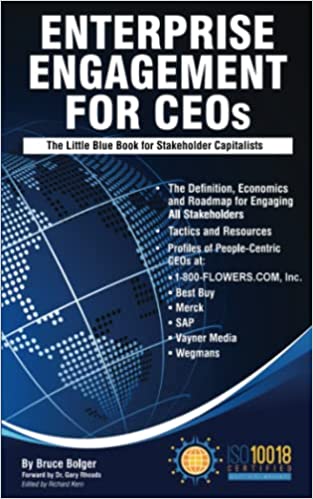
 
Shepherd says he wrote the books because “Business has access to literally millions of how to books written by experts in every subject imaginable. There are also legions of management consultants available who will offer solutions to any type of business problem. The challenge is that for many issues there is no silver bullet, no turnkey, broad-base fits-all approach. Educational programs such as MBAs have realized this for many years and used case studies as a holistic approach of putting business problems into a context that reflects reality.”
 
 [return to top]


Master the “S” of Environmental, Social, Governance (ESG), A.k.a. Stakeholder Capitalism
 
The Enterprise Engagement Alliance at TheEEA.org is the world’s first and only organization that focuses on outreach, certification and training, and advisory services to help organizations achieve their goals by fostering the proactive involvement of all stakeholders. This includes customers, employees, distribution and supply chain partners, and communities, or anyone connected to an organization’s success.
 
Training and Thought Leadership 
Engagement Digital Media and Marketplaces
Video Learning
The EEA Human Capital Management and ROI of Engagement YouTube channel features a growing library of 30- to 60-minute panel discussions with leading experts in all areas of engagement and total rewards.
 
Books
Enterprise Engagement Advisory Services 
The Engagement Agency helps:
Click here for complete information on Enterprise Engagement Alliance benefits and to join.  

For more information: Contact Bruce Bolger at Bolger@TheICEE.org or call 914-591-7600, ext. 230. 


Save Link

Global Agency Founder to Help Companies "Build Corporate Soul"

Ralf Specht, founding partner of Spark44, an international ad agency he helped grow into a $100 million plus company with 1,200 employees, now turns his attention to promote “a framework that aligns value-creating employee action with broader corporate strategy through shared understanding and shared purpose.” 
Building Corporate Soul
 
To regular readers of ESM, the theme of Building Corporate Soul: Powering Culture and Success with the Soul System™ sounds familiar. Corporate soul, the author Ralf Specht writes, “is a function of aligning value-creating employee behaviors with corporate strategy through understanding and shared purpose.” 
 
Specht says he knows that many books already focus on values and principles. His book, he says, is designed to provide “a strong outline for implementation.” In 12 chapters, he provides a step-by-step implementation process CEOs and business leaders can use based on his own management experience and research on other companies.
 
To support the return-on-investment of “soul,” he created a Soul Index “comprised of companies that have a shared understanding of vision, mission, values and spirit, and corresponding shared behaviors of leadership, ecosystem drivers, compensation, recruitment, development, partnerships, and followers centered on shared purpose.” The companies selected, ranging from Adobe, Salesforce, Microsoft, and Amazon, to Workday, Hilton, Apple, SAP and American Express, significantly outperformed all the major stock indices from 2016 to 2021, the five years he tracked. 
 
The book defines the concept of the corporate soul. It provides a description of the author’s soul system; outlines the role of purpose; discusses how to understand the soul of your company; lead with soul; nurture the soul ecosystem; promote its drivers, reward soul supporters; hire for soul; develop soul leaders, allies, and followers, and concludes with some of the author’s personal reflections.
 
Ralph SpechtHere’s a recent Q&A with Specht about his book. 
 
ESM: This all makes sense. Why isn’t it being done now?
 
RS. It is being done. But it is not being done by the majority of businesses. Everybody in the world by now has understood what exponential growth is. That is what I see is happening at this moment. There is a fast-growing dynamic in place; companies the world over do realize that they have to do things differently. 
 
The book includes the Soul Index, a performance ranking that is predominantly based on employee data about satisfaction and engagement at work as well as CEO approval data combined with business and brand success data. The results speak volumes. Companies that rank in the top 20 are delivering better returns than their peers. Happier employees drive better products and services as well as more satisfied customers. It´s an equation that gets more and more acceptance. Recent data by JUST Capital in the US are confirming the trend. Soul Index winner Adobe is also the number one on Benefits & Work-Life Balance as well as Diversity, Equity, & Inclusion. 
 
The focus on corporate culture is growing and the recent moves from the Securities & Exchange Commission (SEC) will drive listed companies to consider the implications of any actions on their workforce more than ever before. There will be a better world – hence my vision is to make soulless companies a thing of the past.
 
ESM: Who is going to lead the way to making this happen? What role do you wish to play and how?
 
RS: Change is coming from many different players. There are the government bodies like the SEC that could have a huge impact if they finally commit to it. The power of employees should not be underestimated. The ´Great Resignation´ or ´Great Reshuffle´ as it is more rightfully named is actually nothing but a movement – although it is not organized like a movement but by millions of individual decisions – of workers who vote with their feet as a consequence of feeling undervalued by their companies or managers. They do not feel any sense of belonging to their company. Those businesses that do not have corporate soul – and their leaders are realizing that they need to act. Otherwise, there won´t be a company in the future.
 
I do much more believe in the concept of ´carrot´ rather than ´stick´. The carrot for any CEO is that a company of which the employees say ´our firm has got soul´ tastes so good because it means it is a highly successful company. Look at prime examples like Microsoft and Salesforce – you can see that the leadership has fully understood why it is critical and what needs to be done to make it tangible for all stakeholders.
 
My book is a reach for a book. It is written by a global business leader informed by the latest studies from academia and consultancies – it brings together practitioner realism with the theoretic wisdom. It is the basis for my engagement in this space in consulting companies and organizations to fully understand that thriving cultures, cultures with soul, are more successful than others. One of the options I am currently looking into is to open a Leadership Academy that focuses on implementing successful human-centric corporate cultures.
 
ESM. You come from the advertising business, and yet you barely mention the field. What role do you think advertising/marketing play in the current state of affairs, and what can or should advertising do about it?
 
RS. True. Because ´Corporate Soul´ is not an advertising or marketing idea. I spent more than two decades with McCann – their mantra has always been ´Truth Well Told´. Today, this is more relevant than ever. But too often, ´brand purpose´ has become a fig leaf concept for CMO´s (chief marketing officers) and their agencies to market products or services. But ´purpose´ is not a marketing concept. 
 
´Purpose´ is at the core of how to lead a company. It is the key to align corporate strategy and corporate behaviors with that ´purpose´. Hence the Soul System framework defines it as ´shared purpose´. Shared by the entire board and shared with all stakeholders, especially staff. That is the critical first step. Then all corporate functions get involved – marketing being one of them and then agencies come into play.
 
Agencies need to ask the ´Truth Well Told´ questions:
Is your purpose just an answer that sounds good to the questions consumers have? 
Is it a truth that is grounded in the very essence and reality of the company that is bringing this brand to market? 
Is it real or is it just wishful thinking?
If it is not real, they need to advise their clients on the risk that they are about to enter for their firm. As we all know, it takes a lot of time to earn trust and build a sound reputation. But you can destroy it faster than you think. But agencies are not the ultimate decision makers. CMOs have a real responsibility here – and given their often short-lived tenure these days, one can see the pressures that they are dealing with.
 
ESM. Your book makes no mention of human capital reporting or the greater ESG or Stakeholder Capitalism movement. 
 
RS. When I wrote the book, it has been my intention to celebrate companies that have built corporate soul. Real-life cases of established firms like Lego, Hilton Hotels or Bentley Motors that have returned to the foundations of their founders’ beliefs on why the firm had been in business in the first place. Or start-up companies that are characterized by the innate energy, drive and focus of their founders to design a company that is better than any competitor in the field.
 
It´s my belief that learning from great and successful examples is the most infectious way to support the (Stakeholder Capitalism) movement. In my view, we need to make the leadership behaviors which build soul synonymous with the behaviors which build success. If we are successful in doing so, then the movements will all benefit. The value proposition is about success, because that is a language leaders understand. But the language of success needs to evolve and corporate soul needs to become the new language of success.
 
ESM: Do you think companies with corporate soul should publish human capital and sustainability reports to demonstrate this commitment? 
 
RS. Absolutely. But there needs to be a clear framework for these – similar to accounting standards. We need human capital standards so that is easier for all stakeholders to compare sectors and companies. In the future, I am expecting that investor roadshows will no longer be a CEO and CFO show. We will see the Chief Talent Officer playing a key role at an equal level. Something we are not seeing in many companies at this day and age. But this will change as the largest stakeholder groups such as customers and employees will increasingly want to see the real facts when it comes how a corporation deals with its human capital.
 
“Our people are our biggest asset.” How often have we heard that statement since former Xerox CEO Anne M. Mulcahy spoke these words at the 2003 Life Management Conference? The time has come to make this not just nice words, but a reality.
 
About the Author
Ralf Specht is the author of “Building Corporate Soul”. He developed the Soul System™, a framework designed to power culture and success for any business.

After two decades with McCann Erickson in various executive roles, he was a founding partner of Spark44, an innovative, industry-first joint venture with Jaguar Land Rover. Under his leadership as CEO, Spark44 grew to a 1,200 people business in 18 countries. He is the author of Building Corporate Soul: Powering Culture & Success with the Soul System™ from Fast Company Press. 

Connect with Specht on LinkedIn and buildingcorporatesoul.com.


Click here to get ESM news delivered each week.


Master the “S” of Environmental, Social, Governance (ESG), A.k.a. Stakeholder Capitalism
 
The Enterprise Engagement Alliance at TheEEA.org is the world’s first and only organization that focuses on outreach, certification and training, and advisory services to help organizations achieve their goals by fostering the proactive involvement of all stakeholders. This includes customers, employees, distribution and supply chain partners, and communities, or anyone connected to an organization’s success.
 
Training and Thought Leadership 
  • Founded in 2008, the Enterprise Engagement Alliance provides outreach, learning and certification in Enterprise Engagement, an implementation process for the “S” or Social of Stakeholder Capitalism and Human Capital Management and measurement of engagement across the organization.
  • The Enterprise Engagement Alliance provides a training and certification program for business leaders, practitioners, and solution providers, as well as executive briefings and human capital gap analyses for senior leaders.
  • The EEA produces an education program for CFOs for the CFO.University training program on Human Capital Management.
  • Join the EEA to become a leader in the implementation of the “S” of ESG and Stakeholder Capitalism. 
EE for CEOsEngagement Digital Media and Marketplaces
Video Learning
The EEA Human Capital Management and ROI of Engagement YouTube channel features a growing library of 30- to 60-minute panel discussions with leading experts in all areas of engagement and total rewards.
 
EE RoadmapBooks
Enterprise Engagement Advisory Services 
The Engagement Agency helps:
  • Organizations of all types develop strategic Stakeholder Capitalism and Enterprise Engagement processes and human capital management and reporting strategies; conduct human capital gap analyses; design and implement strategic human capital management and reporting plans that address DEI (Diversity, Equity, and Inclusion), and assist with managed outsourcing of engagement products and services.
  • Human resources, sales and marketing solution providers profit from the emerging discipline of human capital management and ROI of engagement through training and marketing services.
  • Investors make sense of human capital reporting by public companies.
  • Buyers and sellers of companies in the engagement space or business owners or buyers who seek to account for human capital in their mergers and acquistions
For more information: Contact Bruce Bolger at Bolger@TheICEE.org or call 914-591-7600, ext. 230.
 

Save Link

Enterprise Engagement for CEOs Outlines Stakeholder Capitalism Implementation

The Enterprise Engagement Alliance’s newly updated Enterprise Engagement for CEOs: The Little Blue Book for Stakeholder Capitalists provides boards and senior management with a short course on how to turn theory into action. A recent survey by the Conference Board found that 92% of CEOs agree with the shift to Stakeholder Capitalism and 82% say they have begun the implementation process. 
 
EE for CEOs new coverEnterprise Engagement for CE0s: The Little Blue Book for Stakeholder Capitalists provides a practical overview of how to implement the “S” of Environmental, Social, Governance (ESG), increasingly known as Stakeholder Capitalism. Click here to order in paperback or Kindle.  
 
The book provides a short, practical overview of how to use Enterprise Engagement principles to increase profitability and lower costs by establishing a brand that attracts and retains highly committed, focused, and capable customers, employees, distribution and supply chain partners, and communities. The processes are based on the proven approach applied by ISO (International Organization for Standardization) standards to help enhance quality, environmental, and safety practices in manufacturing.
 
For those seeking a comprehensive textbook on all aspects of implementation, see: Enterprise Engagement: The Roadmap—How to Implement Stakeholder Capitalism and Enhance Organizational Results Through a Strategic Approach to People Management.
 
This increasingly important approach to business is not about “woke” capitalism; donating more money to charities or lowering an organization’s carbon footprint in reaction to societal pressures. It’s backed by over 30 years of academic research and ISO (International Organization for Standardization)-based business practices aimed at enhancing sustainable returns for shareholders by creating value for customers, employees, supply chain and distribution partners, communities, and the environment—otherwise known as Environmental, Social, Governance (ESG) management, increasingly known as Stakeholder Capitalism. 
 
Multiple books have documented the economics of Stakeholder Capitalism, including the book by that name authored by Klaus Schwab of the World Economic Forum or The Heart of Business, by Hubert Joly, former CEO of Best Buy, another committed Stakeholder Capitalist. Enterprise Engagement for CEOs is designed for management that seeks to move from theory to practical applications. Based on the experience of literally millions of companies that have used or use ISO standards in one way or other, success depends on having a CEO-led strategic and systematic approach to achieving goals by strategically and systematically addressing the interests of all stakeholders.  

Enterprise Engagement for CEOs is for boards, executives, management in all areas, and educators seeking to go beyond the talk to focus on the actual implementation process. The enterprise approach to engaging all stakeholders in a systematic way is based on extensive academic work and case studies of successful organizations going back to the early work of R. Edward Freeman, Professor of Business Administration, that demonstrate the ability to enhance performance and lower costs by:
Establishing a clear organizational purpose baked into the culture and business plans.
Strategically aligning the interests and activities related to all stakeholders, rather than having them siloed between marketing, sales, human resources, operations, finance, etc.
Baking people strategies and tactics into the organization’s business operating system.
Creating a culture of continuous improvement that encourages the voice of all stakeholders, including front-line workers and other employees; customers; supply chain and distribution partners, and communities. 
Having a formal system for managing people investments, the strategies and tactics, and performance metrics. 
 
Click here to order Enterprise Engagement for CEOs in paperback or Kindle.  
 

Master the “S” of Environmental, Social, Governance (ESG), A.k.a. Stakeholder Capitalism
 
The Enterprise Engagement Alliance at TheEEA.org is the world’s first and only organization that focuses on outreach, certification and training, and advisory services to help organizations achieve their goals by fostering the proactive involvement of all stakeholders. This includes customers, employees, distribution and supply chain partners, and communities, or anyone connected to an organization’s success.
 
Training and Thought Leadership 
  • Founded in 2008, the Enterprise Engagement Alliance provides outreach, learning and certification in Enterprise Engagement, an implementation process for the “S” or Social of Stakeholder Capitalism and Human Capital Management and measurement of engagement across the organization.
  • The Enterprise Engagement Alliance provides a training and certification program for business leaders, practitioners, and solution providers, as well as executive briefings and human capital gap analyses for senior leaders.
  • The EEA produces an education program for CFOs for the CFO.University training program on Human Capital Management.
  • Join the EEA to become a leader in the implementation of the “S” of ESG and Stakeholder Capitalism. 
EE for CEOsEngagement Digital Media and Marketplaces
Video Learning
The EEA Human Capital Management and ROI of Engagement YouTube channel features a growing library of 30- to 60-minute panel discussions with leading experts in all areas of engagement and total rewards.
 
EE RoadmapBooks
Enterprise Engagement Advisory Services 
The Engagement Agency helps:
  • Organizations of all types develop strategic Stakeholder Capitalism and Enterprise Engagement processes and human capital management and reporting strategies; conduct human capital gap analyses; design and implement strategic human capital management and reporting plans that address DEI (Diversity, Equity, and Inclusion), and assist with managed outsourcing of engagement products and services.
  • Human resources, sales and marketing solution providers profit from the emerging discipline of human capital management and ROI of engagement through training and marketing services.
  • Investors make sense of human capital reporting by public companies.
  • Buyers and sellers of companies in the engagement space or business owners or buyers who seek to account for human capital in their mergers and acquistions
For more information: Contact Bruce Bolger at Bolger@TheICEE.org or call 914-591-7600, ext. 230.


Save Link

Now Available: The Essential Guide to Implementation of Stakeholder Capitalism

Last week, the Enterprise Engagement Alliance released its updated Enterprise Engagement for CEOs: The Little Blue Book for Stakeholder Capitalists. This week, it has published its updated Enterprise Engagement: The Roadmap—How to Implement Stakeholder Capitalism to provide management at all levels a comprehensive implementation guide with detailed information on the theory, economics, and practices of Stakeholder Capitalism and human capital management across the enterprise. 
EE Roadmap new cover
 
While Enterprise Engagement for CEOs provides an abbreviated overview of the principles of Stakeholder Capitalism and profiles of some of the CEOs who have practiced it at their organizations, Enterprise Engagement: The Roadmap offers a practical detailed implementation guide that includes information on the principles and economics, as well as on almost all of the tactics involved. 
 
The challenge facing the Stakeholder Capitalism movement is that it is not taught in any schools nor even in executive education program and that it requires organizations to break down the siloes between finance, marketing, human resources, operations, and other business units that hamper efficiency and create poor experiences for customers and employees alike. 
EE for CEOs
 
Stakeholder Capitalism enhances returns for investors by creating value for customers, employees, supply chain and distribution partners, communities, and the environment and should not be confused with “woke” capitalism or Corporate Social Responsibility. See ESM: Stakeholder Capitalism—A Primer.
 
Enterprise Engagement: The Roadmap aims to address the knowledge gap with a desk reference covering almost all the key areas of the field. Writes Grace Swanson, Vice President, Human Capital at Accumold, a leading precision manufacturer, “By the time I finished reading Enterprise Engagement: The Roadmap my copy was filled with Post-it notes highlighting information I knew I would need to reference later. This book provides a complete guide to almost everything an organization needs to implement a strategic approach to engaging everyone in organizational goals in a systematic way.”               
 
Gary Rhoads, retired Stephen Mack Covey Professor of Marketing Emeritus at the Marriot School of Business at Brigham Young University and Chairman of Xvoyant, a sales engagement technology firm, “As a professor of marketing and entrepreneurship for most of my career, and founder of two leading companies in sales and marketing management, I know that delivering promises is one of the most critical strategies for success. Yet too many organizations fail to address the importance of engaging all stakeholders in organizational goals. Enterprise Engagement: The Roadmap is the only book I know that focuses on how to apply a strategic and tactical approach to engagement across the enterprise in a systematic way.” 
          
Adds Barbara Porter, Managing Director, Ernst & Young, "I have spent much of my career helping organizations develop great cultures, and in the end a successful strategy requires a CEO-led approach to connecting employees, managers, customers, vendors, suppliers, the community—everyone inside and outside the organization who has a stake in its success. I have repeatedly referenced almost every chapter in Enterprise Engagement: The Roadmap since the first edition came out, as it’s the only book I know of that puts together in one place all the tactics needed to address engagement to achieve organizational results.” 
 
As shown in the table of contents below, the book covers almost every topic involved with the implementation of Stakeholder Capitalism, including career opportunities and the potential impact on government. The edition now includes appendices on human capital management, reporting, and analysis. 
 
Here is the table of contents: 
 
Part I: Introduction to Stakeholder Capitalism, Enterprise Engagement, ISO
Intro: Enterprise Engagement and ISO Annex SL and ISO 10018 and ISO 30414
Standards – A Practical Framework for Implementation and Measurement
Chapter 1  ISO 10018: People Engagement
Chapter 2 The Role of ISO Standards in Business and People Management
Chapter 3  Economics of Enterprise Engagement
Chapter 4  Culture and the Enterprise Brand
Chapter 5   Breaking Down Organizational Silos
 
Part II: Audiences of Engagement
Intro: The Audience Challenge
Chapter 6 Customer Engagement
Chapter 7 Channel Partner Engagement
Chapter 8 Employee Engagement
Chapter 9 Sales Engagement
Chapter 10  Volunteer & Community Engagement
Chapter 11  Supply Chain Engagement
Chapter 12 The Employee / Customer Link
Chapter 13 Case Study: Northwell Health
 
Part III: Tools of Engagement
Intro: Tools and Tactics
Chapter 14 Employee Assessment
Chapter 15  Communication
Chapter 16 Permission Management
Chapter 17 Content Marketing
Chapter 18 Learning and Training
Chapter 19  Gamification
Chapter 20 Collaboration and Innovation
Chapter 21  Rewards & Recognition
Chapter 22 Loyalty
Chapter 23  Recognition in the Era of Employee Engagement
Chapter 24 Diversity and Community
Chapter 25 Wellness
Chapter 26  Enterprise Safety Engagement
Chapter 27  Enterprise Technology Engagement
Chapter 28 Meetings and Motivational Events 
Chapter 29 Travel Rewards and Engagement
Chapter 30 The Importance of an Engaging Environment
Chapter 31  Trade Shows & Conferences: Engaging the Stakeholders
Chapter 32  Technology: The Heart of the Problem, The Core of the Solution
Chapter 33 Measuring Enterprise Engagement and Performance
Chapter 34 Big Data and Analytics
Chapter 35 Case Study: UnitedHealth Group
 
Part IV: Applications of Engagement
Intro: The Enterprise Engagement Framework
Chapter 36  Keys to Implementation
Chapter 37  Budgeting and ROI
Chapter 38 Engagement Careers
Chapter 39 Engagement and Nonprofits
Chapter 40 Implications for Government
Chapter 41  Engagement, Human Capital and the Accounting Profession
Chapter 42 Enterprise Engagement and ISO 30414 Human Capital Reporting Standards
 
Appendix 1  Sample Engagement Business Plan
Appendix 2  An Explanation of Tracer Audit Methodology
Appendix 3  ISO 10018 Audit
Appendix 4 Human Capital Evaluation Checklist
Appendix 5 Example of a “Model” Company
 
 
For More Information
Bruce Bolger
Founder, Enterprise Engagement Alliance
914-591-7600, ext. 230
Bolger@The ICEE.org 
 

Master the “S” of Environmental, Social, Governance (ESG), A.k.a. Stakeholder Capitalism
 
The Enterprise Engagement Alliance at TheEEA.org is the world’s first and only organization that focuses on outreach, certification and training, and advisory services to help organizations achieve their goals by fostering the proactive involvement of all stakeholders. This includes customers, employees, distribution and supply chain partners, and communities, or anyone connected to an organization’s success.
 
Training and Thought Leadership 
  • Founded in 2008, the Enterprise Engagement Alliance provides outreach, learning and certification in Enterprise Engagement, an implementation process for the “S” or Social of Stakeholder Capitalism and Human Capital Management and measurement of engagement across the organization.
  • The Enterprise Engagement Alliance provides a training and certification program for business leaders, practitioners, and solution providers, as well as executive briefings and human capital gap analyses for senior leaders.
  • The EEA produces an education program for CFOs for the CFO.University training program on Human Capital Management.
  • Join the EEA to become a leader in the implementation of the “S” of ESG and Stakeholder Capitalism. 
Engagement Digital Media and Marketplaces
Video Learning
The EEA Human Capital Management and ROI of Engagement YouTube channel features a growing library of 30- to 60-minute panel discussions with leading experts in all areas of engagement and total rewards.
 
Books
Enterprise Engagement Advisory Services 
The Engagement Agency helps:
  • Organizations of all types develop strategic Stakeholder Capitalism and Enterprise Engagement processes and human capital management and reporting strategies; conduct human capital gap analyses; design and implement strategic human capital management and reporting plans that address DEI (Diversity, Equity, and Inclusion), and assist with managed outsourcing of engagement products and services.
  • Human resources, sales and marketing solution providers profit from the emerging discipline of human capital management and ROI of engagement through training and marketing services.
  • Investors make sense of human capital reporting by public companies.
  • Buyers and sellers of companies in the engagement space or business owners or buyers who seek to account for human capital in their mergers and acquistions
For more information: Contact Bruce Bolger at Bolger@TheICEE.org or call 914-591-7600, ext. 230.
 

Save Link

Enterprise Engagement: The Roadmap, 3rd Edition

Enterprise Engagement: The Roadmap, 3rd Edition has been completely updated with new information, illustrations and new chapters. Authored and edited by dozens of experts in general management, marketing, sales, data management, business and academia, the Textbook’s methodology has been endorsed by leading companies as a means of achieving both strategic and tactical organizational goals related to sales, marketing, human resources, vendor management, and community relations. A proven strategy to:
  • Increase long-term profitability
  • Maximize customer loyalty and referrals
  • Capture the commitment of dealers, agents and distributors
  • Increase sales and improve customer service
  • Maximize quality, productivity, quality and wellness
  • Foster greater prosperity through a focus on people 
 
Enterprise Engagement: The Roadmap, 3rd Edition also provides formal preparation for the Enterprise Engagement Certification program. To order a copy, click here.

Bruce Bolger, Allan Schweyer & Richard Kern . 242 pp. Cost: $36

Sorry, no results matched your search.


Earn Big $ In EEA Referral Program
Enterprise Engagement Resources
Committed to Stakeholder Capitalism   Refer, Rate, Suggest & Earn
Engagement Solutions

EGR

Citizen

PurposePoint: The Purpose Leadership Community

BCAT

Catalyst Performance Group

CarltonOne

BMC

Fire Light Group

Luxe Incentives